- 338 pages
- English
- ePUB (mobile friendly)
- Available on iOS & Android
eBook - ePub
About this book
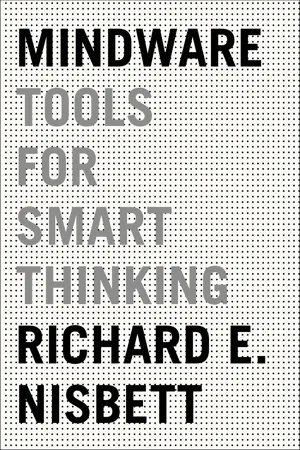
An accessible guide to essential tools of reasoning that can help you make better decisions in your daily life.
Scientific and philosophical concepts can change the way we solve problems by helping us to think more effectively about our behavior and our world. Surprisingly, despite their utility, many of these tools remain unknown to most of us.
In Mindware, the world-renowned psychologist Richard E. Nisbett presents these ideas in clear and accessible detail. Nisbett has made a distinguished career of studying and teaching such powerful problem-solving concepts as the law of large numbers, statistical regression, cost-benefit analysis, sunk costs and opportunity costs, and causation and correlation, probing the best methods for teaching others how to use them effectively in their daily lives. In this groundbreaking book, Nisbett shows us how to frame common problems in such a way that these scientific and statistical principles can be applied to them. The result is an enlightening and practical guide to the most essential tools of reasoning ever developed—tools that can easily be used to make better professional, business, and personal decisions.
Praise for Mindware
"Compelling . . . With clear explanations of relevant principles from statistics, formal logic, economics, and psychology, Nisbett does indeed assemble a powerful toolkit for examining the validity of claims made by marketers, politicians, and scientists. Just as important, he encourages us to turn these tools inward and test the legitimacy of our own easily swayed opinions and beliefs." — The Boston Globe
"[ Mindware] is friendly and practical and aimed squarely at the lay reader. [Nisbett] sees his book as rather like a crash course in making better decisions and learning what scientifically proven theory to apply to which problem, enabling the reader to "perceive the world more accurately and behave more sensibly.""— The Sunday Times (UK)
Scientific and philosophical concepts can change the way we solve problems by helping us to think more effectively about our behavior and our world. Surprisingly, despite their utility, many of these tools remain unknown to most of us.
In Mindware, the world-renowned psychologist Richard E. Nisbett presents these ideas in clear and accessible detail. Nisbett has made a distinguished career of studying and teaching such powerful problem-solving concepts as the law of large numbers, statistical regression, cost-benefit analysis, sunk costs and opportunity costs, and causation and correlation, probing the best methods for teaching others how to use them effectively in their daily lives. In this groundbreaking book, Nisbett shows us how to frame common problems in such a way that these scientific and statistical principles can be applied to them. The result is an enlightening and practical guide to the most essential tools of reasoning ever developed—tools that can easily be used to make better professional, business, and personal decisions.
Praise for Mindware
"Compelling . . . With clear explanations of relevant principles from statistics, formal logic, economics, and psychology, Nisbett does indeed assemble a powerful toolkit for examining the validity of claims made by marketers, politicians, and scientists. Just as important, he encourages us to turn these tools inward and test the legitimacy of our own easily swayed opinions and beliefs." — The Boston Globe
"[ Mindware] is friendly and practical and aimed squarely at the lay reader. [Nisbett] sees his book as rather like a crash course in making better decisions and learning what scientifically proven theory to apply to which problem, enabling the reader to "perceive the world more accurately and behave more sensibly.""— The Sunday Times (UK)
Tools to learn more effectively

Saving Books

Keyword Search

Annotating Text

Listen to it instead
Information
Table of contents
- Cover
- Title Page
- Copyright Notice
- Dedication
- Introduction
- Part I: Thinking About Thought
- Part II: The Formerly Dismal Science
- Part III: Coding, Counting, Correlation, and Causality
- Part IV: Experiments
- Part V: Thinking, Straight and Curved
- Part VI: Knowing the World
- Conclusion: The Tools of the Lay Scientist
- Notes
- Bibliography
- Acknowledgments
- Index
- A Note About the Author
- Also by Richard E. Nisbett
- Newsletter Sign-up
- Contents
- Copyright
Frequently asked questions
Yes, you can cancel anytime from the Subscription tab in your account settings on the Perlego website. Your subscription will stay active until the end of your current billing period. Learn how to cancel your subscription
No, books cannot be downloaded as external files, such as PDFs, for use outside of Perlego. However, you can download books within the Perlego app for offline reading on mobile or tablet. Learn how to download books offline
Perlego offers two plans: Essential and Complete
- Essential is ideal for learners and professionals who enjoy exploring a wide range of subjects. Access the Essential Library with 800,000+ trusted titles and best-sellers across business, personal growth, and the humanities. Includes unlimited reading time and Standard Read Aloud voice.
- Complete: Perfect for advanced learners and researchers needing full, unrestricted access. Unlock 1.4M+ books across hundreds of subjects, including academic and specialized titles. The Complete Plan also includes advanced features like Premium Read Aloud and Research Assistant.
We are an online textbook subscription service, where you can get access to an entire online library for less than the price of a single book per month. With over 1 million books across 990+ topics, we’ve got you covered! Learn about our mission
Look out for the read-aloud symbol on your next book to see if you can listen to it. The read-aloud tool reads text aloud for you, highlighting the text as it is being read. You can pause it, speed it up and slow it down. Learn more about Read Aloud
Yes! You can use the Perlego app on both iOS and Android devices to read anytime, anywhere — even offline. Perfect for commutes or when you’re on the go.
Please note we cannot support devices running on iOS 13 and Android 7 or earlier. Learn more about using the app
Please note we cannot support devices running on iOS 13 and Android 7 or earlier. Learn more about using the app
Yes, you can access Mindware by Richard E. Nisbett in PDF and/or ePUB format, as well as other popular books in Psychology & Personal Success. We have over one million books available in our catalogue for you to explore.