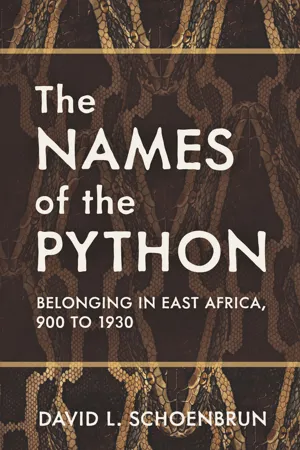
Systems of belonging, including ethnicity, are not static, automatic, or free of contest. Historical contexts shape the ways which we are included in or excluded from specific classifications. Building on an amazing array of sources, David L. Schoenbrun examines groupwork—the imaginative labor that people do to constitute themselves as communities—in an iconic and influential region in East Africa. His study traces the roots of nationhood in the Ganda state over the course of a millennia, demonstrating that the earliest clans were based not on political identity or language but on shared investments, knowledges, and practices.
Grounded in Schoenbrun's skillful mastery of historical linguistics and vernacular texts, The Names of the Python supplements and redirects current debates about ethnicity in ex-colonial Africa and beyond. This timely volume carefully distinguishes past from present and shows the many possibilities that still exist for the creative cultural imagination.
- 359 pages
- English
- PDF
- Available on iOS & Android
eBook - PDF
About this book
Information
Publisher
University of Wisconsin PressYear
2021Print ISBN
9780299332549
9780299332501
eBook ISBN
9780299332532
Table of contents
- Contents
- List of Illustrations
- Acknowledgments
- Introduction
- 1. Python Imaginaries: Conceiving Ancient Groups beyond the Face-to-Face, 800 to 1200
- 2. Possessing an Inland Sea: Making Mukasa, 1200s to 1600s
- 3. Mukasa’s Wealth: Belonging and Information, 1500s and 1600s
- 4. Vigilant Python: A Bellicose Eighteenth Century and Groupwork’s Inner Edge
- 5. Ladies and Slaves: Gendered Groupwork and a Long Nineteenth Century
- 6. Hiding Clans: Eighteenth-Century Misrule and Twentieth-Century Groupwork
- Conclusion
- Appendix: Lexical-Semantic Reconstructions
- Notes
- Bibliography
- Index
Trusted by 375,005 students
Access to over 1.5 million titles for a fair monthly price.
Study more efficiently using our study tools.
Frequently asked questions
Yes, you can cancel anytime from the Subscription tab in your account settings on the Perlego website. Your subscription will stay active until the end of your current billing period. Learn how to cancel your subscription
No, books cannot be downloaded as external files, such as PDFs, for use outside of Perlego. However, you can download books within the Perlego app for offline reading on mobile or tablet. Learn how to download books offline
Perlego offers two plans: Essential and Complete
- Essential is ideal for learners and professionals who enjoy exploring a wide range of subjects. Access the Essential Library with 800,000+ trusted titles and best-sellers across business, personal growth, and the humanities. Includes unlimited reading time and Standard Read Aloud voice.
- Complete: Perfect for advanced learners and researchers needing full, unrestricted access. Unlock 1.5M+ books across hundreds of subjects, including academic and specialized titles. The Complete Plan also includes advanced features like Premium Read Aloud and Research Assistant.
We are an online textbook subscription service, where you can get access to an entire online library for less than the price of a single book per month. With over 1.5 million books across 990+ topics, we’ve got you covered! Learn about our mission
Look out for the read-aloud symbol on your next book to see if you can listen to it. The read-aloud tool reads text aloud for you, highlighting the text as it is being read. You can pause it, speed it up and slow it down. Learn more about Read Aloud
Yes! You can use the Perlego app on both iOS and Android devices to read anytime, anywhere — even offline. Perfect for commutes or when you’re on the go.
Please note we cannot support devices running on iOS 13 and Android 7 or earlier. Learn more about using the app
Please note we cannot support devices running on iOS 13 and Android 7 or earlier. Learn more about using the app
Yes, you can access The Names of the Python by David L. Schoenbrun in PDF and/or ePUB format, as well as other popular books in History & African History. We have over 1.5 million books available in our catalogue for you to explore.