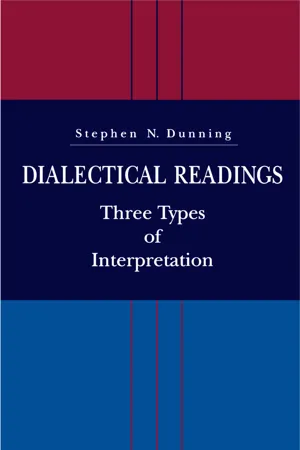
Dialectical Readings
eBook - PDF

Dialectical Readings

Three Types of Interpretations

  1. English
  2. PDF
  3. Available on iOS & Android
eBook - PDF

Dialectical Readings

Three Types of Interpretations

About this book

Interpretation pervades human thinking. Whether perception or experience, spoken word or written theory, whatever enters our consciousness must be interpreted in order to be understood. Every area of inquiry—art and literature, philosophy and religion, history and the social sciences, even many aspects of the natural sciences—involves countless opportunities to interpret the object of inquiry according to very different paradigms. These paradigms may derive from the language we speak, the nature of our education, or personal preferences. The abundance and diversity of paradigms make interpretation both fascinating in its complexity and often frustrating for the conflicts it generates.

In Dialectical Readings, Dunning distinguishes three types of interpretation, each defined in terms of a distinctive dialectical way of thinking: theoretical interpretation, which assumes binary oppositions; transactional interpretation, which seeks reciprocal relations; and transformational interpretation, which discerns paradoxical meanings. Dunning offers new and insightful readings of familiar texts by B. F. Skinner, Claude Lévi-Strauss, Lee Benson, Roland Barthes, Friedrich Nietzsche, and Michel Foucault and sheds new light on works by Thomas Kuhn, Joseph Campbell, Reinhold Niebuhr, Søren Kierkegaard, Paul Tillich, and Paul Ricoeur. Dialectical Readings enables readers to recognize diverse dialectical approaches to understanding—their own as well as those of others—in a way that provides new and helpful insights into a wide variety of subjects in which conflicting interpretations abound.

Frequently asked questions

Yes, you can cancel anytime from the Subscription tab in your account settings on the Perlego website. Your subscription will stay active until the end of your current billing period. Learn how to cancel your subscription.
At the moment all of our mobile-responsive ePub books are available to download via the app. Most of our PDFs are also available to download and we're working on making the final remaining ones downloadable now. Learn more here.
Perlego offers two plans: Essential and Complete
  • Essential is ideal for learners and professionals who enjoy exploring a wide range of subjects. Access the Essential Library with 800,000+ trusted titles and best-sellers across business, personal growth, and the humanities. Includes unlimited reading time and Standard Read Aloud voice.
  • Complete: Perfect for advanced learners and researchers needing full, unrestricted access. Unlock 1.4M+ books across hundreds of subjects, including academic and specialized titles. The Complete Plan also includes advanced features like Premium Read Aloud and Research Assistant.
Both plans are available with monthly, semester, or annual billing cycles.
We are an online textbook subscription service, where you can get access to an entire online library for less than the price of a single book per month. With over 1 million books across 1000+ topics, we’ve got you covered! Learn more here.
Look out for the read-aloud symbol on your next book to see if you can listen to it. The read-aloud tool reads text aloud for you, highlighting the text as it is being read. You can pause it, speed it up and slow it down. Learn more here.
Yes! You can use the Perlego app on both iOS or Android devices to read anytime, anywhere — even offline. Perfect for commutes or when you’re on the go.
Please note we cannot support devices running on iOS 13 and Android 7 or earlier. Learn more about using the app.
Yes, you can access Dialectical Readings by Stephen N. Dunning in PDF and/or ePUB format, as well as other popular books in Philosophy & Translating & Interpreting. We have over one million books available in our catalogue for you to explore.

Table of contents

  1. Cover
  2. Title
  3. Copyright
  4. Contents
  5. Acknowledgments
  6. Dedication
  7. Introduction
  8. 1. Paradigms of Science and Technology
  9. 2. Myths and Their Meanings
  10. 3. Frontiers in History
  11. 4. Variations on the Theme of Love
  12. 5. Dialectics of Identity
  13. 6. Interpreting Theories of Interpretation
  14. Conclusion
  15. Index