This transdisciplinary study offers a fresh perspective on the intersections of photography, cinema, and visual perception, making it an essential addition to collections in art history, film studies, and photography.
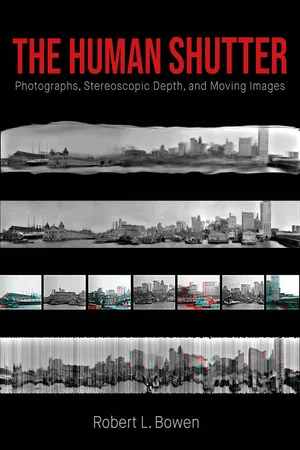
Robert L. Bowen delves into the complex relationship between art, binocular vision, space, and time across both early and modern histories of photography. Central to Bowen's analysis is the concept of "the human shutter," a metaphor for binocular rivalry, which he interprets as a form of proto-cinema – linking early photographic processes with the evolution of cinematic temporality.
The book provides a rich examination of the near-simultaneous emergence of still, moving, and stereoscopic depth media, while challenging the gradualist view of visual technologies. Through a preliminary taxonomy of rare stereoviews, Bowen draws connections between experimental film, painting, philosophy, and perception theory, opening new avenues for understanding the history of visual media.
Additionally, Bowen traces the fascinating journey of early pioneers like Antoine Claudet and Giorgio Sommer, whose work in motion and binocular vision plays a pivotal role in rethinking the origins of photographic cinema. Bowen bridges this history with contemporary innovations, including the dissolution of time in photography with the advent of generative AI.
The volume also highlights the work of modern and contemporary artists and filmmakers such as Marcel Duchamp, Robert Smithson, Lucy Raven, Ken Jacobs, and OpenEndedGroup, who have explored stereoscopic spaces and perceptions in innovative ways.
Key for undergraduate and postgraduate students studying art, art history, film, photography, and new media. It is also relevant to photographers, photo historians, experimental filmmakers, video artists, digital media artists, painters, and sculptors seeking fresh insights into their respective fields. Will resonate with readers interested in the history of 19th-century photography and the development of stereoscopic media.
- 195 pages
- English
- ePUB (mobile friendly)
- Available on iOS & Android
eBook - ePub
About this book
Information
Subtopic
Art Theory & CriticismTable of contents
- Cover
- Title
- Copyright
- Contents
- List of Figures
- Acknowledgments
- Introduction: Quickstart Guide
- 1. Antoine Claudet … Photographer
- 2. The Mind Completes the Action—Herschel's Dream
- 3. The Human Shutter: Binocular Rivalry and Delirium in Two-Frame Cinema
- 4. Cutting into the Picture Plane: Painting, Binocular Vision
- 5. Walter Benjamin: Cascading Metaphors of Binocular Vision and the Unique Perspectives of Lucy Raven and Jean-Luc Godard
- 6. Taxonomies of Duration in Nineteenth and Early Twentieth Century Stereographic Media
- 7. Joseph Spithover or How to Be in Two Places at Once (Maybe More)
- 8. Schilling
- 9. Crowd Control: Giorgio Sommer and Ken Jacobs
- 10. The Crystalline Visions of Robert Smithson
- 11. Reality and Virtuality: Marcel Duchamp, Arakawa and Gins, OpenEndedGroup
- 12. The Model of the Model
- Glossary of Terms
- Bibliography
- Index
- Back cover
Trusted by 375,005 students
Access to over 1.5 million titles for a fair monthly price.
Study more efficiently using our study tools.
Frequently asked questions
Yes, you can cancel anytime from the Subscription tab in your account settings on the Perlego website. Your subscription will stay active until the end of your current billing period. Learn how to cancel your subscription
No, books cannot be downloaded as external files, such as PDFs, for use outside of Perlego. However, you can download books within the Perlego app for offline reading on mobile or tablet. Learn how to download books offline
Perlego offers two plans: Essential and Complete
- Essential is ideal for learners and professionals who enjoy exploring a wide range of subjects. Access the Essential Library with 800,000+ trusted titles and best-sellers across business, personal growth, and the humanities. Includes unlimited reading time and Standard Read Aloud voice.
- Complete: Perfect for advanced learners and researchers needing full, unrestricted access. Unlock 1.5M+ books across hundreds of subjects, including academic and specialized titles. The Complete Plan also includes advanced features like Premium Read Aloud and Research Assistant.
We are an online textbook subscription service, where you can get access to an entire online library for less than the price of a single book per month. With over 1.5 million books across 990+ topics, we’ve got you covered! Learn about our mission
Look out for the read-aloud symbol on your next book to see if you can listen to it. The read-aloud tool reads text aloud for you, highlighting the text as it is being read. You can pause it, speed it up and slow it down. Learn more about Read Aloud
Yes! You can use the Perlego app on both iOS and Android devices to read anytime, anywhere — even offline. Perfect for commutes or when you’re on the go.
Please note we cannot support devices running on iOS 13 and Android 7 or earlier. Learn more about using the app
Please note we cannot support devices running on iOS 13 and Android 7 or earlier. Learn more about using the app
Yes, you can access The Human Shutter by Robert L. Bowen in PDF and/or ePUB format, as well as other popular books in Media & Performing Arts & Art Theory & Criticism. We have over 1.5 million books available in our catalogue for you to explore.