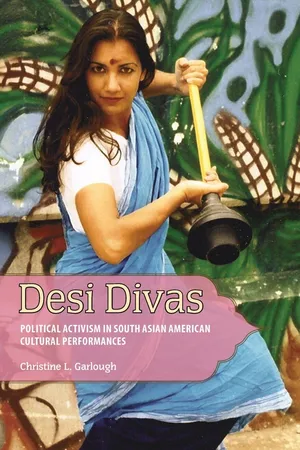
Desi Divas: Political Activism in South Asian American Cultural Performances is the product of five years of field research with progressive activists associated with the School for Indian Languages and Cultures (SILC), South Asian Americans Leading Together (SAALT), the feminist dance collective Post Natyam, and the grassroots feminist political organization South Asian Sisters. Christine L. Garlough explores how traditional cultural forms may be critically appropriated by marginalized groups and used as rhetorical tools to promote deliberation and debate, spur understanding and connection, broaden political engagement, and advance particular social identities. Within this framework she examines how these performance activists advocate a political commitment to both justice and care, to both deliberative discussion and deeper understanding. To consider how this might happen in diasporic performance contexts, Garlough weaves together two lines of thinking. One grows from feminist theory and draws upon a core literature concerning the ethics of care. The other comes from rhetoric, philosophy, and political science literature on recognition and acknowledgment. This dual approach is used to reflect upon South Asian American women's performances that address pressing social problems related to gender inequality, immigration rights, ethnic stereotyping, hate crimes, and religious violence. Case study chapters address the relatively unknown history of South Asian American rhetorical performances from the early 1800s to the present. Avant-garde feminist performances by the Post Natyam dance collective appropriate women's folk practices and Hindu goddess figures make rhetorical claims about hate crimes against South Asian Americans after 9/11. In Yoni ki Bat (a South Asian American version of The Vagina Monologues ) a progressive performer transforms aspects of the Mahabharata narrative to address issues of sexual violence, such as incest and rape. Throughout the volume, Garlough argues that these performers rely on calls for acknowledgment that intertwine calls for justice and care. That is, they embed their testimony in traditional cultural forms to invite interest, reflection, and connection.
eBook - ePub
Desi Divas
Political Activism in South Asian American Cultural Performances
- 244 pages
- English
- ePUB (mobile friendly)
- Available on iOS & Android
eBook - ePub
About this book
Information
Publisher
University Press of MississippiYear
2013Print ISBN
9781496853691
9781617037320
eBook ISBN
9781628468328
Table of contents
- Cover Page
- Title Page
- Copyright Page
- Dedication
- Contents
- Acknowledgments
- Chapter One Toward Acknowledgment: Care in Diasporic Performances
- Chapter Two Performing South Asian American Histories
- Chapter Three National Recognition and Community Acknowledgment
- Chapter Four A Future in Relation to the Other
- Chapter Five Cultural Activism and Sexuality in Feminist Performance
- Chapter Six Intertwining Folklore and Rhetoric: Cultural Performance, Acknowledgment, and Social Justice
- Notes
- References
- Index
Trusted by 375,005 students
Access to over 1.5 million titles for a fair monthly price.
Study more efficiently using our study tools.
Frequently asked questions
Yes, you can cancel anytime from the Subscription tab in your account settings on the Perlego website. Your subscription will stay active until the end of your current billing period. Learn how to cancel your subscription
No, books cannot be downloaded as external files, such as PDFs, for use outside of Perlego. However, you can download books within the Perlego app for offline reading on mobile or tablet. Learn how to download books offline
Perlego offers two plans: Essential and Complete
- Essential is ideal for learners and professionals who enjoy exploring a wide range of subjects. Access the Essential Library with 800,000+ trusted titles and best-sellers across business, personal growth, and the humanities. Includes unlimited reading time and Standard Read Aloud voice.
- Complete: Perfect for advanced learners and researchers needing full, unrestricted access. Unlock 1.5M+ books across hundreds of subjects, including academic and specialized titles. The Complete Plan also includes advanced features like Premium Read Aloud and Research Assistant.
We are an online textbook subscription service, where you can get access to an entire online library for less than the price of a single book per month. With over 1.5 million books across 990+ topics, we’ve got you covered! Learn about our mission
Look out for the read-aloud symbol on your next book to see if you can listen to it. The read-aloud tool reads text aloud for you, highlighting the text as it is being read. You can pause it, speed it up and slow it down. Learn more about Read Aloud
Yes! You can use the Perlego app on both iOS and Android devices to read anytime, anywhere — even offline. Perfect for commutes or when you’re on the go.
Please note we cannot support devices running on iOS 13 and Android 7 or earlier. Learn more about using the app
Please note we cannot support devices running on iOS 13 and Android 7 or earlier. Learn more about using the app
Yes, you can access Desi Divas by Christine L. Garlough in PDF and/or ePUB format, as well as other popular books in Social Sciences & Dance. We have over 1.5 million books available in our catalogue for you to explore.