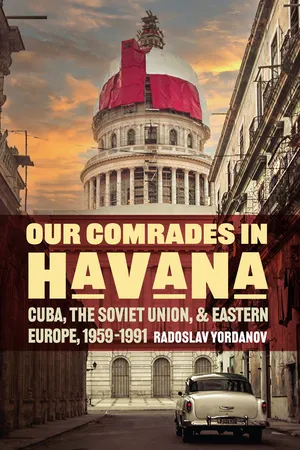
Our Comrades in Havana
Cuba, the Soviet Union, and Eastern Europe, 1959–1991
- 354 pages
- English
- PDF
- Available on iOS & Android
About this book
In the immediate aftermath of its successful revolution, Cuba was heralded by socialist nations as the vanguard of communism in Latin America in the early 1960s. But by the late 1980s, Cuba's inability to adopt the modes of socialist planning and Mikhail Gorbachev's reforms had deeply soured the relationship between Havana and the Soviet-led socialist bloc. While secondary literature often highlights Cuba's political and economic relations with Washington and Moscow, Havana's ideological, political, and economic relations with the Eastern European states have received considerably less attention. This book aims to fill this gap by offering a detailed chronological account of how Cuba's post-revolutionary development was influenced by Eastern European diplomats.
Outside of their roles as representatives of their respective states, Eastern European diplomats were entrusted with the task of educating local Cuban leadership in the intricacies of Marxism-Leninism, steering Cuba's governors onto the "correct path of development," helping them eradicate "erroneous ideas" of economic development, and showing them the validity of socialist "morals and ideology." By considering these developments and analyzing firsthand accounts of Eastern European diplomats' experiences in Havana, historian Radoslav Yordanov reconstructs the thinking of Eastern European diplomats and specialists in their dealings with Cuba from the 1959 Cuban revolutionary victory to the 1991 dissolution of the Soviet Union, shedding new light on Cuba's role in the global Cold War.
Frequently asked questions
- Essential is ideal for learners and professionals who enjoy exploring a wide range of subjects. Access the Essential Library with 800,000+ trusted titles and best-sellers across business, personal growth, and the humanities. Includes unlimited reading time and Standard Read Aloud voice.
- Complete: Perfect for advanced learners and researchers needing full, unrestricted access. Unlock 1.4M+ books across hundreds of subjects, including academic and specialized titles. The Complete Plan also includes advanced features like Premium Read Aloud and Research Assistant.
Please note we cannot support devices running on iOS 13 and Android 7 or earlier. Learn more about using the app.
Information
Table of contents
- Cover
- Series Page
- Title Page
- Copyright
- Dedication
- Contents
- List of Maps, Figures, and Tables
- Foreword
- Preface: From the Outskirts of Sofia to the Center of Havana
- Acknowledgments
- Abbreviations
- Map of Cuba
- Introduction—Revolutionary Cuba and the Special Mission of Socialist Diplomacy
- 1. Castro, Moscow, and Eastern Europe during the Revolution (1959–1962)
- 2. The Cuban Missile Crisis of October 1962
- 3. Parting Ways in the Short 1960s (1963–1968)
- 4. On the Road to Forgiveness (1969–1972)
- 5. The East and Cuba’s Socialist Institutionalization (1972–1980)
- 6. Cuba’s World Order as Seen from Berlin to Sofia (1975–1980)
- 7. Clouds Gather over Havana in the Early 1980s
- 8. Into the Central American Turmoil (July 1979–October 1983)
- 9. Arming Cuba for the War of All the People (1980–1985)
- 10. The Slow Showdown (1985–1991)
- Conclusion: Chronicling the Cuba-East Modus Convivendi
- Notes
- Bibliography
- Index
- Series List
- Back Cover