This book explores the uncanny afterlife of modernist ideals in the second half of the twentieth century. Rejecting the familiar notion that modernism dissolved during the 1930s, it argues that the fusion of rationalism and mysticism which characterises modernist poetics was sustained long after its politics had been discredited by the events of World War Two.
The book's central concern is why the aesthetic mysticism that Walter Benjamin called the faith of those 'who made common cause with Fascism' continued to be a guiding principle for literary elites and countercultural movements alike. New light is shed on the relationship between occultism and the Pound tradition, especially in terms of Pound's influence on post-1945 Anglo-American poetry, and a critical theory of 'late modernism' is offered which shows how belated notions of cultural redemption have survived in contemporary poetry.
This wide-ranging contextual study focuses on the poetry of Ezra Pound, Charles Olson, Paul Celan, and J H Prynne, and explores the development of modernist culture through its theories of phenomenology, psychoanalysis, science, ethnography, and ancient history.
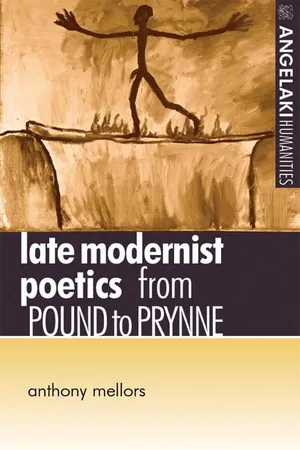
- 241 pages
- English
- PDF
- Available on iOS & Android
eBook - PDF
About this book
Information
Subtopic
Literary Criticism in PoetryIndex
LiteratureTable of contents
- Front matter
- Dedication
- Contents
- Acknowledgements
- Introduction
- Chapter 1: Hermetic poetry and late modernism
- Chapter 2: Cunning man: Ezra Pound and secret wisdom
- Chapter 3: Maximal extent: Charles Olson and C. G. Jung
- Chapter 4: Shamanism and the poetics of late modernism: J. H. Prynne
- Chapter 5: The spirit of poetry: Heidegger, Trald, Derrida and Prynne
- Chapter 6: Obscurity, fragmentation and the uncanny in Prynne and Celan
- Bibliography
- Index
Trusted by 375,005 students
Access to over 1.5 million titles for a fair monthly price.
Study more efficiently using our study tools.
Frequently asked questions
Yes, you can cancel anytime from the Subscription tab in your account settings on the Perlego website. Your subscription will stay active until the end of your current billing period. Learn how to cancel your subscription
No, books cannot be downloaded as external files, such as PDFs, for use outside of Perlego. However, you can download books within the Perlego app for offline reading on mobile or tablet. Learn how to download books offline
Perlego offers two plans: Essential and Complete
- Essential is ideal for learners and professionals who enjoy exploring a wide range of subjects. Access the Essential Library with 800,000+ trusted titles and best-sellers across business, personal growth, and the humanities. Includes unlimited reading time and Standard Read Aloud voice.
- Complete: Perfect for advanced learners and researchers needing full, unrestricted access. Unlock 1.5M+ books across hundreds of subjects, including academic and specialized titles. The Complete Plan also includes advanced features like Premium Read Aloud and Research Assistant.
We are an online textbook subscription service, where you can get access to an entire online library for less than the price of a single book per month. With over 1.5 million books across 990+ topics, we’ve got you covered! Learn about our mission
Look out for the read-aloud symbol on your next book to see if you can listen to it. The read-aloud tool reads text aloud for you, highlighting the text as it is being read. You can pause it, speed it up and slow it down. Learn more about Read Aloud
Yes! You can use the Perlego app on both iOS and Android devices to read anytime, anywhere — even offline. Perfect for commutes or when you’re on the go.
Please note we cannot support devices running on iOS 13 and Android 7 or earlier. Learn more about using the app
Please note we cannot support devices running on iOS 13 and Android 7 or earlier. Learn more about using the app
Yes, you can access Late modernist poetics by Anthony Mellors in PDF and/or ePUB format, as well as other popular books in Literature & Literary Criticism in Poetry. We have over 1.5 million books available in our catalogue for you to explore.