- 220 pages
- English
- PDF
- Available on iOS & Android
eBook - PDF
About this book
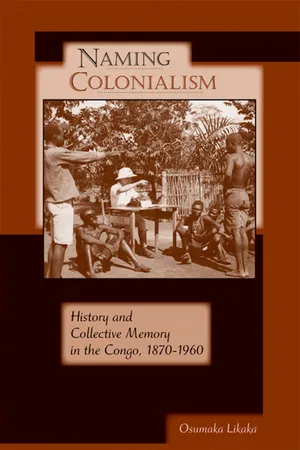
What's in a name? As Osumaka Likaka argues in this illuminating study, the names that Congolese villagers gave to European colonizers reveal much about how Africans experienced and reacted to colonialism. The arrival of explorers, missionaries, administrators, and company agents allowed Africans to observe Westerners' physical appearances, behavior, and cultural practices at close rangeâoften resulting in subtle yet trenchant critiques. By naming Europeans, Africans turned a universal practice into a local mnemonic system, recording and preserving the village's understanding of colonialism in the form of pithy verbal expressions that were easy to remember and transmit across localities, regions, and generations.
Methodologically innovative, Naming Colonialism advances a new approach that shows how a cultural processâthe naming of Europeansâcan provide a point of entry into economic and social histories. Drawing on archival documents and oral interviews, Likaka encounters and analyzes a welter of coded fragments. The vivid epithets Congolese gave to rubber company agentsâ"the home burner," "Leopard," "Beat, beat," "The hippopotamus-hide whip"âclearly conveyed the violence that underpinned colonial extractive economies. Other names were subtler, hinting at derogatory meaning by way of riddles, metaphors, or symbols to which the Europeans were oblivious. Africans thus emerge from this study as autonomous actors whose capacity to observe, categorize, and evaluate reverses our usual optic, providing a critical window on Central African colonialism in its local and regional dimensions.
Frequently asked questions
Yes, you can cancel anytime from the Subscription tab in your account settings on the Perlego website. Your subscription will stay active until the end of your current billing period. Learn how to cancel your subscription.
At the moment all of our mobile-responsive ePub books are available to download via the app. Most of our PDFs are also available to download and we're working on making the final remaining ones downloadable now. Learn more here.
Perlego offers two plans: Essential and Complete
- Essential is ideal for learners and professionals who enjoy exploring a wide range of subjects. Access the Essential Library with 800,000+ trusted titles and best-sellers across business, personal growth, and the humanities. Includes unlimited reading time and Standard Read Aloud voice.
- Complete: Perfect for advanced learners and researchers needing full, unrestricted access. Unlock 1.4M+ books across hundreds of subjects, including academic and specialized titles. The Complete Plan also includes advanced features like Premium Read Aloud and Research Assistant.
We are an online textbook subscription service, where you can get access to an entire online library for less than the price of a single book per month. With over 1 million books across 1000+ topics, weâve got you covered! Learn more here.
Look out for the read-aloud symbol on your next book to see if you can listen to it. The read-aloud tool reads text aloud for you, highlighting the text as it is being read. You can pause it, speed it up and slow it down. Learn more here.
Yes! You can use the Perlego app on both iOS or Android devices to read anytime, anywhere â even offline. Perfect for commutes or when youâre on the go.
Please note we cannot support devices running on iOS 13 and Android 7 or earlier. Learn more about using the app.
Yes, you can access Naming Colonialism by Osumaka Likaka in PDF and/or ePUB format, as well as other popular books in History & African History. We have over one million books available in our catalogue for you to explore.
Information
Table of contents
- Contents
- List of Illustrations
- Acknowledgments
- Introduction: Naming and African Voices
- 1. The Dynamics of Naming in Precolonial Congo: An Overview
- 2. Colonialism and the Village World: Contexts to Naming
- 3. Naming, Colonialism, Making History, and Social Memories
- 4. Early Naming, Explorations, Trade, and Rubber Collection
- 5. Naming and Belgian Colonial Rule
- 6. Talking under One's Breath: Praise Names as Strategic Ambiguities
- 7. Confronting African Voices: Negotiations and Instrumentalization of Names
- Conclusions
- Sample of Names Used in This Work
- Notes
- Works Cited
- Index