Facing Images
eBook - PDF

Facing Images

Medieval Japanese Art and the Problem of Modernity

  1. English
  2. PDF
  3. Available on iOS & Android
eBook - PDF

Facing Images

Medieval Japanese Art and the Problem of Modernity

About this book

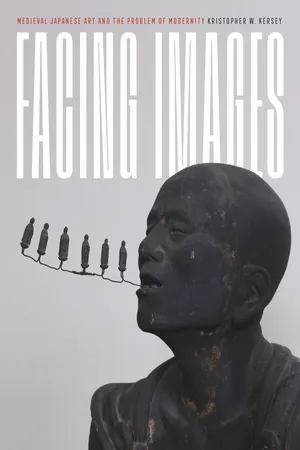
If we want to decolonize the history of art, argues Kristopher Kersey, we must rethink our approach to the historical record. This means dispensing with Eurocentric binaries—divisions between Western and non-Western, modern and premodern—and making a commitment to artworks that challenge the perspectives we build upon them. In Facing Images, the question takes elegant and intriguing form: If the aesthetic hallmarks of "modernity" can be found in twelfth-century art, what does it really mean to be "modern"?

Kersey's answer to this question models a new historiography. Facing Images begins by tracing the turbulent discourse surrounding the emergence of Japanese art history as a modern field. In lieu of examining canonical works from the twelfth century, Kersey foregrounds the elusive and the enigmatic in artworks little known and understudied outside Japan; the manuscripts he selects defy traditional art-historical narratives by exhibiting decidedly modern techniques, including montage, self-reference, reuse, noise, dissonance, and chronological disarray. Kersey weaves these medieval case studies together with insights from a wide range of interdisciplinary scholarship, using a methodology that will prove important for historians: Facing Images produces a history of non-Western art in which diverse and anachronic works are brought responsibly and equitably into dialogue with the present, without being subsumed under Eurocentric formalisms or false universals.

A timely intervention in the history of medieval Japanese art, art historiography, and the history of global modernism, Facing Images redefines the relationship of the "premodern" non-West to "modern" art. It will be of particular interest to scholars of medieval Japanese art and of modernism.

Frequently asked questions

Yes, you can cancel anytime from the Subscription tab in your account settings on the Perlego website. Your subscription will stay active until the end of your current billing period. Learn how to cancel your subscription.
No, books cannot be downloaded as external files, such as PDFs, for use outside of Perlego. However, you can download books within the Perlego app for offline reading on mobile or tablet. Learn more here.
Perlego offers two plans: Essential and Complete
  • Essential is ideal for learners and professionals who enjoy exploring a wide range of subjects. Access the Essential Library with 800,000+ trusted titles and best-sellers across business, personal growth, and the humanities. Includes unlimited reading time and Standard Read Aloud voice.
  • Complete: Perfect for advanced learners and researchers needing full, unrestricted access. Unlock 1.4M+ books across hundreds of subjects, including academic and specialized titles. The Complete Plan also includes advanced features like Premium Read Aloud and Research Assistant.
Both plans are available with monthly, semester, or annual billing cycles.
We are an online textbook subscription service, where you can get access to an entire online library for less than the price of a single book per month. With over 1 million books across 1000+ topics, we’ve got you covered! Learn more here.
Look out for the read-aloud symbol on your next book to see if you can listen to it. The read-aloud tool reads text aloud for you, highlighting the text as it is being read. You can pause it, speed it up and slow it down. Learn more here.
Yes! You can use the Perlego app on both iOS or Android devices to read anytime, anywhere — even offline. Perfect for commutes or when you’re on the go.
Please note we cannot support devices running on iOS 13 and Android 7 or earlier. Learn more about using the app.
Yes, you can access Facing Images by Kristopher W. Kersey in PDF and/or ePUB format, as well as other popular books in Art & Art Theory & Criticism. We have over one million books available in our catalogue for you to explore.

Information

Table of contents

  1. COVER Front
  2. Copyright Page
  3. Table of Contents
  4. Acknowledgments
  5. Introduction
  6. Notes to Introduction
  7. Chapter 1: Antinomies Transiting Modernity in Japanese Art History
  8. Notes to Chapter 1
  9. Chapter2: Interface Between Visuality and Alterity
  10. Nottes to Chapter 2
  11. Chapter 3: Stratigraphy Facing the Eyeless Sutras
  12. Notes to Chapter 3
  13. Chapter 4: Anti-Aesthetics: Materiality and Visuality in The Significance of the Character “A” (Ajigi)
  14. Notes to Chapter 4
  15. Chapter 5: Viscera Anatomy, Prosthesis, and the Physiology of Vision
  16. Notes to Chapter 5
  17. Chapter 6: Montage The Anthology of the Thirty-Six Poets and the Modernity of Collage
  18. Notes to Chapter 6
  19. Notes
  20. Bibliography
  21. Index