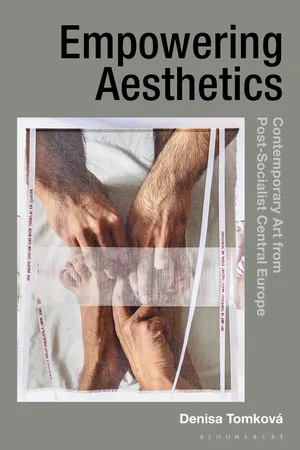
The artistic strategies explored in this book are essential tools in fostering emancipatory consciousness in marginalized communities. Empowering Aesthetics weaves together case studies from the post-socialist Central European region (the Czech Republic, Hungary, Poland, and Slovakia) to show how art can provide critical support to gender, sexual and racialized groups. The empowering aesthetics employed by the artists in this book are not only urgent and critical, but also vitally personal, each chapter building a clear understanding of what social equality looks like in these specific political and geographic contexts. These practices are a response to the rise of nationalism, homophobia, transphobia, and xenophobia in the region.
Engaging with contemporary philosophy and feminist, queer and decolonial (art) theory (Sara Ahmed, Judith Butler, Angela Dimitrakaki, Boris Groys, Jack Halberstam, Grant Kester, Ewa Majewska, Paul B. Preciado, Legacy Russell, Madina Tlostanova, etc.), this book highlights a shift in the understanding of the artwork and aesthetic experience that is enduring rather than immediate, drawing attention to a given community. The projects discussed in this book are created with the artist and the wider community or family in mind and are created in intersubjective connection with others. This volume highlights that empowering aesthetics perform an important function in challenging these narratives while contributing to building an inclusive collective memory that emancipates systematically marginalized individuals and communities.
- 198 pages
- English
- ePUB (mobile friendly)
- Available on iOS & Android
eBook - ePub
About this book
Information
Topic
PhilosophySubtopic
History of Contemporary ArtTable of contents
- Cover
- Half-Title
- Series
- Dedication
- Title
- Contents
- List of Figures
- Acknowledgements
- 1 Introduction
- 2 (Not) being at home in institutions
- 3 Unintended diaspora
- 4 Survival of those who fit?
- 5 Can a woman sing?
- 6 Conclusion
- Notes
- Literature
- Index
- Copyright
Trusted by 375,005 students
Access to over 1.5 million titles for a fair monthly price.
Study more efficiently using our study tools.
Frequently asked questions
Yes, you can cancel anytime from the Subscription tab in your account settings on the Perlego website. Your subscription will stay active until the end of your current billing period. Learn how to cancel your subscription
No, books cannot be downloaded as external files, such as PDFs, for use outside of Perlego. However, you can download books within the Perlego app for offline reading on mobile or tablet. Learn how to download books offline
Perlego offers two plans: Essential and Complete
- Essential is ideal for learners and professionals who enjoy exploring a wide range of subjects. Access the Essential Library with 800,000+ trusted titles and best-sellers across business, personal growth, and the humanities. Includes unlimited reading time and Standard Read Aloud voice.
- Complete: Perfect for advanced learners and researchers needing full, unrestricted access. Unlock 1.5M+ books across hundreds of subjects, including academic and specialized titles. The Complete Plan also includes advanced features like Premium Read Aloud and Research Assistant.
We are an online textbook subscription service, where you can get access to an entire online library for less than the price of a single book per month. With over 1.5 million books across 990+ topics, we’ve got you covered! Learn about our mission
Look out for the read-aloud symbol on your next book to see if you can listen to it. The read-aloud tool reads text aloud for you, highlighting the text as it is being read. You can pause it, speed it up and slow it down. Learn more about Read Aloud
Yes! You can use the Perlego app on both iOS and Android devices to read anytime, anywhere — even offline. Perfect for commutes or when you’re on the go.
Please note we cannot support devices running on iOS 13 and Android 7 or earlier. Learn more about using the app
Please note we cannot support devices running on iOS 13 and Android 7 or earlier. Learn more about using the app
Yes, you can access Empowering Aesthetics by Denisa Tomková in PDF and/or ePUB format, as well as other popular books in Philosophy & History of Contemporary Art. We have over 1.5 million books available in our catalogue for you to explore.