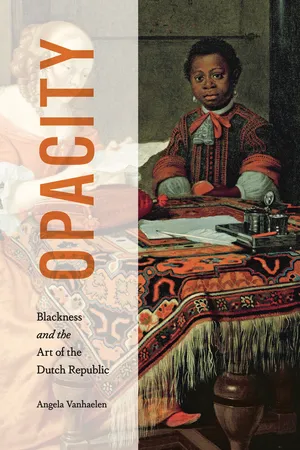
Opacity
eBook - PDF

Opacity

Blackness and the Art of the Dutch Republic

  1. 205 pages
  2. English
  3. PDF
  4. Available on iOS & Android
eBook - PDF

Opacity

Blackness and the Art of the Dutch Republic

About this book

As Dutch merchants became drivers of the transatlantic slavery business in the seventeenth century, Dutch art increasingly used Blackness to signal slavery and servitude. In this brilliant and pathbreaking work, Angela Vanhaelen proposes new ways of looking at Dutch paintings that do not equate Blackness with enslavement.

Vanhaelen reframes the conversation on Netherlandish art by placing seventeenth-century domestic scenes and portraits in dialogue with images of trading forts, markets, and plantations in West Africa and Brazil. She argues that Dutch paintings depicting enslaved Black Africans—for example, Frans Hals's Family Group in a Landscape—not only obscure information about the institution of slavery but fail to capture the resistance and dissent of people who did not conform to the anti-Black world created by Dutch art. Opacity leads readers to grapple with difficult and complex questions: How do we reconcile images of peace and prosperity with the horror of the slave trade? How do we teach imagery of Black people as enslaved without reinforcing anti-Black racism? Can we interpret dehumanizing imagery in ways that consider the complexities of enslavement?

Refusing to view Dutch pictures on their own terms, Opacity recognizes the historical persistence of non-sovereign positions, anticolonial settlements, non-patriarchal homeplaces, open-ended forms of religion and culture, as well as the possibilities of oppositional modes of world-making. This important, thought-provoking book will be essential reading for students and scholars of Black studies and early modern European art history as well as general readers looking for a fresh approach to Dutch art of the period.

Frequently asked questions

Yes, you can cancel anytime from the Subscription tab in your account settings on the Perlego website. Your subscription will stay active until the end of your current billing period. Learn how to cancel your subscription.
No, books cannot be downloaded as external files, such as PDFs, for use outside of Perlego. However, you can download books within the Perlego app for offline reading on mobile or tablet. Learn more here.
Perlego offers two plans: Essential and Complete
  • Essential is ideal for learners and professionals who enjoy exploring a wide range of subjects. Access the Essential Library with 800,000+ trusted titles and best-sellers across business, personal growth, and the humanities. Includes unlimited reading time and Standard Read Aloud voice.
  • Complete: Perfect for advanced learners and researchers needing full, unrestricted access. Unlock 1.4M+ books across hundreds of subjects, including academic and specialized titles. The Complete Plan also includes advanced features like Premium Read Aloud and Research Assistant.
Both plans are available with monthly, semester, or annual billing cycles.
We are an online textbook subscription service, where you can get access to an entire online library for less than the price of a single book per month. With over 1 million books across 1000+ topics, we’ve got you covered! Learn more here.
Look out for the read-aloud symbol on your next book to see if you can listen to it. The read-aloud tool reads text aloud for you, highlighting the text as it is being read. You can pause it, speed it up and slow it down. Learn more here.
Yes! You can use the Perlego app on both iOS or Android devices to read anytime, anywhere — even offline. Perfect for commutes or when you’re on the go.
Please note we cannot support devices running on iOS 13 and Android 7 or earlier. Learn more about using the app.
Yes, you can access Opacity by Angela Vanhaelen in PDF and/or ePUB format, as well as other popular books in Art & Art Theory & Criticism. We have over one million books available in our catalogue for you to explore.

Information

Table of contents

  1. COVER Front
  2. Copyright Page
  3. Table of Contents
  4. Acknowledgments
  5. Introduction
  6. Notes to Introduction
  7. Chapter 1: Vermeer’s Secrets
  8. Notes to Chapter 1
  9. Chapter 2: Sovereignty and Non-sovereignty
  10. Notes to Chapter 2
  11. Chapter 3: Displacement
  12. Notes to Chapter 3
  13. Chapter 4: Plantation Worldscape
  14. Notes to Chapter 4
  15. Chapter 5: Inventing at the Edge of Visibility
  16. Notes to Chapter 5
  17. Notes
  18. Bibliography
  19. Index