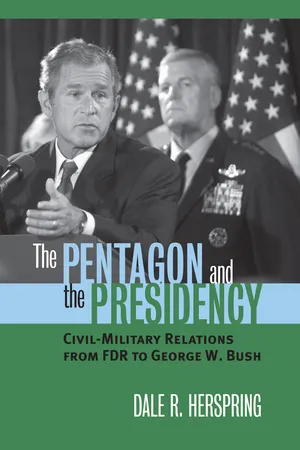
While presidents have always kept a watchful eye on the military, our generals have been equally vigilant in assessing the commander-in-chief. Their views, however, have been relatively neglected in the literature on civil-military relations. By taking us inside the military’s mind in this matter, Dale Herspring’s new book provides a path-breaking, utterly candid, and much-needed reassessment of a key relationship in American government and foreign policymaking.
As Herspring reminds us, that relationship has often been a very tense, even extremely antagonistic one, partly because the military has become a highly organized and very effective bureaucratic interest group. Reevaluating twelve presidents—from Franklin D. Roosevelt to George W. Bush—Herspring shows how the intensity of that conflict depends largely on the military’s perception of the president’s leadership style. Quite simply, presidents who show genuine respect for military culture are much more likely to develop effective relations with the military than those who don’t.
Each chapter focuses on one president and his key administrators—such as Robert McNamara, Henry Kissinger, and Donald Rumsfeld—and contains case studies showing how the military reacted to the president’s leadership. In the final chapter, Herspring ranks the presidents according to their degree of conflict with the military: Lyndon Johnson received exceedingly low marks for being overbearing and dismissive of the armed forces, further aggravating his Vietnam problem. George H. W. Bush inspired respect for not micromanaging military affairs. And Bill Clinton was savaged both privately and publicly by military leaders for having been a “draft dodger,” cutting Pentagon spending, and giving the “Don’t Ask, Don’t Tell” tag an unnecessarily high profile.
From World War II to Operation Iraqi Freedom, Herspring clearly shows how the nature of civilian control has changed during the past half century. He also reveals how the military has become a powerful bureaucratic interest group very much like others in Washington—increasingly politicized, media-savvy, and as much accountable to Congress as to the commander-in-chief.
Ultimately, The Pentagon and the Presidency illuminates how our leaders devise strategies for dealing with threats to our national security—and how the success of that process depends so much upon who’s in charge and how that person’s perceived by our military commanders.