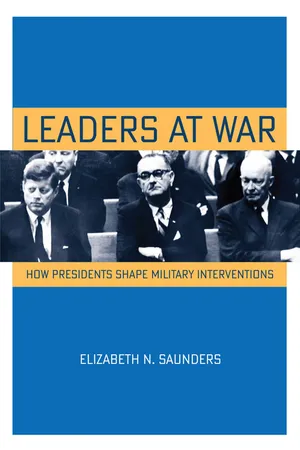
One of the most contentious issues in contemporary foreign policy—especially in the United States—is the use of military force to intervene in the domestic affairs of other states. Some military interventions explicitly try to transform the domestic institutions of the states they target; others do not, instead attempting only to reverse foreign policies or resolve disputes without trying to reshape the internal landscape of the target state. In Leaders at War, Elizabeth N. Saunders provides a framework for understanding when and why great powers seek to transform foreign institutions and societies through military interventions. She highlights a crucial but often-overlooked factor in international relations: the role of individual leaders.
Saunders argues that leaders' threat perceptions—specifically, whether they believe that threats ultimately originate from the internal characteristics of other states—influence both the decision to intervene and the choice of intervention strategy. These perceptions affect the degree to which leaders use intervention to remake the domestic institutions of target states. Using archival and historical sources, Saunders concentrates on U.S. military interventions during the Cold War, focusing on the presidencies of Eisenhower, Kennedy, and Johnson. After demonstrating the importance of leaders in this period, she also explores the theory's applicability to other historical and contemporary settings including the post–Cold War period and the war in Iraq.