Within the realist school of international relations, a prevailing view holds that the anarchic structure of the international system invariably forces the great powers to seek security at one another's expense, dooming even peaceful nations to an unrelenting struggle for power and dominance. Rational Theory of International Politics offers a more nuanced alternative to this view, one that provides answers to the most fundamental and pressing questions of international relations.
Why do states sometimes compete and wage war while at other times they cooperate and pursue peace? Does competition reflect pressures generated by the anarchic international system or rather states' own expansionist goals? Are the United States and China on a collision course to war, or is continued coexistence possible? Is peace in the Middle East even feasible? Charles Glaser puts forward a major new theory of international politics that identifies three kinds of variables that influence a state's strategy: the state's motives, specifically whether it is motivated by security concerns or "greed"; material variables, which determine its military capabilities; and information variables, most importantly what the state knows about its adversary's motives.
Rational Theory of International Politics demonstrates that variation in motives can be key to the choice of strategy; that the international environment sometimes favors cooperation over competition; and that information variables can be as important as material variables in determining the strategy a state should choose.
eBook - PDF
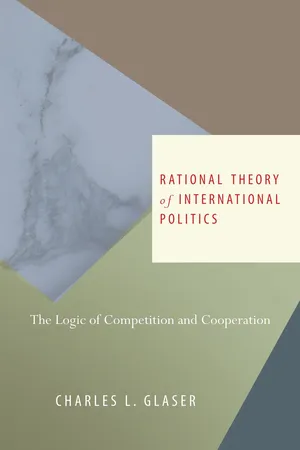
Rational Theory of International Politics
The Logic of Competition and Cooperation
- 329 pages
- English
- PDF
- Available on iOS & Android
eBook - PDF
About this book
Information
Publisher
Princeton University PressYear
2010Print ISBN
9780691143729
9780691143712
eBook ISBN
9781400835133
Table of contents
- Cover
- Title
- Copyright
- Contents
- Preface
- Chapter One: Introduction
- Chapter Two: Setting Up the Theory
- Chapter Three: The Theory
- Chapter Four: Extensions of the Theory
- Chapter Five: Counterarguments
- Chapter Six: Placing the Theory in the IR Theory Landscape
- Chapter Seven: Evaluating the Theory from Within
- Chapter Eight: Evaluating the Theory—Important Cases and Useful Comparisons
- Chapter Nine: Applying the Theory to Arms Races; Testing It with Counterfactuals
- Chapter Ten: Summary and Policy Implications
- Bibliography
- Index
Trusted by 375,005 students
Access to over 1.5 million titles for a fair monthly price.
Study more efficiently using our study tools.
Frequently asked questions
Yes, you can cancel anytime from the Subscription tab in your account settings on the Perlego website. Your subscription will stay active until the end of your current billing period. Learn how to cancel your subscription
No, books cannot be downloaded as external files, such as PDFs, for use outside of Perlego. However, you can download books within the Perlego app for offline reading on mobile or tablet. Learn how to download books offline
Perlego offers two plans: Essential and Complete
- Essential is ideal for learners and professionals who enjoy exploring a wide range of subjects. Access the Essential Library with 800,000+ trusted titles and best-sellers across business, personal growth, and the humanities. Includes unlimited reading time and Standard Read Aloud voice.
- Complete: Perfect for advanced learners and researchers needing full, unrestricted access. Unlock 1.5M+ books across hundreds of subjects, including academic and specialized titles. The Complete Plan also includes advanced features like Premium Read Aloud and Research Assistant.
We are an online textbook subscription service, where you can get access to an entire online library for less than the price of a single book per month. With over 1.5 million books across 990+ topics, we’ve got you covered! Learn about our mission
Look out for the read-aloud symbol on your next book to see if you can listen to it. The read-aloud tool reads text aloud for you, highlighting the text as it is being read. You can pause it, speed it up and slow it down. Learn more about Read Aloud
Yes! You can use the Perlego app on both iOS and Android devices to read anytime, anywhere — even offline. Perfect for commutes or when you’re on the go.
Please note we cannot support devices running on iOS 13 and Android 7 or earlier. Learn more about using the app
Please note we cannot support devices running on iOS 13 and Android 7 or earlier. Learn more about using the app
Yes, you can access Rational Theory of International Politics by Charles L. Glaser in PDF and/or ePUB format, as well as other popular books in Politics & International Relations & International Relations. We have over 1.5 million books available in our catalogue for you to explore.