Over the past years, studies have begun not only to identify the factors that impeded the full participation of women artists in French cultural life, such as women's limited access to professional art education, but also to bring to light the considerable artistic accomplishments of women occluded by historians for over a century. A similar effort at historical revision has been under way for French women writers. Works of fiction that enjoyed many editions in the nineteenth-century receded from our field of vision for almost a century before being rediscovered and reissued during the last decades of the twentieth century. Such efforts have resulted in scholarship that has helped revise the history of both artistic and literary expression in nineteenth-century France.
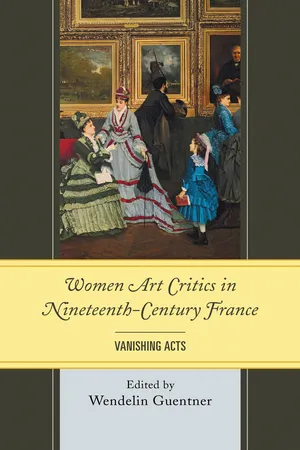
Similarly, many women in nineteenth-century France had their art criticism published both in journal reviews and in book form, often for decades, in a number of the most influential venues of their day. However, it is perplexing that they remain almost totally invisible in histories of French culture. Women Art Critics in Nineteenth-Century France: Vanishing Acts is the first sustained effort to bring these prolific and influential critics out from the shadows. Although each of the chapters in this volume results from an interdisciplinary approach, the fact that they are written by scholars in art history and in literature means that there will be inevitable differences in approach and methodology. Thus, we study the women's reception of specific artworks and aesthetic movements, discuss intersections of aesthetics and politics in their essays and the literary styles and rhetorical strategies of individual critics, explore the social conditions that allowed or impeded their successes, and suggest reasons for their all but disappearance in the twentieth century. In bringing to light for twenty-first-century readers the "vanished" writings of heretofore unrecognized or underrecognized women art critics, the authors hope to contribute to the ongoing revision of women's role in cultural history. The multifaceted approaches to word/image studies modeled in this book, and the many avenues for further research it identifies, will inspire scholars in a number of disciplines to continue the work of reinscribing women in the history of cultural life.
- English
- ePUB (mobile friendly)
- Available on iOS & Android
eBook - ePub
About this book
Information
Topic
ArtSubtopic
Art Theory & CriticismTable of contents
- Title Page
- List of Figures
- Acknowledgments
- Preface
- Introduction
- “ C. W. . . . académicienne ”
- Amélie-Julie Candeille’s Critical Enterprise and the Creation of “Girodet”
- Women Art Critics during the July Monarchy (1830–1848)
- “A Career True to Woman’s Nature”
- Claude Vignon’s Salon de 1850–51
- “Dieu! Une plume de femme!”
- “Marc” de Montifaud
- “ Tel père, telle fille ”
- Conclusion
- Appendix 1
- Appendix 2
- Appendix 3
- Appendix 4
- Appendix 5
- Appendix 6
- Appendix 7
- Selected Bibliography
- Index
- About the Contributors
Trusted by 375,005 students
Access to over 1.5 million titles for a fair monthly price.
Study more efficiently using our study tools.
Frequently asked questions
Yes, you can cancel anytime from the Subscription tab in your account settings on the Perlego website. Your subscription will stay active until the end of your current billing period. Learn how to cancel your subscription
No, books cannot be downloaded as external files, such as PDFs, for use outside of Perlego. However, you can download books within the Perlego app for offline reading on mobile or tablet. Learn how to download books offline
Perlego offers two plans: Essential and Complete
- Essential is ideal for learners and professionals who enjoy exploring a wide range of subjects. Access the Essential Library with 800,000+ trusted titles and best-sellers across business, personal growth, and the humanities. Includes unlimited reading time and Standard Read Aloud voice.
- Complete: Perfect for advanced learners and researchers needing full, unrestricted access. Unlock 1.5M+ books across hundreds of subjects, including academic and specialized titles. The Complete Plan also includes advanced features like Premium Read Aloud and Research Assistant.
We are an online textbook subscription service, where you can get access to an entire online library for less than the price of a single book per month. With over 1.5 million books across 990+ topics, we’ve got you covered! Learn about our mission
Look out for the read-aloud symbol on your next book to see if you can listen to it. The read-aloud tool reads text aloud for you, highlighting the text as it is being read. You can pause it, speed it up and slow it down. Learn more about Read Aloud
Yes! You can use the Perlego app on both iOS and Android devices to read anytime, anywhere — even offline. Perfect for commutes or when you’re on the go.
Please note we cannot support devices running on iOS 13 and Android 7 or earlier. Learn more about using the app
Please note we cannot support devices running on iOS 13 and Android 7 or earlier. Learn more about using the app
Yes, you can access Women Art Critics in Nineteenth-Century France by Wendelin Guentner in PDF and/or ePUB format, as well as other popular books in Art & Art Theory & Criticism. We have over 1.5 million books available in our catalogue for you to explore.