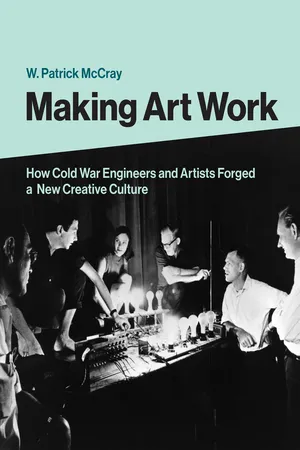
Artwork as opposed to experiment? Engineer versus artist? We often see two different cultural realms separated by impervious walls. But some fifty years ago, the borders between technology and art began to be breached. In this book, W. Patrick McCray shows how in this era, artists eagerly collaborated with engineers and scientists to explore new technologies and create visually and sonically compelling multimedia works. This art emerged from corporate laboratories, artists' studios, publishing houses, art galleries, and university campuses. Many of the biggest stars of the art world—Robert Rauschenberg, Yvonne Rainer, Andy Warhol, Carolee Schneemann, and John Cage—participated, but the technologists who contributed essential expertise and aesthetic input often went unrecognized.
Coming from diverse personal backgrounds, this roster of engineers and scientists includes Frank J. Malina, the American rocket-pioneer turned kinetic artist who launched the art-science journal Leonardo, and Swedish-born engineer Billy Klüver, who established the group Experiments in Art and Technology (E.A.T). At schools ranging from MIT to Caltech, engineers engaged with such figures as artist Gyorgy Kepes and celebrity curator Maurice Tuchman.
Today, we are in the midst of a new surge of corporate and academic promotion of projects and programs combining art, technology, and science. Making Art Work reveals how artists and technologists have continually constructed new communities in which they exercise imagination, display creative expertise, and pursue commercial innovation.
eBook - ePub
Making Art Work
How Cold War Engineers and Artists Forged a New Creative Culture
- English
- ePUB (mobile friendly)
- Available on iOS & Android
eBook - ePub
About this book
Information
Topic
ArtSubtopic
History of Contemporary ArtTable of contents
- Cover
- Contents
- Acknowledgments
- Introduction: Schematics
- 1 Preamplifier
- 2 Fluxes
- 3 Heterodyne
- 4 Powering Up
- 5 Transducer
- 6 Surges
- 7 Parallel Processing
- 8 Overload
- 9 Amplitudes
- Conclusion: Waves, Loops, and Bubbles
- Notes on Sources
- Notes
- Index
Trusted by 375,005 students
Access to over 1.5 million titles for a fair monthly price.
Study more efficiently using our study tools.
Frequently asked questions
Yes, you can cancel anytime from the Subscription tab in your account settings on the Perlego website. Your subscription will stay active until the end of your current billing period. Learn how to cancel your subscription
No, books cannot be downloaded as external files, such as PDFs, for use outside of Perlego. However, you can download books within the Perlego app for offline reading on mobile or tablet. Learn how to download books offline
Perlego offers two plans: Essential and Complete
- Essential is ideal for learners and professionals who enjoy exploring a wide range of subjects. Access the Essential Library with 800,000+ trusted titles and best-sellers across business, personal growth, and the humanities. Includes unlimited reading time and Standard Read Aloud voice.
- Complete: Perfect for advanced learners and researchers needing full, unrestricted access. Unlock 1.5M+ books across hundreds of subjects, including academic and specialized titles. The Complete Plan also includes advanced features like Premium Read Aloud and Research Assistant.
We are an online textbook subscription service, where you can get access to an entire online library for less than the price of a single book per month. With over 1.5 million books across 990+ topics, we’ve got you covered! Learn about our mission
Look out for the read-aloud symbol on your next book to see if you can listen to it. The read-aloud tool reads text aloud for you, highlighting the text as it is being read. You can pause it, speed it up and slow it down. Learn more about Read Aloud
Yes! You can use the Perlego app on both iOS and Android devices to read anytime, anywhere — even offline. Perfect for commutes or when you’re on the go.
Please note we cannot support devices running on iOS 13 and Android 7 or earlier. Learn more about using the app
Please note we cannot support devices running on iOS 13 and Android 7 or earlier. Learn more about using the app
Yes, you can access Making Art Work by W. Patrick McCray in PDF and/or ePUB format, as well as other popular books in Art & History of Contemporary Art. We have over 1.5 million books available in our catalogue for you to explore.