The LASSO model (Lateral; Addictive; Storied; Scalable; Own-able) offers a simple, accessible and effective way for marketers to get their heads around the desired attributes of highly successful growth programs. With insightful advice, anecdotes and tips from leading brand licensing professionals, household names like Coca-Cola and Disney, senior marketers and inspiring individuals, Canalichio has created a measured and proven "Think Big, Get Big" framework to truly help your brand first expand, grow successfully, and ultimately thrive.
eBook - ePub
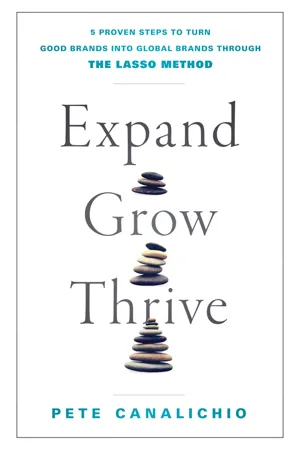
Expand, Grow, Thrive
5 Proven Steps to Turn Good Brands into Global Brands through the LASSO Method
- 200 pages
- English
- ePUB (mobile friendly)
- Available on iOS & Android
eBook - ePub
Expand, Grow, Thrive
5 Proven Steps to Turn Good Brands into Global Brands through the LASSO Method
About this book
Using powerful storytelling and unique access to the personal perspectives of top-flight marketers who have developed truly world-class business growth programs, Pete Canalichio shows us how successful marketers have extended and expanded their brands, and the challenges they have had to overcome along the way.
Information
1
Pinning Their Hopes
A great brand licensing program isn’t simply looking to extend a brand into new places, it’s looking to work with what people know and love in order to change the emotional scale at which the brand operates.
A Tale of One Pin, Two Brands, and 3,000 People Waiting in the Cold
Scott Pitts felt like he had just placed his head on the pillow when the phone rang in his small Olympic apartment one-half mile from the Outdoor Medal Ceremony in Honshu, the main island of Japan. It was 12:56 a.m.
“Who could be calling me at this hour?” thought Scott. It was the final day of the Nagano Olympic Games, and Coca-Cola’s Nagano Olympic merchandise manager was beyond exhausted. He had been in bed barely two hours. A pause … then the phone rang again.
“Hello. This is Scott Pitts,” he mumbled, trying to shake himself awake.
A Japanese voice responded, “Pitts-san, this is the Nagano Police. Your presence is required at the station immediately.”
“My presence is required at the station? Why? What’s wrong?” Scott implored, collecting his bearings.
“You must have a business permit,” stated the police officer.
“I don’t understand. Why do I need a permit?” Scott asked. “What the heck is going on?”
“There is a line forming outside the Coca-Cola Olympic Pin Trading Center. This is not authorized without a permit.”
Scott scratched his head, thinking, “Why would there be a line forming outside the Coke Pin Trading Center at this hour?” While Coke’s Olympic licensing program had many facets, the most important was the Coca-Cola Pin Trading Center located in downtown Nagano. Each day, Coca-Cola sold their special “Pin of the Day” there at 11 a.m. Normally, the line would begin forming two hours earlier. Who would be crazy enough to line up in the middle of the night? It had to be 20 degrees Fahrenheit outside.
“Pitts-san. Are you there?” inquired the police officer, growing weary over the conversation.
“Yes. Yes. I’m here. I understand. I will be there shortly.”
“Very good, sir. The permit costs ¥200,000 yen. You will need to bring cash.”
The phone went dead. Bring ¥200,000? That was almost $2,000! Where was he going to find ¥200,000 at this time of the night? Scott knew of an ATM near his apartment. He ran over and put in his card. The maximum he could withdraw was ¥25,000. Eight ATMs later, Scott arrived at the police station with the money in hand.
Scott got the permit and finally made it back to his apartment. He put his head on the pillow. Before he knew it, the alarm went off … at 6 a.m. He hit the snooze button. An hour later, Scott reached for what he thought must be the alarm — and realized it was his phone again. It was 7:17 a.m. What could be wrong now? He hoped no one had started a riot or been hurt.
It was Jonathan. “Scott, I am sorry to disturb you, but you’ve got to get down to the Pin Trading Center. You won’t believe what is going on.” A short and precise summary of the situation followed.
“I’m on my way. Try to keep things under control until I get there.”
Scott hung up and dressed as quickly as he could. Fortunately, he didn’t have to think about what to wear. A Coke uniform lay strewn over the chair where he left it the previous night. As he walked up to the Coca-Cola Pin Trading Center he couldn’t believe his eyes. The line stretched for blocks. Never in his imagination did he think that a brand licensing program would impel thousands of people to line up in the dark on a cold February morning for a simple Coca-Cola Olympic pin.
His thoughts flashed back 13 months to January 1997.
____________________
Now, allow me to pick up the story…
Scott had joined Coca-Cola after working on the 1996 Olympic Torch Relay. As the Midwest Regional Coordinator, he had been responsible for crowd-building along the relay route in his region. In that environment, things happen in a rush. About 90% of Torch Relay crowd-building occurred in the 60 minutes prior to the passing of the Olympic Flame. Scott and the rest of the Atlanta Torch Relay Team had successfully wrangled more than 20 million people to witness the Olympic Flame going by. Now he had joined Coca-Cola, one of the premier Olympic sponsors, and would get to be part of another Olympic Games.
I had just come off working on the Atlanta Olympics myself. As a Coke employee, my role had been substantially different from Scott’s. Because the 1996 Olympics were in Coke’s hometown, the company had pulled out all the stops. One of their initiatives had been to build a seven-acre theme park they affectionately titled, Coca-Cola Olympic City. It sat across from Centennial Park and would be open for 100 days. My job had been to negotiate contracts with Coke’s suppliers to ensure the park was built on time and on budget.
This was my first Olympic experience. I found it exhilarating and wanted more. When Laurie Ann Goldman, head of Coke’s worldwide licensing program, asked me to join her team to head up a newly formed event licensing group which would support Olympic sponsorships,1 I jumped at the chance.
Scott and I were both newbies to the world of licensing and event marketing, but we were confident we could make up for our inexperience with our business skills, exuberance, and perseverance. We quickly realized we had jumped into the deep end. With the Nagano Olympic Games just over a year away and nothing started, we needed to complete 30 months of work in the span of 9. This meant running processes in parallel that normally functioned in series.
Our role was to create a co-branded merchandise program that integrated the Nagano Olympic and Coca-Cola marques. We decided merchandise would be sold at the World of Coca-Cola in Atlanta, Georgia, allowing us to ride a wave of momentum from the prior Games hosted in Atlanta. We would also target Olympic pin collectors based in the United States through a catalog. Furthermore, we would sell merchandise along the Torch Relay routes throughout the Nagano prefecture and at a Coca-Cola Olympic Pin Trading Center located in downtown Nagano.
However, first, we had to negotiate a program agreement with the Nagano Olympic Committee. That agreement would authorize us to create and sell the co-branded merchandise and set the terms for how the program would be run, including where the merchandise could be sold, what categories would be allowed, who could manufacture the merchandise, how product would be approved, the levels of royalties that would be paid, and finally, how those royalties would be split between Coca-Cola and the Nagano Olympic Committee.
We pulled together our plan and I flew to Tokyo to meet four members of the Committee. Through a colleague who served as my interpreter, we went back and forth for hours on the merits of a co-branded program. Because the Nagano Olympic Committee would be required to split the royalty revenue with Coke, the members were concerned that our program would cannibalize their existing program and deliver less royalty to them. I countered that it would likely bring in Coke-friendly consumers who would buy not only our co-branded merchandise but more of their Nagano single-branded merchandise. However, the Committee appeared to have no real interest in allowing Coca-Cola to create an additional merchandise program so close to the start of the Games. The objections continued. They didn’t have any additional resources to put toward the program.
“Not to worry,” I told them. “All you have to do is stick out your hand and collect the royalties and we’ll do the rest.” Still, they seemed to balk at my request.
With a wry smile, one gentleman asked, “Why would anyone want to buy Coca-Cola merchandise?”
I paused for a moment, and they must have felt they had finally won their argument and could politely escort this persistent American to the door. I then answered with as much confidence as I could muster, “I can’t say for certain, but what I can tell you is that almost a billion dollars of Coca-Cola branded merchandise was purchased worldwide last year.”
That statement won the day! The Committee members agreed to our program and I left for my hotel, and then a 14-hour flight home. I was elated and exhausted! Our work had just begun.
With approval to move forward, the next thing was to identify what categories of merchandise we would sell and who would manufacture them. We knew that Olympic pins would be our most important category. Coke had sponsored the first Official Pin Trading Center in Calgary, Canada, in 1988. Since then they had hosted a Pin Trading Center at each subsequent Olympics. Pins had become the number one spectator sport at the Games so we were banking on another big turnout of pin buyers and collectors. In addition to the pins, we wanted to produce apparel, Coca-Cola Polar Bear plush, commemorative crystal and gold-plated Coca-Cola bottles, and other souvenir and collectors’ items.
We almost didn’t get approval for the plush. The Nagano Olympic Committee felt the Coca-Cola Polar Bear might raise concerns. The Nagano mascots, known as the Snowlets, were four cute little owls. Given that polar bears eat owls, there might be an uproar from the public! We shared our advertising campaign with the Committee and, thankfully, they quickly saw that the Coca-Cola Polar Bear was only interested in sharing a Coke and promoting friendship. It seemed as soon as we gained approval from the Nagano Olympic Committee that we started hearing from our colleagues in Japan that building a Pin Trading Center in Nagano was not a good idea. “The Japanese are sophisticated buyers. They would have no interest in buying Coca-Cola branded Olympic pins.”
Oh boy! A large part of our budgeted revenue for the project was tied to the successful sale of Coca-Cola Olympic Pins. If the naysayers were right, not only would we not reach our targets, we would also have an egg all over our faces. The road to Nagano was getting narrower and more isolated by the moment.
To get an accurate assessment, Scott pulled together focus groups in the United States and Japan and asked each whether Japanese would want to buy and trade Coca-Cola Olympic Pins. It was a possibility, he was told, but only if the designs were right and we could appeal to enough people to build sufficient momentum. Many of the team from Coca-Cola Japan believed that the resources should go to other market initiatives. However, if we chose not to build the Pin Trading Center, we risked missing a big opportunity to connect thousands of new potential consumers with the Coca-Cola brand in a unique way. Not building might be the easy way out, but we believed deep down it was important for us to press ahead anyway.
Our next job was to find an event retailer who would believe in the opportunity enough to assume the inventory risk, pay for additional staff, and cover the additional expenses associated with selling the pins when the Center was open. We knew that W.C. Bradley had had a profitable event merchandising program helping Coke with the Atlanta Olympic Torch Relay. Would they be interested in being our partners again for a project that would be staged on the other side of the planet?
Fortunately, it didn't take much convincing to get the team from Columbus, Georgia, signed up. I thought about those Southern gentlemen doing business in central Japan and cracked a smile. It would be entertaining, if nothing else. We collectively decided that the best way to build momentum was to open the Pin Trading Center early. That way, people would learn the location of the Center and become familiar with the concept prior to the start of the Games.
Almost immediately we ran into another roadblock. Per our agreement with the Nagano Olympic Committee, we had to use the Japanese pin manufacturer which had acquired the licensing rights to sell Nagano Olympic-branded pins. Instead of having one company to create more than 100 different designs of pins, the Japanese licensee turned out to be a consortium of small companies. There was no way we were going to be able to meet our objectives if we had to deal with dozens of companies scattered all over the country!
Fortunately, the agreement between Coca-Cola and the Nagano Olympic Committee allowed us to choose an alternative supplier if the licensee was not able to meet our delivery schedule. With the approval of the Nagano Olympic Committee, we turned to Aminco, which had supplied pins to Coca-Cola for previous Olympic Games. Not only did they know how to deliver hundreds of quality designed pins on time, they could execute a program at world-class pricing.
Good. But we were about to be dealt with another major setback to our fledgling program. With all the challenges we had been facing, we had not seen that our “get it done” attitude had put a tremendous cultural strain on our Event Merchandising team member based in Japan. Miho2 was a young professional woman with Japanese parents who had been educated in the United States so she had grown up speaking both Japanese and English. Bright and energetic, she wanted to help us be successful. However, from the outset she struggled to fit in with the male-dominated Coca-Cola Japanese team. As I had shared earlier, they did not wish for us to open a Pin Trading Center in Nagano. At the same time, Miho had to answer to Scott and me, who were asking her to move forward with the project. By April, it had become too much and Miho told us she was leaving the team. Literally our one line of communication in Japan had just been cut off!
We considered all the options, including sending Scott to Japan for the duration, but with all his responsibilities in Atlanta we knew it would never work. Moreover, Scott didn’t speak Japanese. After a series of false starts we found Jonathan, an American who had grown up in Japan with missionary parents. Bi lingual, culturally aware, energetic, and enthusiastic, he was quickly signed to the team and sent to Japan.
Even though we had W.C. Bradley as our event retailer for the Coke Pin Trading Center, we still needed an event retailer for the other Coke Olympic-branded merchandise that would be sold along the Torch Relay route and during the time of the Games throughout the Nagano prefecture. This proved to be one of our biggest challenges. Few companies in general are willing to take the risk of buying event-specific merchandise. While the payoff can be huge, the program is fraught with risks, including obtaining sales permits, staffing for the event, gaining merchandise approvals from the brand owners, selecting the right mix of merchandise, and finally, finding each of the exact locations for selling the merchandise where the crowds would be.
Event retailing just didn’t make sense to most Japanese businesses. They would be happy for us to hire them, but they had no interest in signing up to own and sell the licensed merchandise. While Scott and I focused on getting our contracts signed with the Nagano Olympic Committee and the licensees who would manufacture the merchandise, we continued looking for an event retailer who would meet our requirements. The search proved elusive. Finally, after two months, we found a small company in Japan whose owner was entrepreneurial. After vetting them, we felt they were qualified in every way except one: financially. The owner’s limited capital would put the program at risk because he would not be able to secure the entire inventory needed for the program to reach its full potential. We advised him accordingly and, to our delight, he went out and found a larger company willing to back him. This enabled us to close the deal. The pieces were finally coming together to deliver the merchandise by the time of the Games. Now the questions were: “Would they come?” and if they did, “Would they buy?”
The latter half of 1997 was a blur, as Scott, Jonathan, and I raced to approve the concepts, prototypes, and final projection run product that was being made by our licensees. Once Coke had approved the product, and we had gone through the Nagano Olympic Committee approval process, it still had to be tested for safety and quality standards. Having Jonathan on the team proved a godsend as he followed through on every task. He also settled in well with our Coke colleagues in Japan, which strengthened the chemistry between the two teams.
Construction on the Coke Pin Trading Center finally began in November 1997. Despite only wanting to have the building erected for 60 days, Japanese construction laws required that the center be built to the standards of a permanent structure. On January 1, 1998 a small crowd of dignitaries from the Olympic Committee, the City of Nagano, and Coca-Cola senior executives gathered for the official opening. The center itself looked amazing. The exterior featured a 40-foot-tall Coca-Cola bottle with a large sign. Inside, the walls were stocked with brightly colored pins in all shapes, sizes, and colors, each commemorating something different: count downs; countries; sports pictograms; mascots; Nagano-centric; and...
Table of contents
- Cover
- Title Page
- 1 Pinning Their Hopes
- 2 Choose to Lead — How to Succeed in the Connective Economy
- 3 Lateral — Beyond Where They’ve Been
- 4 Addictive — Growing to Love
- 5 Storied — The Power of Heritage in a World of Action
- 6 Scalable — Achieving Your Best Size
- 7 Own-able — How You Expand and Stay True to Your DNA
- 8 Is Your Brand Optimized?
- 9 Making the Decision to License
- 10 License to Operate — The Future of the Licensed Brand
- 11 Epilogue
- Appendix A LASSO Evaluation, Questions and Scoring Kit
- Appendix B LASSO Methodology
- Appendix C LASSO Methodology Q&A
- Index
Trusted by 375,005 students
Access to over 1.5 million titles for a fair monthly price.
Study more efficiently using our study tools.
Frequently asked questions
Yes, you can cancel anytime from the Subscription tab in your account settings on the Perlego website. Your subscription will stay active until the end of your current billing period. Learn how to cancel your subscription
No, books cannot be downloaded as external files, such as PDFs, for use outside of Perlego. However, you can download books within the Perlego app for offline reading on mobile or tablet. Learn how to download books offline
Perlego offers two plans: Essential and Complete
- Essential is ideal for learners and professionals who enjoy exploring a wide range of subjects. Access the Essential Library with 800,000+ trusted titles and best-sellers across business, personal growth, and the humanities. Includes unlimited reading time and Standard Read Aloud voice.
- Complete: Perfect for advanced learners and researchers needing full, unrestricted access. Unlock 1.5M+ books across hundreds of subjects, including academic and specialized titles. The Complete Plan also includes advanced features like Premium Read Aloud and Research Assistant.
We are an online textbook subscription service, where you can get access to an entire online library for less than the price of a single book per month. With over 1.5 million books across 990+ topics, we’ve got you covered! Learn about our mission
Look out for the read-aloud symbol on your next book to see if you can listen to it. The read-aloud tool reads text aloud for you, highlighting the text as it is being read. You can pause it, speed it up and slow it down. Learn more about Read Aloud
Yes! You can use the Perlego app on both iOS and Android devices to read anytime, anywhere — even offline. Perfect for commutes or when you’re on the go.
Please note we cannot support devices running on iOS 13 and Android 7 or earlier. Learn more about using the app
Please note we cannot support devices running on iOS 13 and Android 7 or earlier. Learn more about using the app
Yes, you can access Expand, Grow, Thrive by Pete Canalichio in PDF and/or ePUB format, as well as other popular books in Business & Marketing. We have over 1.5 million books available in our catalogue for you to explore.