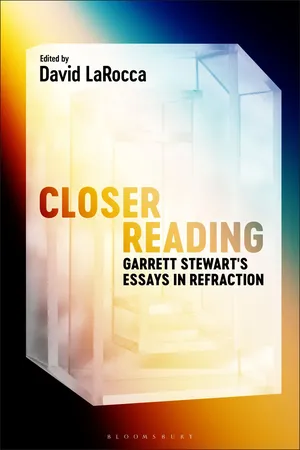
In his first book of essays, Garrett Stewart demonstrates and reframes his formidable powers as a close reader of a vast range of texts: novels, films, songs, book art, digital media, and more.
Among the most prolific and exacting readers of his generation, Stewart is renowned for his virtuosic interventions across a number of humanistic fields, including prose narrative, screen studies, and literary theory. Elected to the American Academy of Arts and Sciences in 2010 and winner of the International Society for the Study of Narrative's prize for Novel Violence (2009), Stewart draws on these varied realms in his intensive readings of enduring works across media – ones worthy of a re-view and a closer look.
Closer Reading, like Stewart's writing more broadly, offers up-close analyses of novels, poetry, cinema, and conceptual art, including chapters on Gerard Manley Hopkins, Charles Dickens, Francis Ford Coppola, Stanley Cavell, and John le Carré. A collection a half-century in the making – yet brimming with critical notes from the vanguard – Closer Reading finds Stewart demonstrating, from sentence to sentence, a sustained rethinking of the value of close reading not just as a methodology but also as a cognitive disposition.
Leaving paranoid, symptomatic, and surface reading to the side, Stewart revels in the workings of sentences and the many senses of media. Such a "prismatic reading" affords insight into the spectrum of interpretation and the bent light of interaction, refraction, and diffraction. To dwell in the astute and generous line of Stewart's inquiry is to experience an exhilaration rare in critical commentary. Featuring full-length essays, including still-potent early publications and accompanied by an entirely new and wide-ranging interview with David LaRocca, Closer Reading provides a deep and satisfying critical survey of and immersion in Garrett Stewart's inimitable oeuvre.
- 305 pages
- English
- PDF
- Available on iOS & Android
eBook - PDF
About this book
Information
Table of contents
- Cover
- CONTENTS
- Introduction: Reading Prismatically / A Spectrum Analysis David LaRocca
- I. Revisitations
- II. Renewed Ventures
- III. Revenant Revisions: “Ghost Reading”
- A Dialogue in Diffraction
- Contributors
- Index
Trusted by 375,005 students
Access to over 1.5 million titles for a fair monthly price.
Study more efficiently using our study tools.
Frequently asked questions
Yes, you can cancel anytime from the Subscription tab in your account settings on the Perlego website. Your subscription will stay active until the end of your current billing period. Learn how to cancel your subscription
No, books cannot be downloaded as external files, such as PDFs, for use outside of Perlego. However, you can download books within the Perlego app for offline reading on mobile or tablet. Learn how to download books offline
Perlego offers two plans: Essential and Complete
- Essential is ideal for learners and professionals who enjoy exploring a wide range of subjects. Access the Essential Library with 800,000+ trusted titles and best-sellers across business, personal growth, and the humanities. Includes unlimited reading time and Standard Read Aloud voice.
- Complete: Perfect for advanced learners and researchers needing full, unrestricted access. Unlock 1.5M+ books across hundreds of subjects, including academic and specialized titles. The Complete Plan also includes advanced features like Premium Read Aloud and Research Assistant.
We are an online textbook subscription service, where you can get access to an entire online library for less than the price of a single book per month. With over 1.5 million books across 990+ topics, we’ve got you covered! Learn about our mission
Look out for the read-aloud symbol on your next book to see if you can listen to it. The read-aloud tool reads text aloud for you, highlighting the text as it is being read. You can pause it, speed it up and slow it down. Learn more about Read Aloud
Yes! You can use the Perlego app on both iOS and Android devices to read anytime, anywhere — even offline. Perfect for commutes or when you’re on the go.
Please note we cannot support devices running on iOS 13 and Android 7 or earlier. Learn more about using the app
Please note we cannot support devices running on iOS 13 and Android 7 or earlier. Learn more about using the app
Yes, you can access Closer Reading by Garrett Stewart, David LaRocca in PDF and/or ePUB format, as well as other popular books in Literature & Art Theory & Criticism. We have over 1.5 million books available in our catalogue for you to explore.