“When I became secretary of defense,” Ashton B. Carter said when announcing that the Pentagon would open all combat jobs to women, “I made a commitment to building America’s force of the future. In the twenty-first century, that requires drawing strength from the broadest possible pool of talent.”
That “pool of talent”—and how our nation’s civilian and military leaders have tried to fill it—is what Military Service and American Democracy is all about. William Taylor chronicles and analyzes the long and ever-changing history of that often contentious and controversial effort, from the initiation of America’s first peacetime draft just before our entry into World War II up to present-day conflicts in Iraq and Afghanistan. A history that runs from the selective service era of 1940–1973 through the era of the All-Volunteer Force of 1973 to the present, his book details the many personnel policies that have shaped, controlled, and defined American military service over the last eight decades. Exploring the individual and group identities excluded from official personnel policy over time—African Americans, women, and gays among others—Taylor shows how military service has been an arena of contested citizenship, one in which American values have been tested, questioned, and ultimately redefined. Yet, we see how this process has resulted in greater inclusiveness and expanded opportunities in military service while encouraging and shaping similar changes in broader society.
In the distinction between compulsory and voluntary military service, Taylor also examines the dichotomy between national security and individual liberty—two competing ideals that have existed in constant tension throughout the history of American democracy.
Normal was the day at Camp Red Cloud, South Korea. The weather was cold, as was usually the case, and members of the 2nd Infantry Division conducted military training. For one soldier, 28 October 2014 marked the culmination of more than four decades of military service. Chief Warrant Officer 5 Ralph Rigby celebrated a major milestone for himself, his family, and coincidentally America. On that crisp fall day, Rigby retired after 42 years of military service. Because he was the last continuously serving draftee in the U.S. military, his retirement also marked the end of an era. Born in Auburn, New York, Rigby was drafted in 1972 when he was only nineteen years of age. Encouraged by his mother Dorothy to accept his fate, apply his efforts, and achieve his goals, Rigby did that and more. When President Richard M. Nixon ordered all draftees released from the army, Rigby elected to continue his military service. Over the years, the army repeatedly promoted him, first to sergeant first class and then to warrant officer, eventually vaulting him to the pinnacle of chief warrant officer 5. In a crowded room at Rigby’s retirement ceremony, Major General Thomas S. Vandal, commanding general of the 2nd Infantry Division, remarked, “Chief, you have truly been a bargain for the American people and our Army; a giver who has sacrificed much for the sake of our nation.” Indeed. Expressing his thanks to his many friends and colleagues present, Rigby quipped, “After all, being drafted was the closest I have come to winning the lottery. . . . If I had the chance to do it all over again, I would.”1 While the event marked an immense individual accomplishment, Rigby’s retirement also denoted a significant landmark in the history of American military service. It served as an indelible reminder that U.S. military service since World War II has witnessed many manifestations. For many Americans, especially those born after the advent of the all-volunteer force (AVF) in 1973, the draft was and is a distant concept. As Chief Warrant Officer 5 Ralph E. Rigby’s retirement demonstrated, however, its legacy remains today.
This book analyzes U.S. military service from World War II to the conclusion of Operation Enduring Freedom. It is a broad history that details the many personnel policies that have shaped, controlled, and defined military service during that time period. My purpose in writing this book is to explore two pivotal questions regarding U.S. military service: who serves in the military, and how. The first question delves into individual and group identity. At various times, official personnel policy has excluded certain groups from military service. As a result, military service has been an arena of contested citizenship, one in which American values have been tested, questioned, and ultimately redefined. Over time, this process resulted in greater inclusiveness and expanded opportunities in military service.
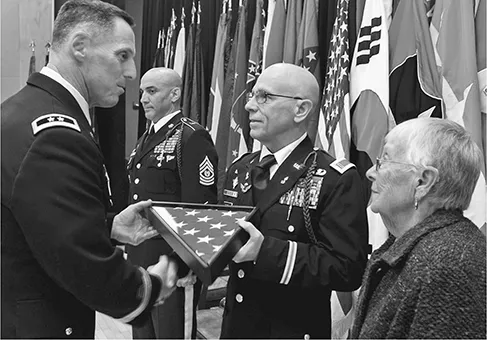
Major General Thomas S. Vandal, commanding general of the 2nd Infantry Division, presents Chief Warrant Officer 5 Ralph E. Rigby an encased flag as a token of appreciation for his 42 years of dedicated service in the U.S. Army during his retirement ceremony at Camp Red Cloud, South Korea. 28 October 2014. (U.S. Army, courtesy 2nd Infantry Division Public Affairs Office)
The second question involves the oft-forgotten dichotomy between national security and individual liberty in American democracy. These two competing ideals have existed in constant tension throughout recent American history, especially since the emergence of the United States as a world superpower after World War II. U.S. policy makers faced difficulty in justifying any form of compulsory military service, primarily because of the value of individual liberty in American democracy. They often succeeded, however, at implementing compulsory military service. Even though the nation’s first peacetime draft commenced in 1940 and continued in varying forms and to differing degrees until 1973 (except for a brief interval in 1947–1948), a generation of Americans has grown up in the absence of compulsory military service. To many Americans, therefore, debates regarding various forms of military service are a foreign concept. My hope is that this book serves as an indicator of the duality of U.S. military service since World War II; it has been roughly equal parts conscript and volunteer.
My central argument in this book is that modern American history witnessed constant debates regarding military service: whether it was to be compulsory or voluntary, who served, and what was the best method of providing personnel for the nation’s defense. This process of defining military service through personnel policy, reconstructing it based on practical, political, and social pressures, and expanding it to eliminate inequities illuminates the role of military service as a litmus test for American values. As a result, military service promoted citizenship, opportunity, and equality. In this sense, military personnel policy served as the nation’s conscience, bringing difficult and uncomfortable questions about American values into sharp relief. While I explore social and political factors throughout, my focus is military personnel policies. My hope is that the book will prove useful for scholars, students, and general readers interested in military service in modern American history.
The book benefits from extensive primary source research, including visits to the National Archives and Records Administration, Library of Congress, George C. Marshall Library, Harry S. Truman Library, Dwight D. Eisenhower Library, Lyndon B. Johnson Library, Gerald R. Ford Library, Richard M. Nixon Library, U.S. Army Heritage and Education Center, U.S. Air Force Historical Research Agency, and University of North Texas Libraries Special Collections. During my research I have assembled, presented, and analyzed a vast array of primary sources including letters, personal papers, memoranda, government reports, congressional hearings, and oral history interviews, as well as historical books, magazines, and newspapers. Throughout this book, I endeavor to present these archival materials directly to the reader, allowing the words and deeds of participants to be front and center. The book also synthesizes existing literature on military service, much of it narrow in either chronological or topical scope. As a historian and security studies scholar, I am indebted to colleagues in a variety of fields. American civil-military relations generally and military personnel policy specifically are truly multidisciplinary fields. They encompass the work of historians, sociologists, political scientists, and psychologists, among others. Eminent scholars such as Samuel P. Huntington, Morris Janowitz, Charles C. Moskos, Andrew J. Bacevich, Beth Bailey, David R. Segal, Eliot A. Cohen, Lawrence J. Korb, and Robert L. Goldich, among many others, have shaped the contours of the field for decades and continue to do so. In this volume, I emulated this multidisciplinary approach. For example, I examined treatments such as Samuel A. Stouffer’s massive G.I. survey during World War II, Leo Bogart’s analysis of Project Clear surveys during the Korean War, and Department of Defense surveys associated with a repeal of the “Don’t Ask, Don’t Tell” (DADT) policy during Operation Enduring Freedom to illuminate insights into U.S. military service that augment political, social, and policy understandings derived from archival research. Such an interdisciplinary approach makes this study useful for historians as well as colleagues in other disciplines interested in the dynamic and contested nature of military service.
I organized the book into ten topical chapters that follow a chronological order, each analyzing a particular debate about military service in recent American history. This first chapter introduces the topic and sets the overall context for the book. Chapter 2, “The Selective Service Idea,” provides an overview of the nation’s first peacetime draft, instituted in 1940; the subsequent unprecedented expansion of the Selective Service System during World War II; and implications of both for military service in the United States. Chapter 3, “A Sound and Democratic Principle,” examines the impact of World War II on military service in the postwar environment. It analyzes the campaign for universal military training (UMT), the ascendance of selective service over UMT as the basis for postwar national security, and initial attempts of military personnel policy to grapple with race after World War II. Chapter 4, “Freedom to Serve,” considers changes in military personnel policy between World War II and the Korean War that dealt primarily with the desegregation of the military. Policy changes during the Truman administration initiated this watershed, and developments on the battlefield several years later during the Korean War cemented it. The chapter explores the Gillem Board, the Fahy Committee, and rapidly burgeoning military personnel requirements of the Korean War. Chapter 5, “Who Serves When Not All Serve?,” analyzes U.S. military service from the Korean War to the early Vietnam War. It studies such important milestones as the Gesell Committee and the Marshall Commission that respectively considered issues of equal opportunity and equity within military service. Chapter 6, “Conscription Is a Tax,” scrutinizes the transition from the draft to the all-volunteer force. This momentous change occurred among heightened mobilization, impassioned debates, and tremendous uncertainty. Its importance cannot be overstated. Chapter 7, “More Than Ever Before,” examines the results of the transition to the AVF, including the consequential increase of women in military service partly spurred by the loss of draftees and a shortage of male volunteers. As the U.S. military discarded the draft, it lost a valuable source of personnel: draftees and draft-motivated volunteers. Reserve components suffered the most. One offset to this conundrum was an expanded role for women in military service. Chapter 8, “To Serve in Silence,” studies early debates surrounding the “Don’t Ask, Don’t Tell” policy in the 1990s and its subsequent repeal in 2010. It considers the relationship between sexual orientation and military service, the debates about it, and changes in military personnel policy that ensued. Chapter 9, “An Uneasy Relationship,” investigates the ascendance of private security contractors and considers political, ethical, and strategic implications of the privatization of force. As military personnel shortages surfaced during Operations Iraqi Freedom and Enduring Freedom in Afghanistan, the utilization of private security contractors dramatically increased, with negative consequences. Chapter 10, “The Nation’s Conscience,” concludes the work with some reflections and questions regarding the AVF today, especially its political, economic, and social repercussions. In it, I argue that military service has played a valuable role in American society since World War II as a litmus test for American values. Discriminatory military personnel policies accentuated problems in a unique way due to the symbolic power of military service. As a result, military service often sparked debates about problems elsewhere in American society and often spurred further change. In this way, military service has often proved the nation’s conscience, for better or worse.
This work is important for four reasons. First, this contribution places current debates regarding the AVF in historical context. Many recent observers have questioned it from a variety of perspectives: political accountability, economic feasibility, social representativeness, and civil-military relations, among others. It is instructive to remember that current conversations regarding military service are only one episode in a much larger historical discussion regarding who serves in the U.S. military and how. Situating the current dialogue in its broader historical context benefits both contemporary and historical examinations of the vital and fluid relationship between military service and democracy in America. Second, it is a useful reminder that U.S. military service since World War II existed under fairly equal periods of compulsory and voluntary constructs. The duality of military service exhibited a unique and intimate tension; national security and individual liberty have crested or receded in relative importance, depending on the historical context. Therefore, it is crucial to remember that the AVF is not the only military service that the United States has utilized in the recent past. Third, this volume outlines the crucial impact of military service on American society, especially in terms of framing debates regarding who serves, why, or why not. The book illuminates how military issues, in this case personnel policy, impacted society. While many of these effects were unintended consequences, they nonetheless had far-reaching results within American democracy. Even though the smoke of battle exhibits more dramatic consequences, military service as an ideal in American society also had effects all its own. Practical, political, and social pressures, as well as the constant need for personnel to fill the ranks of the military, led to perennial debates, contested conceptualizations, and redefinitions of who served. Ultimately, military service functioned as a litmus test of American values and expanded opportunities within military service as a result. Finally, this book demonstrates an irony about American civil-military relations. When the military has been considered in isolation, observers have often correctly characterized it as a traditional and conservative organization that was resistant to change. The unique nature of American civil-military relations, however, has ensured another characteristic. Civilian leaders have often been able to reshape and reform restrictive military personnel policies precisely because of the organizational characteristics of the military: strict civilian control, deference to authority, adherence to orders, and rigid vertical hierarchy. In context, these factors resulted in malleability. When military service reflected values inconsistent with American society, civilian leaders were able to hammer, forge, hone, and polish military personnel policies so that they more accurately reflected the nation’s conscience.
I hope that this book will stimulate broad questions and motivate additional research into U.S. military service and its important relationship to American society. Overall, Military Service and American Democracy contributes extensive historical context to current debates that are central to illuminating the complex relationship between military policy, politics, and American society.
chapter two
the selective service idea
The Selective Service System has as its foundation little groups of neighbors in every one of the 3,070 counties or parishes in the United States. These neighbors in every county make up the 6,443 local boards. On them is placed with an utter and complete confidence the primary responsibility to determine who is to serve the Nation by training for the armed forces, and who is to serve in industry, agriculture and government. All must serve. This decision of where the registrant shall serve is, in wartime, often a question of life or death.1—Lewis B. Hershey, 1942
The United States of America has just successfully concluded a global war which strained her manpower, industry and material resources to the utmost. Every citizen of the democracy was called upon to exertthe utmost effort as part of the National team. That every citizen did so, to the limit of his and her ability,is history. The natural and artificial resources of any nation are dependent upon and re-reflect the vigor of her manpower. An intelligent patriotism is imperative, if the nation is to vindicate the past, maintain the present, and rise to its future destiny.2—Gillem Board, 4 March 1946
During the emergency of World War II, the Selective Service idea of decentralized or local operation was in operation six and one-half years from September 16, 1940 to March 31, 1947. It began with about 15 months of peace, came to maturity during three and three-fourths years of war and terminated 19 months after victory. On the mobilization side, the 6,443 local boards of the System accomplished the stupendous task of registering 50,680,137 men, classifying and reclassifying 36,677,024 who were liable for military service, gave physical examinations to or forwarded for physical examination around 20,000,000 and secured the induction of 10,022,367.3—Lewis B. Hershey, 1948
The year 1939 witnessed the founding of future technology juggernaut Hewlett-Packard, the publication of John Steinbeck’s now classic The Grapes of Wrath, and the first NCAA basketball tournament, where in the finals the University of Oregon Ducks handily defeated the Ohio State Buckeyes by a score of 46 to 33. It also marked the beginning of World War II, a conflict that defined modern American history and propelled the United States toward becoming a world superpower. World War II also fundamentally shaped U.S. military service in the modern era. Beforehand, the nation’s military was quite small; relatively few individuals experienced ...
Table of contents
Front Cover
Title
Copyright
Contents
List of Illustrations
Acknowledgments
List of Abbreviations and Acronyms
1 Camp Red Cloud
2 The Selective Service Idea
3 A Sound and Democratic Principle
4 Freedom to Serve
5 Who Serves When Not All Serve?
6 Conscription Is a Tax
7 More Than Ever Before
8 To Serve in Silence
9 An Uneasy Relationship
10 The Nation’s Conscience
Individuals of Note
Chronology
Note on Sources
About the Author
Notes
Selected Bibliography
Index
Back Cover
Trusted by 375,005 students
Access to over 1.5 million titles for a fair monthly price.
Study more efficiently using our study tools.
Frequently asked questions
Yes, you can cancel anytime from the Subscription tab in your account settings on the Perlego website. Your subscription will stay active until the end of your current billing period. Learn how to cancel your subscription
No, books cannot be downloaded as external files, such as PDFs, for use outside of Perlego. However, you can download books within the Perlego app for offline reading on mobile or tablet. Learn how to download books offline
Perlego offers two plans: Essential and Complete
Essential is ideal for learners and professionals who enjoy exploring a wide range of subjects. Access the Essential Library with 800,000+ trusted titles and best-sellers across business, personal growth, and the humanities. Includes unlimited reading time and Standard Read Aloud voice.
Complete: Perfect for advanced learners and researchers needing full, unrestricted access. Unlock 1.5M+ books across hundreds of subjects, including academic and specialized titles. The Complete Plan also includes advanced features like Premium Read Aloud and Research Assistant.
Both plans are available with monthly, semester, or annual billing cycles.
We are an online textbook subscription service, where you can get access to an entire online library for less than the price of a single book per month. With over 1.5 million books across 990+ topics, we’ve got you covered! Learn about our mission
Look out for the read-aloud symbol on your next book to see if you can listen to it. The read-aloud tool reads text aloud for you, highlighting the text as it is being read. You can pause it, speed it up and slow it down. Learn more about Read Aloud
Yes! You can use the Perlego app on both iOS and Android devices to read anytime, anywhere — even offline. Perfect for commutes or when you’re on the go. Please note we cannot support devices running on iOS 13 and Android 7 or earlier. Learn more about using the app
Yes, you can access Military Service and American Democracy by William A. Taylor in PDF and/or ePUB format, as well as other popular books in History & Military & Maritime History. We have over 1.5 million books available in our catalogue for you to explore.