The surprising story of the Army's efforts to combat PTSD and traumatic brain injury
The wars in Iraq and Afghanistan have taken a tremendous toll on the mental health of our troops. In 2005, then-Senator Barack Obama took to the Senate floor to tell his colleagues that "many of our injured soldiers are returning from Iraq with traumatic brain injury," which doctors were calling the "signature wound" of the Iraq War. Alarming stories of veterans taking their own lives raised a host of vital questions: Why hadn't the military been better prepared to treat post-traumatic stress disorder (PTSD) and traumatic brain injury (TBI)? Why were troops being denied care and sent back to Iraq? Why weren't the Army and the VA doing more to address these issues?
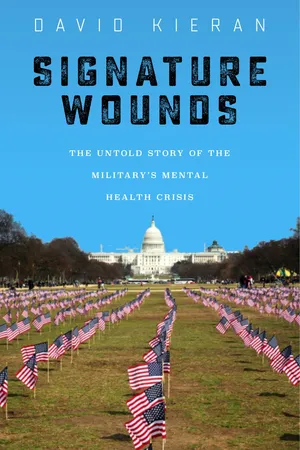
Drawing on previously unreleased documents and oral histories, David Kieran tells the broad and nuanced story of the Army's efforts to understand and address these issues, challenging the popular media view that the Iraq War was mismanaged by a callous military unwilling to address the human toll of the wars. The story of mental health during this war is the story of how different groups—soldiers, veterans and their families, anti-war politicians, researchers and clinicians, and military leaders—approached these issues from different perspectives and with different agendas. It is the story of how the advancement of medical knowledge moves at a different pace than the needs of an Army at war, and it is the story of how medical conditions intersect with larger political questions about militarism and foreign policy.
This book shows how PTSD, TBI, and suicide became the signature wounds of the wars in Iraq and Afghanistan, how they prompted change within the Army itself, and how mental health became a factor in the debates about the impact of these conflicts on US culture.
- 404 pages
- English
- ePUB (mobile friendly)
- Available on iOS & Android
eBook - ePub
About this book
Information
Topic
StoriaSubtopic
Storia nordamericana1
“At the Time People Hadn’t Been Asking Those Sorts of Questions”
Army Mental Health Research between Vietnam and Iraq
On September 3, 1981, twenty-five Army psychiatrists and psychologists settled into a classroom at Fort Sam Houston’s Academy of Health Sciences in San Antonio, Texas, to chart the future of the Army mental health. Most of the seven majors and eight captains there had likely not been in the Army long enough to have served in the war in Vietnam, from which the United States had withdrawn combat forces in 1973.1 The ten colonels and lieutenant colonels there might have been among the relatively few psychiatrists who deployed to Southeast Asia, but even if they had, they likely spent the bulk of their time treating the rampant substance abuse issues that troops faced.2 Very few had significant experience with combat stress, much less post-traumatic stress disorder, a condition that had been included for the first time in the previous year’s revision of the American Psychiatric Association’s Diagnostic and Statistical Manual of Mental Disorders (DSM-III).3
They were all, however, part of an institution still recuperating from the war. In the late 1970s, Americans worried about a “hollow Army” populated by soldiers who were unprepared for modern warfare.4 That summer, the New York Times had reported that the Army was struggling to recruit qualified soldiers and that officers in the U.S. Seventh Army in West Germany were finding that “many of the soldiers coming . . . from training in the United States cannot read or write or do simple arithmetic.”5 For those ill-prepared soldiers, a tour of duty in Germany was hardly an adventure.6 During the day, they trained on outdated equipment; at night, they slept in dilapidated barracks. “In most American prisons,” the Times wrote in May, “such working and living conditions would probably lead to riots.”7 Morale, unsurprisingly, was low.8
These issues mattered greatly. After Vietnam, the U.S. military turned away from fighting insurgencies in the developing world and focused on building capacity to fight a conventional war to counter potential Soviet aggression in Europe, and the Seventh Army was the bellwether of the United States’s ability to meet that challenge.9 For Ronald Reagan, who would oversee a massive increase in defense spending and the recuperation of the U.S. armed forces, that threat was not notional. Telling the West German Bundestag in 1982 that “we’re menaced by a power that openly condemns our values and answers our restraint with a relentless military buildup,” Reagan called for “the presence of well-equipped and trained forces on Europe” and promised “a national effort . . . to make long-overdue improvements in our military posture.”10
This anxiety and these promises benefited the U.S. Army. As Andrew Bacevich explains, “Preparing to fight Russians was . . . the ready-made answer to every question essential to institutional recovery and continual health.”11 Reagan’s increased defense spending led to massive modernization of equipment, and the Army finally figured out how to recruit quality soldiers.12 The Seventh Army alone saw an increase of $239 million in its budget in 1983, and new weapons like the M-1 Abrams tank and the Bradley fighting vehicle poured into its arsenal.13 By the fall of 1984, soldiers in the Seventh Army were boasting of the unit’s morale and capabilities, and simulations showed that the Army was capable of defeating a Soviet advance.14 An entire generation of Army armor and infantry officers—those soldiers who became senior leaders in the twenty-first century—made their careers by demonstrating their ability to lead troops in an imagined battle on the plains of Central Europe.15
So it was in the Army Medical Department, or AMEDD, as well. Medical Department researchers contemplated the likely psychological consequences of the brutal, brief war with the Soviet Union that the larger Army imagined and studied how they could be prevented, mitigated, and treated. Two major schools of thought approached this question. At the Walter Reed Army Institute of Research (WRAIR) outside of Washington, DC, a group of researchers led by Dave Marlowe investigated how soldiers could be made more resilient, focusing on issues including the creation of cohesive units, the impact of strong leadership, and the effects of sleep deprivation. Marlowe was a World War II infantry veteran and Harvard-trained anthropologist who was, one colleague explained, the kind of man who “could spend hours watching you make soup, just to understand something about you.”16 The WRAIR faction thus embraced his anthropological approach and viewed combat stress somewhat differently than a group at the AMEDD Center and School in San Antonio. This was led by A. David Mangelsdorff, a reservist and civilian psychologist for the Army’s Medical School who had taken an interest in how soldiers could become better able to cope with adversity, and Col. James Stokes, an Army psychiatrist. This group focused primarily on combat stress and battle fatigue—a temporary but treatable ailment brought about by the overwhelming violence and chaos of combat—and took a traditional psychomedical approach.17 According to Col. James Martin, who served under Marlowe and led WRAIR’s research unit in Heidelberg, Germany, the two groups were akin to “people with different religious beliefs,” which meant that “there were profound differences in their approach” because “we each had a different view of the elephant.”18
The research conducted by each group and its implementation in the 1980s and 1990s offers an important window into the assumptions and capabilities regarding mental health that the Army brought into the twenty-first century. In particular, the belief that the Army would henceforth fight short, intense conflicts led to a focus on combat stress and battle fatigue that, while clinically valid, did not account for the possibility of protracted irregular warfare that would require individual soldiers to deploy multiple times. Perhaps more important, when the Army did fight in the 1980s and 1990s, the Army persistently struggled to effectively implement its Combat Stress Control program. The combined failure to prepare for lengthy conflicts and to effectively apply the doctrine that it was developing was joined by both a shrinking of the AMEDD’s mental health capabilities after the Cold War and a wider Army culture that disdained mental health care. Despite important successes, like the creation of a combat stress control doctrine and the development of a capacity to survey the well-being of deployed troops, these factors left the AMEDD largely unprepared for, and having to learn in real time how to address, many of the challenges that the twenty-first-century wars would present.
***
Four decades later, it is perhaps difficult to recall the seriousness with which U.S. and NATO military planners accorded a potential Warsaw Pact invasion of Western Europe. In 1981, the RAND Corporation, the most prominent defense think tank, issued a white paper that tallied the number of Soviet divisions in East Germany, Poland, and Czechoslovakia at thirty-one, with another three dozen in the western Soviet Union.19 Although not all of these were combat ready, the balance of forces between the two sides was grim; the Warsaw Pact had more troops, more tanks, more artillery, and more aircraft.20 The report argued that, “in an attack against NATO, 36 divisions could be used in the first wave with the remaining 18 in a second echelon about 72 hours later.”21 That meant that about half a million Soviet troops would pour in Western Europe in an invasion’s first days.22
Given these figures, U.S. Army leaders envisioned a nightmare scenario if war came. At the first Users’ Workshop on Combat Stress, Maj. Raymond Keller told the assembled psychiatrists and psychologists that such a war would be “continuous battle against a seemingly unending stream of fresh enemy forces . . . [that will] provide for no respite from combat” and that “tactical units will be walled off from their support base . . . by conventional and nuclear munitions as well as chemical agents, surrounded and then destroyed in detail.”23 A year later, Maj. William H. Thornton offered a similarly bleak assessment: a Soviet invasion of Central Europe promised “perhaps the most difficult conditions ever faced by American soldiers” and that “there will be neither rest nor respite from the terrors of battle.”24
However terrible they assumed the war would be, though, these presenters also assumed that it would be brief. Assessments of the Soviet doctrine assumed that “the Soviets hope to produce a swift and sudden collapse of NATO, conquer Europe, and sue for peace” and that they would use nuclear weapons at most “after 1–2 days.”25 Another prediction, based on the assumed similarities between the 1973 Arab-Israeli War and a potential war against the Soviet Union, estimated that the conflict would last three or four days.26
These assumptions shaped the Army’s approach to mental health. Army psychologists and psychiatrists maintained that combat inevitably produces psychological changes and that “combat stress reactions” could be either beneficial or debilitating. A solider, for example, might do something uncharacteristically heroic; by the same token, he might suffer a psychotic break.27 Of course, it was combat’s “uncomfortable or performance degrading” effects, which they grouped under the term “battle fatigue,” that worried them.28 Combating and treating battle fatigue thus became Army mental health’s primary preoccupation in the Cold War’s final years. Foremost, the Army sought to minimize battle fatigue casualties. Under the leadership of Gen. Maxwell Thurman, the demanding workaholic leader who as Army Vice Chief of Staff played a defining role in the organization’s post-Vietnam reccuperation, the Army focused on building healthy units—ones in which quality, well-trained soldiers trusted their leaders and colleagues, had stable relationships outside of their units, and felt prepared for their mission.29 Throughout the 1980s, Military Review: The Professional Journal of the US Army, which the Command and General Staff College at Fort Leavenworth published, featured articles with titles like “Soldiers: They Deserve Good Leadership” and “Leadership Challenges on the Nuclear Battlefield.”30 Imagining a battlefield in which the Soviets would deploy tactical nuclear weapons, Lt. Col. Jeffrey L. House, the author of the latter article, argued that “an additional decrease in combat effectiveness can be anticipated from the psychological changes in soldiers” and thus that “we will need leaders who have the thinking skills, moral courage and initiative to form disciplined, cohesive units that are capable of fighting and winning in such an environment.”31 Another piece argued for training under realistically stressful conditions.32 In the field, ensuring that soldiers were well rested was critical because studies showed that soldiers quickly became unable to perform their missions if they got less than four hours of sleep.33 A 1986 “Leader Actions for Battle Fatigue” graphical training aid counseled, “Never waste a chance for sleep.”34
Army researchers knew, however, that battle fatigue was not entirely preventable. Rather, given the war that they expected to fight, one presenter anticipated that over half of the casualties “will be psychiatric casualties within the FIRST 48 hours,” while another predicted that “high stress conditions will prevail and make every soldier susceptible of becoming a psychological casualty,” to the point that “medical facilities will be overwhelmed and engaged forces depleted.”35
These predictions were not, however, as dire as they might have seemed, for the prevailing medical opinion was that the condition was both short-lived and easily treatable. Central to the Army’s treatment protocol were the principles of proximity, immediacy, and expectation, or PIE, which held that battle fatigue casualties stood the best chance of recovery if they were treated promptly near the front lines, rather than being evacuated to the rear, and were told that they would return to their units shortly.36 This concept, of course, was hardly original to the 1980s; it was, as Col. James Stokes, an AMEDD psychiatrist deeply involved in the creation of the Combat Stress Control doctrine, stated, “an understood and well-proved treatment” that had been combat psychiatry’s driving assumption throughout the twentieth century.37 The Army’s protocols in the 1980s thus followed six decades of thinking on matters of military psychiatry. The correct prescription for a soldier “staring into space . . . and unable to carry out his duties or sleep [because] one of his friends had been killed” was “sleep (sedate if necessary). Food and liquid, shower and shave, stress normalcy not illness, and do not evacuate to rear, and return to full duty.”38
The Army sought to communicate this view beyond mental health providers and to train soldiers that battle fatigue was inevitable but not permanently debilitating. In 1985, for example, the First Cavalry Division’s Combat Stress Course was promulgated on the idea that “any ‘normal’ soldier could be expected to become a battle fatigue casualty . . . if exposed to enough stresses in combat,” but the course explained tha...
Table of contents
- Cover
- Title Page
- Copyright Page
- Dedication
- Contents
- Introduction: “These Unseen Wounds Cut Deep”
- 1. “At the Time People Hadn’t Been Asking Those Sorts of Questions”: Army Mental Health Research between Vietnam and Iraq
- 2. “The Psychiatric Cost of Sending Young Men and Women to War”: Mental Health as Crisis and Enigma amid Growing Opposition to the Iraq War
- 3. “Callous Disregard of Veterans’ Rights Is of a Piece with the Administration’s Entire Approach to War”: Veteran Suicide and Anti-war Sentiment
- 4. “The Culture of the Army Wasn’t Ready”: Stigma, Access, and the Politics of Organizational Change
- 5. “Military Families Are Quietly Coming Apart at the Seams”: Managing Family Mental Health and Critiquing the Iraq War
- 6. “The Limited Science of the Brain”: Traumatic Brain Injury and Scientific Uncertainty during Wartime
- 7. “Leaders Can Once Again Determine the Kind of Culture the Army Is Building”: Active-Duty Suicide and Anxiety over Army Culture
- 8. “The Challenge to the VA Is Execution and Implementation”: VA Suicide Prevention in a Moment of Mistrust
- Conclusion: “They Will Start to Bring the . . . Lessons That They Learned Back into Their Communities”
- Acknowledgments
- Notes
- Index
- About the Author
Trusted by 375,005 students
Access to over 1.5 million titles for a fair monthly price.
Study more efficiently using our study tools.
Frequently asked questions
Yes, you can cancel anytime from the Subscription tab in your account settings on the Perlego website. Your subscription will stay active until the end of your current billing period. Learn how to cancel your subscription
No, books cannot be downloaded as external files, such as PDFs, for use outside of Perlego. However, you can download books within the Perlego app for offline reading on mobile or tablet. Learn how to download books offline
Perlego offers two plans: Essential and Complete
- Essential is ideal for learners and professionals who enjoy exploring a wide range of subjects. Access the Essential Library with 800,000+ trusted titles and best-sellers across business, personal growth, and the humanities. Includes unlimited reading time and Standard Read Aloud voice.
- Complete: Perfect for advanced learners and researchers needing full, unrestricted access. Unlock 1.5M+ books across hundreds of subjects, including academic and specialized titles. The Complete Plan also includes advanced features like Premium Read Aloud and Research Assistant.
We are an online textbook subscription service, where you can get access to an entire online library for less than the price of a single book per month. With over 1.5 million books across 990+ topics, we’ve got you covered! Learn about our mission
Look out for the read-aloud symbol on your next book to see if you can listen to it. The read-aloud tool reads text aloud for you, highlighting the text as it is being read. You can pause it, speed it up and slow it down. Learn more about Read Aloud
Yes! You can use the Perlego app on both iOS and Android devices to read anytime, anywhere — even offline. Perfect for commutes or when you’re on the go.
Please note we cannot support devices running on iOS 13 and Android 7 or earlier. Learn more about using the app
Please note we cannot support devices running on iOS 13 and Android 7 or earlier. Learn more about using the app
Yes, you can access Signature Wounds by David Kieran in PDF and/or ePUB format, as well as other popular books in Storia & Storia nordamericana. We have over 1.5 million books available in our catalogue for you to explore.