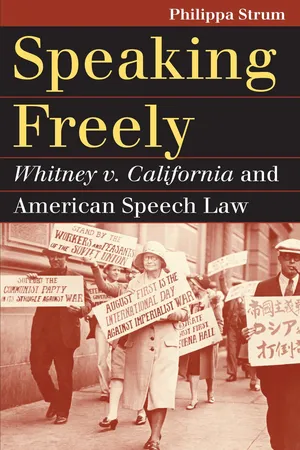
Anita Whitney was a child of wealth and privilege who became a vocal leftist early in the twentieth century, supporting radical labor groups such as the Wobblies and helping to organize the Communist Labor Party. In 1919 she was arrested and charged with violating California's recently passed laws banning any speech or activity intended to change the American political and economic systems. The story of the Supreme Court case that grew out of Whitney’s conviction, told in full in this book, is also the story of how Americans came to enjoy the most liberal speech laws in the world.
In clear and engaging language, noted legal scholar Philippa Strum traces the fateful interactions of Whitney, a descendant of Mayflower Pilgrims; Supreme Court Justice Louis D. Brandeis, a brilliant son of immigrants; the teeming immigrant neighborhoods and left wing labor politics of the early twentieth century; and the lessons some Harvard Law School professors took from World War I-era restrictions on speech. Though the Supreme Court upheld Whitney’s conviction, it included an opinion by Justice Brandeis—joined by Justice Oliver Wendell Holmes, Jr.—that led to a decisive change in the way the Court understood First Amendment free speech protections. Speaking Freely takes us into the discussions behind this dramatic change, as Holmes, Brandeis, Judge Learned Hand, and Harvard Law professors Zechariah Chafee and Felix Frankfurter debate the extent of the First Amendment and the important role of free speech in a democratic society. In Brandeis’s opinion, we see this debate distilled in a statement of the value of free speech and the harm that its suppression does to a democracy, along with reflections on the importance of freedom from government control for the founders and the drafters of the First Amendment.
Through Whitney v. California and its legacy, Speaking Freely shows how the American approach to speech, differing as it does from that of every other country, reflects the nation’s unique history. Nothing less than a primer in the history of free speech rights in the US, the book offers a sobering and timely lesson as fear once more raises the specter of repression.