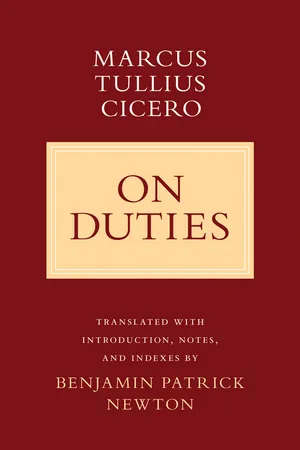
Benjamin Patrick Newton's translation of Cicero's On Duties is the most complete edition of a text that has been considered a source of moral authority throughout classical, medieval, and modern times. Marcus Tullius Cicero was a preeminent Roman statesman, orator, and philosopher who introduced philosophy into Rome, and through Rome, into Christendom and the modern world. On Duties was championed by important thinkers including Thomas Aquinas, Montesquieu, and Voltaire, and it was one of the earliest books printed on the Gutenberg press.The true significance of On Duties lies in its examination of several fundamental problems of political philosophy, the most important being the possible conflict between the honorable and the useful. The honorable encompasses the virtues of human beings, which include justice and concern for the common good. The useful refers to the needs of living beings, which includes certain necessities and concern for private good. Only by understanding the possible conflict between these two sides of human nature, Cicero declares, may we understand our duties to our community and to ourselves. This new edition of On Duties aims to provide readers who cannot read Latin but wish to study the book with a literal yet elegant translation. It features an introduction, outline, footnotes, interpretative essay, glossary, and indexes, making Cicero's thought accessible to a general audience.
- 248 pages
- English
- ePUB (mobile friendly)
- Available on iOS & Android
eBook - ePub
On Duties
About this book
Information
On Duties
Book One
(1) Marcus, my son,1 you have been studying with Cratippus2 for a year now, and this in Athens, so that you ought to abound with the precepts and principles of philosophy owing to the supreme authority of both that learned individual and city, the one able to enrich you with knowledge, the other, precedents. Nevertheless, as I myself3 have always joined things Latin with Greek for my own utility, not only in philosophy, but even in the practice of speaking, I suppose you ought to do the same, so that you might be equally skilled in both languages. Indeed, in this respect it seems to me that I have been of great assistance to our countrymen,4 so that not only those ignorant of Greek, but even the learned think they have received some assistance in learning and judging. (2) Accordingly, you will continue to learn from the preeminent philosopher of our age, and learn for as long as you wish—that is, for as long as you wish and are satisfied with your progress.5 But in reading my works, which do not differ much from the Peripatetics, since we both wish to be Socratics and Platonists, you must use your own judgment about these very things; I will not interfere. Still, your speech in Latin will surely improve by reading them. Nor in truth do I wish to be thought to have said this arrogantly. For in knowledge of philosophy, I yield to many; but in the peculiar domain of the orator, in speaking fittingly, lucidly, and distinctly, since I have consumed a lifetime in that pursuit, if I appropriate this honor for myself, I merely seem to claim it by my own right.
(3) And so I greatly urge you, my dear Cicero, to eagerly read not only my speeches, but also my philosophical books, which now are nearly equal to them.6 While there is greater force in the former, the latter’s equable and temperate kind of speech must also be cultivated. In fact, I see that so far it happens that none of the Greeks have labored in both kinds, pursuing both that forensic kind of speaking and this quieter kind of discussion. Unless by chance Demetrius of Phalerum7 may be counted among their number: a subtle discussant, a subdued, yet pleasant orator, as you may recognize in a pupil of Theophrastus.8 But how much I have accomplished in both is for others to judge; certainly, I have pursued both. (4) Indeed, I believe that Plato,9 had he wished to try the forensic kind of speaking, could have spoken most gravely and copiously; and Demosthenes,10 had he retained and wished to proclaim those things that he had learned from Plato, could have done so distinctly and nobly. I judge the same thing about Aristotle11 and Isocrates,12 each of whom, delighted by his own pursuit, despised the other.
But since I have decided to write something to you at this time, much more at another, I especially wish to begin with what is most fitting for your age and my authority.13 For although in philosophy there are many weighty and useful things discussed carefully and copiously by philosophers, the most widely accessible seem to be those concerning appropriate actions and the precepts derived from them.14 In fact, there is no part of life, neither public nor private, neither forensic nor domestic, neither in how you conduct yourself nor in your dealings with others, when is it possible to be free from appropriate action. It is in cultivating this that all honorableness in life lies, and in neglecting it, disgrace.
(5) To be sure, this is a common query of all philosophers. For who is there who does not hand down precepts on appropriate action and dares to call himself a philosopher? But there are some teachers15 who overturn all appropriate action in what they propose as the ends of good and bad things.16 He who holds the highest good to have no connection to virtue, and measures it by his own advantage, not by honorableness, this person, if he is to remain consistent and not now and then succumb to the goodness of his nature, cannot cultivate friendship, justice, or liberality. In truth, he can in no way be courageous if he judges pain the greatest ill, nor temperate if he holds pleasure the greatest good.17 And although these things are so manifestly obvious that the matter does not warrant discussion, nevertheless, they have been discussed by me elsewhere.18 (6) These teachers, then, if they wish to be consistent, can in no way speak about appropriate action. Nor can any precepts on appropriate action be handed down that are enduring, stable, and in accordance with nature except by those who say that either solely19 or especially for its own sake20 is honorableness desired. Thus advice on appropriate action is peculiar to the Stoics,21 Academics,22 and Peripatetics,23 since the sentiments of Aristo,24 Pyrrho,25 and Erillus26 have long since been rejected. Still, had they left some choice between things, they would have been within their own right to discuss appropriate action, as there might have been a way to approach its discovery. Therefore, at this time and especially in this query, I chiefly follow the Stoics, not as an expounder, but, as I am accustomed, drawing from their wells as much and in whatever way as in my judgment and discernment shall seem best.27
(7) Since, then, the entire discussion is to be about appropriate action, I approve of first defining what appropriate action is. That this was omitted by Panaetius28 amazes me; for all instruction that relies on reason about any subject ought to proceed from a definition, so that we may understand what it is that is being discussed.
Every query into appropriate action is twofold. The first pertains to the end of good things; the second rests upon precepts, the use of which can shape all aspects of life.29 Examples of the former kind include whether all act...
Table of contents
- Acknowledgments
- Introduction
- Outline
- ON DUTIES
- Interpretative Essay
- Glossary
- Selected Bibliography
- Index of Names and Places
- Index of Subjects
Trusted by 375,005 students
Access to over 1.5 million titles for a fair monthly price.
Study more efficiently using our study tools.
Frequently asked questions
Yes, you can cancel anytime from the Subscription tab in your account settings on the Perlego website. Your subscription will stay active until the end of your current billing period. Learn how to cancel your subscription
No, books cannot be downloaded as external files, such as PDFs, for use outside of Perlego. However, you can download books within the Perlego app for offline reading on mobile or tablet. Learn how to download books offline
Perlego offers two plans: Essential and Complete
- Essential is ideal for learners and professionals who enjoy exploring a wide range of subjects. Access the Essential Library with 800,000+ trusted titles and best-sellers across business, personal growth, and the humanities. Includes unlimited reading time and Standard Read Aloud voice.
- Complete: Perfect for advanced learners and researchers needing full, unrestricted access. Unlock 1.5M+ books across hundreds of subjects, including academic and specialized titles. The Complete Plan also includes advanced features like Premium Read Aloud and Research Assistant.
We are an online textbook subscription service, where you can get access to an entire online library for less than the price of a single book per month. With over 1.5 million books across 990+ topics, we’ve got you covered! Learn about our mission
Look out for the read-aloud symbol on your next book to see if you can listen to it. The read-aloud tool reads text aloud for you, highlighting the text as it is being read. You can pause it, speed it up and slow it down. Learn more about Read Aloud
Yes! You can use the Perlego app on both iOS and Android devices to read anytime, anywhere — even offline. Perfect for commutes or when you’re on the go.
Please note we cannot support devices running on iOS 13 and Android 7 or earlier. Learn more about using the app
Please note we cannot support devices running on iOS 13 and Android 7 or earlier. Learn more about using the app
Yes, you can access On Duties by Marcus Tullius Cicero, Benjamin Patrick Newton in PDF and/or ePUB format, as well as other popular books in History & Roman Ancient History. We have over 1.5 million books available in our catalogue for you to explore.