The Life of George Washington
eBook - ePub

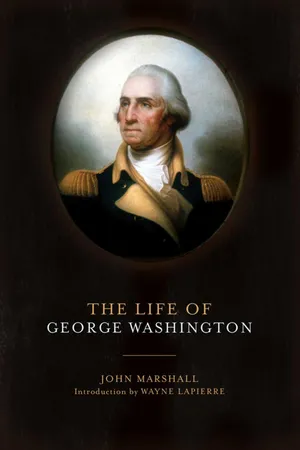
The Life of George Washington

  1. 384 pages
  2. English
  3. ePUB (mobile friendly)
  4. Available on iOS & Android
eBook - ePub

The Life of George Washington

About this book

America's first president has captivated our interest for more than two centuries, but no biographer of George Washington knew him with the authenticity, intimacy, and depth of understanding as John Marshall exhibited in his book The Life of George Washington.This biography was begun in 1799 following Washington's death, when chief justice Marshall was granted by Washington's surviving family full access to all of his records, papers, and personal archives. The result is a story not only of George Washington, but also of America's founding.Marshall covers every major event in Washington's personal life and in his public role as a founding father, including his childhood, his early career, his resignation as colonel, his marriage to Martha, the invasion of Canada, early negotiations with the British, the crossing of the Delaware, the state of Washington's army during the Revolution, the treason of Benedict Arnold, the official announcement of the election of Washington as president, meetings of Congress, a threatened war with France toward the end of his life, his death, and his character.Marshall's biography of George Washington was first published in Philadelphia in five volumes, between 1804 and 1807, and today, copies of this first edition are among the rarest and most expensive of antiquarian books. This edition is an exact facsimile of the one-volume edition published in 1857, also a very rare book, which was specially edited and abridged for a general audience by John Marshall himself.Skyhorse Publishing, along with our Arcade, Good Books, Sports Publishing, and Yucca imprints, is proud to publish a broad range of biographies, autobiographies, and memoirs. Our list includes biographies on well-known historical figures like Benjamin Franklin, Nelson Mandela, and Alexander Graham Bell, as well as villains from history, such as Heinrich Himmler, John Wayne Gacy, and O. J. Simpson. We have also published survivor stories of World War II, memoirs about overcoming adversity, first-hand tales of adventure, and much more. While not every title we publish becomes a New York Times bestseller or a national bestseller, we are committed to books on subjects that are sometimes overlooked and to authors whose work might not otherwise find a home.
Frequently asked questions

Yes, you can cancel anytime from the Subscription tab in your account settings on the Perlego website. Your subscription will stay active until the end of your current billing period. Learn how to cancel your subscription.
At the moment all of our mobile-responsive ePub books are available to download via the app. Most of our PDFs are also available to download and we're working on making the final remaining ones downloadable now. Learn more here.
Perlego offers two plans: Essential and Complete
  • Essential is ideal for learners and professionals who enjoy exploring a wide range of subjects. Access the Essential Library with 800,000+ trusted titles and best-sellers across business, personal growth, and the humanities. Includes unlimited reading time and Standard Read Aloud voice.
  • Complete: Perfect for advanced learners and researchers needing full, unrestricted access. Unlock 1.4M+ books across hundreds of subjects, including academic and specialized titles. The Complete Plan also includes advanced features like Premium Read Aloud and Research Assistant.
Both plans are available with monthly, semester, or annual billing cycles.
We are an online textbook subscription service, where you can get access to an entire online library for less than the price of a single book per month. With over 1 million books across 1000+ topics, we’ve got you covered! Learn more here.
Look out for the read-aloud symbol on your next book to see if you can listen to it. The read-aloud tool reads text aloud for you, highlighting the text as it is being read. You can pause it, speed it up and slow it down. Learn more here.
Yes! You can use the Perlego app on both iOS or Android devices to read anytime, anywhere — even offline. Perfect for commutes or when you’re on the go.
Please note we cannot support devices running on iOS 13 and Android 7 or earlier. Learn more about using the app.
Yes, you can access The Life of George Washington by John Marshall in PDF and/or ePUB format, as well as other popular books in History & Historical Biographies. We have over one million books available in our catalogue for you to explore.

Information

Publisher
Skyhorse
Year
2015
Print ISBN
9781629145013
eBook ISBN
9781632200273

MARSHALL’S

LIFE OF WASHINGTON.

Image

CHAPTER I.

Birth of George Washington.—His mission to the French General of Ohio.—Is appointed Lieutenant of a Colonial regiment.—Surprises Monsieur Junonville.—Capitulation of fort Necessity.—Appointed Aid-de-camp to General Braddock.—Defeat and death of that General.—Appointed to the command of a Colonial regiment.—Distress of the frontiers.—Expedition against fort Du QuĂȘsne.—Defeat of Major Grant.—Fort Du QuĂȘsne evacuated.—Colonel Washington resigns.—His marriage.
GEORGE WASHINGTON, the third son of Augustine Washington, was born on the 22d of February, 1732, near the banks of the Potomac, in the county of Westmoreland, in Virginia. His father married Miss Butler, who died in 1728; leaving two sons, Lawrence and Augustine. In 1730, he intermarried with Miss Mary Ball, by whom he had four sons, George, John, Samuel, and Charles; and one daughter, Betty, who intermarried with Colonel Fielding Lewis, of Fredericksburg.
His great-grand-father, John Washington, had emigrated from the north of England, about the year 1657, and settled on the place where Mr. Washington was born.
At the age of ten years, he lost his father. An affectionate mother continued to impress those principles of religion and virtue on his tender mind, which constituted the solid basis of a character that was maintained throughout all the trying vicissitudes of an eventful life. But his education was limited to subjects strictly useful, not even extending to foreign languages.
At the age of eighteen, he was appointed a surveyor in the western part of the northern neck of Virginia; and, in that office, acquired such information respecting vacant lands, and formed those opinions concerning their future value, which afterwards contributed greatly to the increase of his fortune.
Those powerful attractions, which the profession of arms presents to young and ardent minds, possessed their full influence over Mr. Washington. Stimulated by the enthusiasm of military genius, to take part in the war in which Great Britain was then engaged, he pressed earnestly to enter into the navy, and, at the age of fifteen, a midshipman’s warrant was obtained for him. The interference of a timid and affectionate mother deferred the commencement, and changed the course, of his military career. Four years afterwards, when the militia were to be trained for actual service, he was appointed one of the Adjutants-General of Virginia, with the rank of Major. The duties annexed to this office soon yielded to others of a more interesting character.
France was beginning to develop the vast plan of connecting her extensive dominions in America, by uniting Canada to Louisiana. The troops of that nation had taken possession of a tract of country claimed by Virginia, and had commenced a line of posts, to be extended from the Lakes to the Ohio. The attention of Mr. Dinwiddie, Lieutenant-Governor of that province, was attracted to these supposed encroachments, and he deemed it his duty to demand in the name of the King, his master, that they should be suspended.
This mission was toilsome and hazardous. The Envoy would be under the necessity of passing through an extensive and almost unexplored wilderness, inhabited by fierce savages, who were either hostile to the English or of doubtful attachment. While the dangers and fatigues of this service deterred others from undertaking it, they seem to have possessed attractions for Mr. Washington, and he engaged in it with alacrity.
On receiving his commission, he proceeded to Wills’ creek, then the extreme frontier settlement of the English, where guides were engaged to conduct him over the Alleghany mountains. At the mouth of Turtle creek he was informed that the French general was dead, and that the army had retired into winter quarters. Pursuing his route, he examined the country through which he passed, with a military eye, and selected the confluence of the Monongahela and Alleghany rivers, the place where fort Du QuĂȘsne was afterwards erected by the French, as a position which it would be advisable to seize and fortify immediately.
After employing a few days in securing the fidelity of the Indians in that neighborhood, he ascended the Alleghany to a French fort where he was received by the commanding officer on the Ohio, to whom he delivered the letter of Mr. Dinwiddie, and from whom he received an answer with which he returned to Williamsburg. The exertions made by Mr. Washington on this mission, the perseverance with which he surmounted the difficulties he encountered, and the judgment displayed in his conduct toward the Indians, raised him in the public opinion as well as in that of the Lieutenant-Governor. His journal, drawn up for the inspection of Mr. Davidson, was published, and impressed his countrymen with very favorable sentiments of his understanding and fortitude.
As the answer from the commandant of the French forces on the Ohio indicated no disposition to withdraw from that country it was deemed necessary to make some preparations to maintain the rights asserted over it by the British crown; and the Assembly of Virginia authorized the Executive to raise a regiment for that purpose, to consist of three hundred men. The command of this regiment was given to Mr. Fry, and Major Washington was appointed Lieutenant-Colonel. Anxious to be engaged in active service, he obtained permission, about the beginning of April, to advance with two companies to the Great Meadows, in the Alleghany Mountains. Soon after his arrival at that place, he was informed by some friendly Indians that the French, having dispersed a party of workmen employed by the Ohio Company to erect a fort on the south-eastern branch of the Ohio, were engaged in completing a fortification at the confluence of the Alleghany and Monongahela rivers; a detachment from which place was then on its march towards his camp. Though open hostilities had not yet commenced, the country was considered as invaded; and several circumstances were related, confirming the opinion that this party was approaching with hostile views. Confident of this, Lieutenant-Colonel Washington resolved to anticipate them. Proceeding under the guidance of Indians, through a dark and rainy night, to the French encampment, he completely surrounded it; and, at daybreak, his troops fired and rushed upon the party, which immediately surrendered. One man only escaped capture; and Monsieur Junonville alone, the commanding officer, was killed.
While the regiment was on its march to join the detachment advanced in front, the command devolved on Lieutenant-Colonel Washington by the death of Colonel Fry. Soon after its arrival, it was reinforced by two independent companies of regulars. After erecting a small stockade at the Great Meadows, Colonel Washington commenced his march towards fort Du QuĂȘsne, with the intention of dislodging the French from that place. He had not proceeded more than thirty miles, when he was informed by some friendly Indians, that the French, “as numerous as the pigeons in the wood,” were advancing rapidly to meet him. Among those who brought this information was a trusty chief, only two days from the post on the Ohio, who had observed the arrival of a considerable reinforcement at that place, and had heard them express the intention of marching immediately to attack the English, with a corps composed of eight hundred French and four hundred Indians.
The ground occupied by Colonel Washington was not adapted to military purposes. A road leading through other defiles in the mountains, would enable the French to pass into his rear, intercept his supplies, and starve him into a surrender, or fight him with a superiority of three to one.
In this hazardous situation, a council of war unanimously advised a retreat to the fort at the Great Meadows, now termed fort Necessity; where the two roads united, and where the face of the country was such as not to permit an enemy to pass him unperceived. At that place he intended to await the arrival of reinforcements.
In pursuance of this advice, Colonel Washington returned to fort Necessity, and began a ditch around the stockade. Before it was completed, the French and Indians, computed at fifteen hundred men, commanded by Monsieur de Villier, appeared before the fort, and commenced a furious attack upon it. They were received with great intrepidity by the Americans, who fought partly within the stockade, and partly in the surrounding ditch, which was nearly filled with mud and water. Colonel Washington continued the whole day on the outside of the fort, encouraging the soldiers by his countenance and example. The assailants fought under cover of the trees and high grass with which the country abounds. The action continued from ten in the morning until dark, when Monsieur de Villier demanded a parley, and offered terms of capitulation These were rejected, but, in the course of the night, articles were signed, by which the fort was surrendered on condition that the garrison should be allowed the honors of war—should be permitted to retain their arms and baggage, and be suffered to march unmolested into the inhabited parts of Virginia.
The loss of the Americans in this affair is not ascertained. A return made after arriving at Wills’ creek, states the killed and wounded of the Virginia regiment at fifty-eight. The loss sustained by the two independent companies was not reported. That of the assailants was supposed to be more considerable.
Great credit was given to Colonel Washington by his countrymen, for the courage displayed in this engagement. The legislature evinced its satisfaction with the conduct of the whole party, by passing a vote of thanks to him and the officers under his command; and by giving three hundred pistoles to be distributed among the soldiers engaged in the action.
The regiment returned to Winchester to be recruited; soon after which it was joined by a few companies from North Carolina and Maryland. On the arrival of this reinforcement, the Lieutenant-Governor, with the advice of council, unmindful of the condition and number of the troops, ordered them to march immediately over the Alleghany mountains; and to expel the French from for Du QuĂȘsne, or to build one in its vicinity.
The little army in Virginia, now under the command of Colonel Innes of North Carolina, did not exceed half the number of the enemy, and was neither provided with the means of moving, nor with supplies for a winter campaign. With as little consideration, directions had been given for the immediate completion of the regiment, without furnishing a shilling for the recruiting service—Colonel Washington remonstrated against these orders, but prepared to execute them. The assembly however, having risen without making any provision for the farther prosecution of the war, this wild expedition was abandoned, and the Virginia regiment was reduced to independent companies.
In the course of the winter, orders were received “for settling the rank of his majesty’s forces then serving with the provinces in North America.” These orders directed “that all officers commissioned by the king, or by his general in North America, should-take rank of all officers commissioned by the governors of the respective provinces: and further, that the general and field officers of the provincial troops should have no rank when serving with the general and field officers commissioned by the crown; but that all captains, and other inferior officers of the royal troops, should take rank over provincial officers of the same grade, having senior commissions.”
Still professing his attachment to a military life, Colonel Washington could not submit to hold the station assigned to him, and retired indignantly from a service in which he was degraded by loss of rank.
His eldest brother had lately died and left him Mount Vernon,—a considerable estate on the Potomac. To this delightful spot he withdrew, resolving to devote his future life to private pursuits. This resolution was not long maintained.
General Braddock, being informed of his merit, and his knowledge of the country which was to become the theatre of action, gratified his desire to make one campaign under an officer supposed to possess some knowledge of war, by inviting him to enter his family as a volunteer aid-de-camp.
Having accepted this invitation, he joined the commander-in-chief on his march from Alexandria to Wills’ creek. The army was detained at that place until the 12th of June, by the difficulty of procuring wagons, horses, and provisions. Colonel Washington, impatient under these delays, suggested the propriety of using pack-horses instead of wagons: though the commander-in-chief at first rejected this advice, its propriety, soon after the commencement of the march, became too obvious to be longer neglected.
On the third day after the army had moved from Wills’ creek, Colonel Washington was seized with a violent fever which disabled him from riding on horseback, and was conveyed in a covered wagon. Being still privately consulted by the commander-in-chief, he urged that officer strenuously to leave his heavy artillery and baggage with the rear division, and with a chosen body of troops, and some pieces of light artillery, to press forward to fort Du QuĂȘsne. In support of this advice, he stated that the French were then weak on the Ohio, but daily expected reinforcements. These could not arrive during the drought existing at that time, because the river Le BƓuf, on which their supplies must be brought to Virginia, was too low for the purpose. A rapid movement might enable him to carry the place before the arrival of the expected aid. But should the army remain united, the delays attending its march were such, that rain sufficient to raise the waters might be expected, and the whole force of the French might be collected for their reception;—a circumstance which would render the success of the expedition doubtful.
This advice according with the temper of the commander-in-chief, it was determined in a council of war that twelve hundred select men, to be commanded by the General in person, should advance with the utmost expedition against fort Du QuĂȘsne. Colonel Dunbar was to remain with the residue of the regular troops and all the heavy baggage.
Colonel Washington was obliged to stop at the Great Crossings of the Yohogany—the physician having declared that his life would be endangered by continuing with the army. He obeyed the positive orders of the General to remain at this place; having first received a promise that means should be used to bring him up with the army before it reached fort Du QuĂȘsne.
The day before the action of the Monongahela, he joined the General in a covered wagon; and, though weak, entered on the duties of his station.
In a short time after the action had commenced, Colonel Washington was the only aid remaining alive and unwounded. The whole duty of carrying the orders of the commander-in-chief, in an engagement with marksmen who selected officers, especially those on horseback, devolved on him. Two horses were killed under him, and four balls passed through his coat. To the astonishment of ail he escaped unhurt, while every other officer on horseback was killed or wounded. “I expected every moment,’ says an eye-witness, “to see him fall. His duty and situation exposed him to every danger. Nothing but the superintending care of Providence could have saved him from the fate of all around him.”
At length, after an action of nearly three hours, General Braddock, under whom three horses had been killed, received a mortal wound, and his troops fled in great disorder. Every effort to rally them was ineffectual until they had crossed the Monongahela. The General was brought off in a tumbril, by Colonel Washington, Captain Stewart of the guards, and his servant. The defeated detachment retreated to the rear division of the army, where General Braddock expired. The military stores not necessary for immediate use were destroyed, and Colonel Dunbar marched the remaining European troops to Philadelphia.
Colonel Washington, who was much dissatisfied with the conduct of the regular soldiers in this action, bestowed great praise on the provincials. “The Virginia companies,” he said in a letter to the Lieutenant-Governor, “fought like men and died like soldiers. Captain Peronny and all his officers, down to a corporal, were killed. Captain Poulson had almost as hard a fate, for only one of his escaped.”
Colonel Washington had long been the favorite soldier of Virginia, and his reputation grew with every occasion for exertion. His conduct in this battle had been universally extolled, and the common opinion of his countrymen was, that, had his advice been pursued, the disaster had been avoided.
The Assembly, which was in session when intelligence of this defeat and of the abandonment of the province by Colonel Dunbar was received, immediately determined to raise a regiment for the defence of the colony, the command of which was given to Colonel Washington, who was also designated in his commission as the commander-in-chief of all the forces raised and to be raised in Virginia. The uncommon privilege of naming his field officers was added to this honorable manifestation of public confidence.
After making the necessary arrangements for the recruiting service, and visiting the posts on the frontier, he set out for the sea, of government; but was overtaken by an express carrying the intelligence that a large number of French and Indians, divided into several parties, had broken up the frontier settlements; were murdering and capturing men, women, and children; burning their houses, and destroying their crops. The troops stationed among them for their protection were unequal to that duty, and instead of affording aid to the inhabitants, were blocked up in their forts.
Colonel Washington hastened back to Winchester, but his efforts to raise the militia were unavailing. Instead of assembling in arms and obtaining safety by...

Table of contents

  1. Front Cover
  2. Title Page
  3. Copyright Page
  4. Introduction
  5. Contents
  6. Chapter I.
  7. Chapter II.
  8. Chapter III
  9. Chapter IV.
  10. Chapter V.
  11. Chapter VI.
  12. Chapter VII.
  13. Chapter VIII.
  14. Chapter IX.
  15. Chapter X.
  16. Chapter XI.
  17. Chapter XII.
  18. Chapter XIII.
  19. Chapter XIV.
  20. Chapter XV.
  21. Chapter XVI.
  22. Chapter XVII.
  23. Chapter XVIII.
  24. Chapter XIX.
  25. Chapter XX.
  26. Chapter XXI.
  27. Chapter XXII.
  28. Chapter XXIII.
  29. Chapter XXIV.
  30. Chapter XXV.
  31. Chapter XXVI.
  32. Chapter XXVII.
  33. Chapter XXVIII.
  34. Chapter XXIX.
  35. Chapter XXX.
  36. Chapter XXXI.
  37. Chapter XXXII.
  38. Chapter XXXIII.