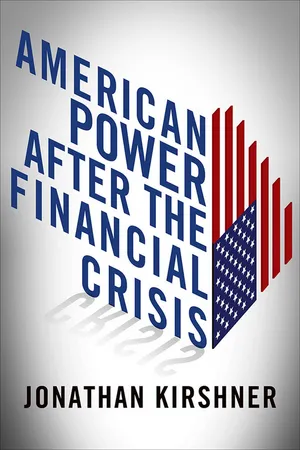
The global financial crisis of 2007–2008 was both an economic catastrophe and a watershed event in world politics. In American Power after the Financial Crisis, Jonathan Kirshner explains how the crisis altered the international balance of power, affecting the patterns and pulse of world politics. The crisis, Kirshner argues, brought about an end to what he identifies as the "second postwar American order" because it undermined the legitimacy of the economic ideas that underpinned that order—especially those that encouraged and even insisted upon uninhibited financial deregulation. The crisis also accelerated two existing trends: the relative erosion of the power and political influence of the United States and the increased political influence of other states, most notably, but not exclusively, China.Looking ahead, Kirshner anticipates a "New Heterogeneity" in thinking about how best to manage domestic and international money and finance. These divergences—such as varying assessments of and reactions to newly visible vulnerabilities in the American economy and changing attitudes about the long-term appeal of the dollar—will offer a bold challenge to the United States and its essentially unchanged disposition toward financial policy and regulation. This New Heterogeneity will contribute to greater discord among nations about how best to manage the global economy. A provocative look at how the 2007–2008 economic collapse diminished U.S. dominance in world politics, American Power after the Financial Crisis suggests that the most significant and lasting impact of the crisis and the Great Recession will be the inability of the United States to enforce its political and economic priorities on an increasingly recalcitrant world.
- 232 pages
- English
- ePUB (mobile friendly)
- Available on iOS & Android
eBook - ePub
American Power after the Financial Crisis
About this book
Information
Topic
EconomíaSubtopic
Historia de Norteamérica1
THE GLOBAL FINANCIAL CRISIS AS WORLD POLITICS
The 2007–8 global financial crisis was a watershed event. With the flicker of screens—overlooking Times Square, on desktop computers, on hand-held devices—trillions of dollars of wealth simply drained away, as if pouring uncontrollably down city streets and vanishing into the sewer. The US financial economy threatened to implode and, with it, the entire global economy. The world was on the brink of another Great Depression. Luckily, the real economic wreckage wrought by the 2007-8 crisis, the worst economic downturn since the Great Depression, wasn’t quite as bad as that earlier catastrophe. Nevertheless, after the initial dust settled, people found themselves, if not in a different country, surely in a different economy, which was dispiritingly different from the one that came before. And recovery from the crisis, within societies and from country to country, was wildly uneven: relatively swift for some, virtually nonexistent for others.
Not surprisingly, such a seismic event has attracted considerable attention. Many books have been written about the crisis, the overwhelming majority of which have focused on (very important) issues such as its economic causes, prospects for reforms designed to prevent its recurrence, and political factors attendant on each of those questions. Less attention has been paid to issues of international relations, although there has been a renewed interest in global economic governance. But with regard to how the crisis might have altered the international balance of power or affected the patterns and rhythms of world politics into the future, there are still more questions than answers—in fact, many such questions have yet to be asked. This book is about the international political meaning and implications of the global financial crisis of 2007–8, with an emphasis on its consequences for American power and influence in world politics.
The global financial crisis was an important inflection point in the trajectory of international relations, and it will be increasingly recognized as such as the events themselves recede into history. This proposition is built on three principal, interrelated contentions, each of which is contestable—indeed, much of the stuffing of this book is designed to establish, provide context for, and support these core claims. First, the crisis brought about an end to what I call the “second US postwar order” (which I define as the period of US hegemony after the Cold War and associated with its project of domestic and international financial deregulation), due to a collapse of its international legitimacy. Second, for both material and ideational reasons (tangible economic factors and changing ideas about economic choices, policies, and orientations), the crisis has accelerated two pre-existing underlying international political trends. One is the relative erosion of the power, and political influence, of the United States in general, and the other is the increased political influence of other states, including China. Third, the crisis has brought about what I term “a new heterogeneity of thinking” with regard to ideas about how to best manage domestic and international money and finance. These divergences are largely the result of new thinking outside of the United States, which will increasingly contrast with the essentially unchanged attitudes suggested by American policy preferences in these areas. This “new heterogeneity” will matter greatly because it will contribute to increased discord between countries with regard to efforts designed to manage and supervise the international economy. This will, in turn, inhibit the prospects for solutions to problems that will inevitably arise, and for consequential reform of existing international institutions.
This book is concerned with international politics, and that is where its novel contributions will be found. But to understand the material and ideational factors that will contribute to the consequences for international relations that I anticipate, it is necessary to work through a good bit of history and political economy. Nothing comes from nowhere, and revisiting the Great Depression, the evolution of post–World War II US hegemony, and the Asian financial crisis of 1997–98 are crucial for my argument and for the implications of the current crisis. Similarly, reviewing how the US economy came to be dominated by its financial sector, competing narratives about the causes of the global financial crisis, and the role of the dollar as an international currency are essential parts of the story. This chapter offers a general overview of the book and previews how these elements link together.
Learning and Unlearning the Lessons of the Past
Although this is a book concerned with the present, informed by the recent past and with an eye on the future, I begin with a discussion of the Great Depression, which is an indispensable excursion for understanding and contextualizing contemporary events. The interwar catastrophe mattered for the reasons that history typically matters—it is rich with lessons for the present, and it was a formative experience that shaped public policy for generations. Although history does not repeat itself, the course of the Great Depression, the general contours of its origins and initial eruption of its crises, offers a hauntingly similar echo of the panic of 2007–8 and its causes. This time around, the result was “the great recession,” which, as the most debilitating economic distress since World War II, is not to be underestimated. But the more recent distress nevertheless pales in comparison with the economic ruin of the Depression, which in turn contributed importantly to the bloodbath of World War II.
The more recent crisis did not spiral out of control, partly because the lessons of the Depression had been learned. It is easy to criticize the policy choices made by various governments; especially after economies pulled back from the brink of the chasm and politicians, no longer desperately scrambling to jointly put out the fire, resumed their normal business of fighting over who should pay for the repairs. But, crucially, those initial choices, to increase spending and assure adequate liquidity, did put the fire out. In the interwar years, by well-remembered contrast, austerity measures (cutting government spending), monetary orthodoxy (especially adherence to the gold standard), and collectively disastrous protectionism shoved the teetering world economy into the abyss.1
Learning—that is, avoiding the blunders of the past—was only part of the story. Luck also played a role, then and now. In the interwar years, economic squabbles were quick to escalate, leaving everyone worse off, partly because security dilemmas between states were especially intense. World War I had traumatized Europe; it shattered the political equilibrium on the Continent and generated more international problems than it resolved. Suspicious and insecure, countries were wary of cooperating with potentially dangerous rivals. In contrast, despite the fact that rivalry is a perennial attribute of international politics, the recent crisis took place in a great power security environment that was markedly benign. None of the major participants hesitated to reach for a policy lever out of fear of an imminent military threat.
But lessons can be unlearned—in fact, unlearning the lessons of the Depression contributed mightily to the global financial crisis—and there are no guarantees that the international security environment will remain benign indefinitely. All the more reason to touch base with the interwar years, which also serve as a useful proving ground to illustrate general attributes about the politics of international money and finance that remain acutely relevant for contemporary politics. One lesson is that because of the unique nature of money—it has value solely because people think it has value—ideas about money, good or bad, right or wrong, have a powerful, formative effect on the choices made by states, and for whether a given macroeconomic policy will succeed or fail.2 Not far behind ideas, it should be added, is power. As Robert Gilpin observed, “every international monetary regime rests on a particular political order.”3 Yet another issue is that international monetary relations have a tendency to be acrimonious because the policy choices of one country tend to put pressure on the politically sensitive interest and exchange rate policies of other countries, often unintentionally. Finally, the interwar years also offer yet another warning with contemporary relevance: international macroeconomic disarray can affect politics within states, helping to empower, as it did in Germany and Japan in the 1930s, political factions that reject cooperative foreign and economic policies.
The lessons of the Great Depression provided the essential building blocks of the financial order constructed after World War II. Although the period from that time to the global financial crisis is commonly described as a period of continuous American hegemony, in fact the United States orchestrated two distinct international orders, each based on a distinct economic ideology and geopolitical vision. The first order, associated with the remarkable quarter-century of economic growth that took place from 1948 to 1973, bore the stamp of John Maynard Keynes’s intellectual influence and was shaped by the Cold War confrontation between the United States and the Soviet Union. (The United States was eager to help its military allies recover from the war, and, in the context of an ideological struggle with the USSR, was tolerant of experimentation with varieties of capitalism.) But these lessons were unlearned in the 1980s and 1990s, setting the stage for the more recent crisis. The “second US postwar order,” which I date from 1994 (as the foreign policy agenda of the Clinton administration took shape) through 2007, was based on an anti-Keynesian economic philosophy, “market fundamentalism,” and coincided with the emergence of unrivaled US unipolarity. Market fundamentalism holds that unfettered markets—even financial markets—left to govern themselves always know best and that there is one singularly correct cocktail of economic policies that applies to all countries in all circumstances.
This was, of course, the antithesis of the first US postwar order. The architects of that earlier system built institutions such as the International Monetary Fund (IMF) and the General Agreement on Tariffs and Trade (GATT), which were designed to respond to the lessons of the Depression and the war.4 They wished to encourage countries to cooperate, to embrace the international economy, and to respond to the incentives presented by market forces. But, at the same time, they understood that unmediated market forces would generate considerable economic distress and create pressures for unwelcome and inappropriate uniformity across countries’ economic policies. The system was thus designed for international institutions and domestic policies to insulate economies from the bitter winds inherent in unbridled capitalism. John Ruggie dubbed this “the compromise of embedded liberalism,” an understanding that market forces would be embraced, but mediated, so that individual states could pursue domestic political and social agendas as each saw fit.5
Keynes was the key intellectual influence on the embedded liberal order, and he understood that it was macroeconomic pressures, and especially short-term capital flows, that presented the gravest danger to these arrangements. Envisioning the postwar monetary order, he emphasized repeatedly that various forms of capital controls, especially those designed to inhibit destabilizing short-run speculation, were essential.6 Given the balance of power between the United States and Britain at the time, it is not surprising that the IMF, as established, was closer to the American vision. But capital controls were a basic part of its charter.7
Keynes’s ideas and the practice of postwar economic policy known as Keynesianism were two different things. The latter, enormously influential in the 1950s and 1960s, got fairly well beaten up first by academic critiques and then by the stagflation of the 1970s. In the 1980s, Keynesianism was declared dead, and a new approach, new classical macroeconomics, was on the rise. Central to this approach was rational expectations theory and its fellow traveler, the efficient markets hypothesis. Rational expectations holds that all actors in the economy share an understanding of the same singularly correct model of how the economy works, and make choices in the context of known risk.8 The efficient markets hypothesis, which holds that current market prices accurately express the intrinsic underlying value of an asset, flows naturally from this position, as those prices reflect the sum of the collective wisdom of savvy market actors.
By the 1990s, what was rebranded as a “new Keynesianism” heralded the convergence of mainstream macroeconomic theory, as both new classicals and new Keynesians embraced rational expectations. But despite the labels, this was even further removed from Keynes, who did not hold “rational expectations.” Rather, Keynes held that investors more often grope in the dark than calculate risk: they can’t assign precise probabilities to all potential eventualities because too many factors are unknowable. In a world of uncertainty, financial markets are susceptible to—even driven by—what he called “animal spirits,” unpredictable shifts in the attitudes and emotions of investors. It should be noted that one need not be a Keynesian to reject rational expectations theory. Both his most famous intellectual opponent, Friedrich von Hayek, and one of the most prominent and passionate anti-Keynesians of his day, Frank Knight, offered analyses that were fundamentally at odds with rational expectations. (Knight saw uncertainty, which he distinguished from risk, as the very engine of capitalism.)9 But the modern mainstream academic convergence around rational expectations—a theory that, it turned out, did not perform well when subjected to empirical tests—provided an important intellectual foundation of the second US postwar order. If financial markets always know best, they need not be regulated. They can, as Federal Reserve chairman Alan Greenspan insisted, supervise themselves. This idea meshed well with political developments—the increasing influence of the growing financial sector and rise of the “New Democrats,” who, in the 1990s, cultivated Wall Street as a source of support—that provided the impetus behind the second US order.
Joining forces with the Republican Party, the Clinton White House orchestrated the deregulation of the US financial sector. The repeal of the Glass-Steagall Act (the Depression-era law designed to create protective firewalls within the financial sector) and the passage of the Commodity Futures Modernization Act (which prevented the regulation of derivatives, including the credit-default swaps that would play a central role in the 2007–8 financial crisis) completed the transition of the US economy from one in which the financial sector was regulated and supervised and whose role in the economy was subordinate (that is, it allocated capital in the service of real economic activity) to an economy dominated by its financial sector. Finance became the largest, the fastest growing, and the most profitable sector in the American economy. And it wielded enormous political influence.
The Second US Postwar Order and the Origins of the Global Financial Crisis
The American financial liberalization project had an international component. In partnership with its new benefactors on Wall Street, officials of the Clinton administration fanned the globe encouraging states to liberalize and to open their domestic markets to US banks, insurance companies, and brokerage houses. From the US perspective all good things went together: financial deregulation was assumed to be good public policy; it was clearly good for US firms, and financial globalization suggested an international environment in which US political power and influence would be relatively enhanced.
Not coincidentally, in the mid-1990s the IMF was reaching similar conclusions about the appeal of unfettered capital. In a radical and bold power play, the Fund moved to abandon its original charter with a planned revision of its articles of agreement. Instead of accommodating capital controls, the IMF would now force its members to renounce their use as a condition of membership in the Fund. But this was not simply a question of the Fund falling into step with American commands: ideas mattered. The US government, the financia...
Table of contents
- Preface
- 1. The Global Financial Crisis as World Politics
- 2. Learning from the Great Depression
- 3. From the First to the Second US Postwar Order
- 4. Seeds of Discord: The Asian Financial Crisis
- 5. The New American Model and the Financial Crisis
- 6. The Crisis and World Politics
- 7. The Crisis and the International Balance of Power
- 8. Conclusions, Expectations, and Speculations
- Notes
Trusted by 375,005 students
Access to over 1.5 million titles for a fair monthly price.
Study more efficiently using our study tools.
Frequently asked questions
Yes, you can cancel anytime from the Subscription tab in your account settings on the Perlego website. Your subscription will stay active until the end of your current billing period. Learn how to cancel your subscription
No, books cannot be downloaded as external files, such as PDFs, for use outside of Perlego. However, you can download books within the Perlego app for offline reading on mobile or tablet. Learn how to download books offline
Perlego offers two plans: Essential and Complete
- Essential is ideal for learners and professionals who enjoy exploring a wide range of subjects. Access the Essential Library with 800,000+ trusted titles and best-sellers across business, personal growth, and the humanities. Includes unlimited reading time and Standard Read Aloud voice.
- Complete: Perfect for advanced learners and researchers needing full, unrestricted access. Unlock 1.5M+ books across hundreds of subjects, including academic and specialized titles. The Complete Plan also includes advanced features like Premium Read Aloud and Research Assistant.
We are an online textbook subscription service, where you can get access to an entire online library for less than the price of a single book per month. With over 1.5 million books across 990+ topics, we’ve got you covered! Learn about our mission
Look out for the read-aloud symbol on your next book to see if you can listen to it. The read-aloud tool reads text aloud for you, highlighting the text as it is being read. You can pause it, speed it up and slow it down. Learn more about Read Aloud
Yes! You can use the Perlego app on both iOS and Android devices to read anytime, anywhere — even offline. Perfect for commutes or when you’re on the go.
Please note we cannot support devices running on iOS 13 and Android 7 or earlier. Learn more about using the app
Please note we cannot support devices running on iOS 13 and Android 7 or earlier. Learn more about using the app
Yes, you can access American Power after the Financial Crisis by Jonathan Kirshner in PDF and/or ePUB format, as well as other popular books in Economía & Historia de Norteamérica. We have over 1.5 million books available in our catalogue for you to explore.