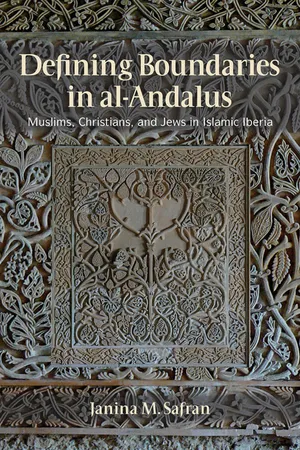
Al-Andalus, the Arabic name for the medieval Islamic state in Iberia, endured for over 750 years following the Arab and Berber conquest of Hispania in 711. While the popular perception of al-Andalus is that of a land of religious tolerance and cultural cooperation, the fact is that we know relatively little about how Muslims governed Christians and Jews in al-Andalus and about social relations among Muslims, Christians, and Jews. In Defining Boundaries in al-Andalus, Janina M. Safran takes a close look at the structure and practice of Muslim political and legal-religious authority and offers a rare look at intercommunal life in Iberia during the first three centuries of Islamic rule.Safran makes creative use of a body of evidence that until now has gone largely untapped by historians—the writings and opinions of Andalusi and Maghribi jurists during the Umayyad dynasty. These sources enable her to bring to life a society undergoing dramatic transformation. Obvious differences between conquerors and conquered and Muslims and non-Muslims became blurred over time by transculturation, intermarriage, and conversion. Safran examines ample evidence of intimate contact between individuals of different religious communities and of legal-juridical accommodation to develop an argument about how legal-religious authorities interpreted the social contract between the Muslim regime and the Christian and Jewish populations. Providing a variety of examples of boundary-testing and negotiation and bringing judges, jurists, and their legal opinions and texts into the narrative of Andalusi history, Safran deepens our understanding of the politics of Umayyad rule, makes Islamic law tangibly social, and renders intercommunal relations vividly personal.
eBook - ePub
Defining Boundaries in al-Andalus
Muslims, Christians, and Jews in Islamic Iberia
- 272 pages
- English
- ePUB (mobile friendly)
- Available on iOS & Android
eBook - ePub
About this book
Trusted by 375,005 students
Access to over 1.5 million titles for a fair monthly price.
Study more efficiently using our study tools.
Information
CHAPTER 1
The Structuring of Umayyad Rule
O Assemby of Muslims! You know that here on this peninsula you are surrounded by all kinds of polytheists and all types of heretics who seek to sow dissension among you and break your community apart, to cause you to forsake your religion, dishonor your women, and undermine the call of your Prophet.
The words of warning in this chapter’s epigraph close a speech Mundhir ibn Saʿid al-Balluti delivered in praise of the caliph ʿAbd al-Rahman III al-Nasir li-Din Allah during a reception for an embassy from Constantinople held in the palace (qaṣr) of Cordoba in 949. The thrust of the speech was to remind the audience of the obedience they owed to the Commander of the Faithful as defender of the community and of the faith, recalling the trials they had endured before the triumph of his rule and invoking God’s command: “O you who believe! Obey God, and obey the Messenger, and those charged with authority among you” (Qur’an 4:59).1
This chapter is about those in authority among the Muslims in al-Andalus and their roles in defining insiders and defending them from outsiders. It provides a historical overview of the structuring of Umayyad authority and the relationship among rulers, judges, and jurists in al-Andalus from the time of the conquest to the consolidation of the caliphate. The discussion hardly refers to the non-Muslim population, reflecting the Umayyads’ construction of their authority (and the perspective of the sources), although the subject of conversion does come up in the discussion of social differentiation and its political significance. This chapter is intended to provide a political context for understanding social and legal boundary making and boundary testing in al-Andalus and at the same time to elucidate the part played by the ruling dynasty in defining political community. A few specific examples will demonstrate how Umayyad concern for boundaries in a variety of situations and interactions was part of a process of enacting authority and building consensus.
The principles of Umayyad dynastic legitimacy and authority and the regime’s exercise of power, as well as the contestation of Umayyad legitimacy and authority and resistance to the regime’s power, structured Umayyad rule and the political culture of al-Andalus in the ninth and tenth centuries. The Umayyad rulers of al-Andalus defined political community most basically in terms of recognition of and submission to their authority. The amir or (after 929) the caliph became overtly involved in the definition of boundaries when the words and actions of individuals seemed to challenge his authority.2 In the Umayyads’ construction of their authority, a political renegade was, by definition, a religious deviant, and a Muslim recognized to have strayed from the straight path became, by definition, someone in defiance of the authority of the legitimate Muslim ruler. What constituted crossing the line in certain politically sensitive situations could be a matter of judgment involving consultation and collaboration with the fuqahāʾ (jurists) who were also engaged with, and at times politically invested in, determining who was an insider and who was an outsider. In such cases the ruler might not only consult but coerce the fuqaha’; he occasionally chastised some individuals for their opinions and exonerated others.
The Umayyads of al-Andalus, like their Syrian dynastic forebears, affirmed the principle of dynastic authority and based their legitimacy on that of the third rightly guided caliph, ʿUthman. The general terms in which they expressed their legitimacy were similar: the dynasty and the ruler are favored by God and meritorious; the ruler ensures the integrity of the faith and the community by upholding justice and promoting the proper practice of religion; he defends the community against infidels and undertakes the expansion of the domain of Islam.3 Descriptions of the personal merits of the Umayyad amirs in Andalusi texts exemplify their legitimacy. For example, Ibn al-Qutiyya writes of Hisham (r. 788–796) that he looked after his “flock” with kindness, justice, and humility. He visited the sick and attended funerals. He collected the zakāt (the legal alms tax) but reduced the ʿushūr (tithes) and was frugal in his expenditure on dress and horse.4 Of his successor al-Hakam I (r. 796–822) Ibn al-Qutiyya begins by reporting that he (too) conducted himself well with his subjects. He was selective in his appointments (he appointed the best judge in al-Andalus, Muhammad ibn Bashir) and governed as a believer, waging jihad repeatedly.5 We can discern how the Andalusi Umayyad amirs enacted their right to rule in accounts of their actions (leading military campaigns against the “unbelievers,” suppressing revolts and uprisings that threatened the security of the community and the faith, choosing the best men to serve as commanders and ministers, appointing upright and learned judges, and undertaking public works). We have more abundant evidence for the caliphal period of how the Umayyad rulers and their officials, courtiers, and subordinates articulated, displayed, demonstrated, and enacted the principles of their legitimacy. The evidence describes a much more hierarchical and complex regime than in the days of Amir Hisham. Ibn al-Qutiyya describes the amir as modest in his public presentation, and his involvement in the lives of others was personal and unmediated; in contrast, Ibn Hayyan’s history of the reign of al-Hakam II describes a formal style of rule where highly developed protocol governed interactions between ruler and ruled.6
The sources for the caliphal era show how principles of Umayyad legitimacy were repeatedly expressed to particular audiences, on specific occasions, and in a variety of forms. The context for the expression of legitimacy could be circumscribed, as in communications between officials, or directed toward the Muslim community as a whole, as in sermons and announcements read in the mosques. The participation of officials in service to the ruler in formal ceremonies to celebrate the annual feasts, to welcome embassies, or to recognize the submission of former rebels enacted the recognition of the legitimacy of the ruler, affirmed bonds of loyalty, and articulated the hierarchy of the ruling elite. Expressions of legitimacy, authority, and power were both verbal and symbolic and could take the form of public display, as in the expansion and embellishment of the congregational mosque in Cordoba and the construction of the palace city of Madinat al-Zahra’, the military cavalcades that left for campaign and returned to the capital triumphant, and the display of the crucified corpses of individuals declared to be enemies of the faith and the community. Symbolic acts and constructions were often accompanied by explicating texts, such as proclamations, inscriptions, and commemorative poetry. Poetry extolled the achievements of Umayyad rulers and celebrated their merits, and dynastic histories provided the narrative of dynastic rule, demonstrating continuity and confirming Umayyad dedication to the principles of legitimate rule. Everyone who participated in Umayyad rule in the caliphal period understood and communicated in an idiom that affirmed the principles of Umayyad caliphal legitimacy.
The Umayyads of al-Andalus exercised their power and authority through individuals bound to them by ties of kinship, patronage, and alliance. As the administration expanded and the regime became more hierarchical, the network of individuals who exercised power on behalf of the ruler became more extensive, and individuals in certain positions wielded significant power; competition between individuals and families involved great stakes. The ruler’s ability to govern depended on his political astuteness, the loyalty he cultivated to his person, family, and office, and his command of the military. The centralization of Umayyad power, characterized by the development of a standing army and the expansion of the administration, began in the ninth century but derailed with the rebellions that broke out in the second half of the century, which were directed, in part, against the centralizing process. This period is dominated in all historical accounts of Umayyad rule in al-Andalus by the rebellion of ʿUmar ibn Hafsun and his sons and the threat it posed to the regime. ʿAbd al-Rahman III’s accession in 912 and his success in extinguishing the rebellion in 928 mark a significant turning point in the history of Umayyad rule and Umayyad political culture. The Umayyad regime was put to the test by the rebellions; reasserting its sovereignty reinforced both territorial and political boundaries in ways that involved changes in the practice of rule and the conception and integration of the political community.
The discussion of Ibn Hafsun’s rebellion is at the center of an analytic time frame that extends from the foundation of Umayyad rule to the consolidation of the Umayyad caliphate. This chapter thus begins with a brief historical narrative of the reign of the amirs to sketch the development of the regime and the organization of power, devoting attention to relations between the ruler and the fuqaha’. This leads to a discussion of accusations of blasphemy and zandaqa (secret apostasy) and the instantiation of the amirs’ authority in legal-religious (as well as political) boundary making. These cases against Muslims were more or less contemporary with charges of blasphemy and apostasy brought against a number of individual Christians in the 850s who defiantly challenged the terms of coexistence between Muslims and Christians (the Christian martyrs to be discussed later). In all these cases the amirs were involved in the judicial process, in consultation with the qāḍī (judge), and in the execution of judgment. The ruler performed and enacted his authority on these occasions before those subject to his rule in the circle of the court and beyond to the street. The final determination by the ruler that an individual was a blasphemer or a secret apostate secured the accused’s public ...
Table of contents
- Acknowledgments
- Introduction
- 1. The Structuring of Umayyad Rule
- 2. Society in Transition
- 3. Between Enemies and Friends
- 4. Borders and Boundaries
- Conclusion
- Bibliography
Frequently asked questions
Yes, you can cancel anytime from the Subscription tab in your account settings on the Perlego website. Your subscription will stay active until the end of your current billing period. Learn how to cancel your subscription
No, books cannot be downloaded as external files, such as PDFs, for use outside of Perlego. However, you can download books within the Perlego app for offline reading on mobile or tablet. Learn how to download books offline
Perlego offers two plans: Essential and Complete
- Essential is ideal for learners and professionals who enjoy exploring a wide range of subjects. Access the Essential Library with 800,000+ trusted titles and best-sellers across business, personal growth, and the humanities. Includes unlimited reading time and Standard Read Aloud voice.
- Complete: Perfect for advanced learners and researchers needing full, unrestricted access. Unlock 1.5M+ books across hundreds of subjects, including academic and specialized titles. The Complete Plan also includes advanced features like Premium Read Aloud and Research Assistant.
We are an online textbook subscription service, where you can get access to an entire online library for less than the price of a single book per month. With over 1.5 million books across 990+ topics, we’ve got you covered! Learn about our mission
Look out for the read-aloud symbol on your next book to see if you can listen to it. The read-aloud tool reads text aloud for you, highlighting the text as it is being read. You can pause it, speed it up and slow it down. Learn more about Read Aloud
Yes! You can use the Perlego app on both iOS and Android devices to read anytime, anywhere — even offline. Perfect for commutes or when you’re on the go.
Please note we cannot support devices running on iOS 13 and Android 7 or earlier. Learn more about using the app
Please note we cannot support devices running on iOS 13 and Android 7 or earlier. Learn more about using the app
Yes, you can access Defining Boundaries in al-Andalus by Janina M. Safran in PDF and/or ePUB format, as well as other popular books in History & European Medieval History. We have over 1.5 million books available in our catalogue for you to explore.