With unprecedented subtlety, compassion and richness of detail, Susan Porter Benson takes readers into the budgets and the lives of working-class families in the United States between the two world wars. Focusing on families from regions across America and of differing races and ethnicities, she argues that working-class families of the time were not on the verge of entering the middle class and embracing mass culture. Rather, she contends that during the interwar period such families lived in a context of scarcity and limited resources, not plenty. Their consumption, Benson argues, revolved around hard choices about basic needs and provided therapeutic satisfactions only secondarily, if at all.Household Accounts is rich with details Benson gathered from previously untapped sources, particularly interviews with women wage earners conducted by field agents of the Women's Bureau of the Department of Labor. She provides a vivid picture of a working-class culture of family consumption: how working-class families negotiated funds; how they made qualitative decisions about what they wanted; how they determined financial strategies and individual goals; and how, in short, families made ends meet during this period. Topics usually central to the histories of consumption—he development of mass consumer culture, the hegemony of middle-class versions of consumption, and the expanded offerings of the marketplace—contributed to but did not control the lives of working-class people. Ultimately, Household Accounts seriously calls into question the usual narrative of a rising and inclusive tide of twentieth-century consumption.
eBook - ePub
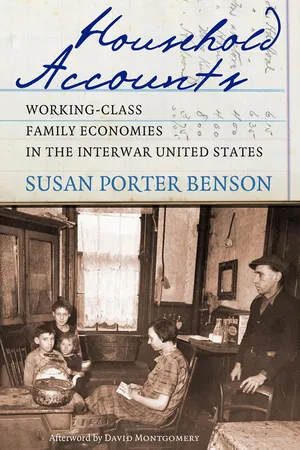
Household Accounts
Working-Class Family Economies in the Interwar United States
- 256 pages
- English
- ePUB (mobile friendly)
- Available on iOS & Android
eBook - ePub
About this book
Information
1
“Living on the Margin”
Working-Class Marriages and Family Survival Strategies
“Walter Benda gave every cent he earned to his wife,” a settlement worker observed approvingly, “and she planned carefully.”1 Scholars such as Susan Levine, Kathy Peiss, Elizabeth Ewen, and Judith Smith have called our attention to the diligence and creativity of working-class women who, like Mrs. Benda, acted as managers of the family fund; they have also acknowledged the limitations of that role, especially when errant husbands proved less cooperative than Walter Benda.2 In fact, I would go even farther than these historians in revising the essentialized picture of the working-class woman as consumer. The power of this trope depends upon an assumption of a gendered division of labor within the family: male as breadwinner, woman as householder. My sources—primarily the raw data from Women’s Bureau investigations of wage-earning women and their families as well as case studies of working-class families experiencing unemployment during the 1920s and 1930s—suggest a much less intense gendering of the work of keeping a family going. On the one hand, the male breadwinning ethic was far from universal among these families. Men’s attitudes toward breadwinning ranged from total acceptance of the ethic through various reservations about it to outright rejection of the responsibility involved. Moreover, many women expressed a sense of obligation to earn some or all of the family support, even when husbands and/or fathers were present and earning. Similarly, some women expressed a preference for wage earning over household work, and some men saw housework as part of their responsibility. One of the most intriguing things about this material is the degree to which the Women’s Bureau agents and the social-science writers did not “take in” these gender transgressions; they invariably ignored this evidence or wrote it out of their analyses. Ironically, this gives me greater confidence in making my arguments: it makes me think that the evidence they did record, even though it clashed with their world-views, is relatively trustworthy and probably only a portion of similar evidence that otherwise-oriented investigators might have recorded.
The marriages discussed in these documents differ distinctly from the companionate marriage that was so widely touted during the 1920s and 1930s.3 I reject the use of the term “companionate” for these evolving relationships for two reasons. First, companionate marriage implies a strong and primarily romantic bond between marriage partners. In working-class relationships the affect was more of a generalized familial one based on loyalty and obligation rather than on romance or sexual attraction; indeed, family economic survival competed with and often obscured such feelings entirely. In this respect, their closest analog would be European peasant marriages in which there was a clear sense of shared responsibility and joint enterprise.4 Second, I find the term inappropriate because companionate marriages rested on a continuing, even rigidifying, set of segregated sex roles that cast husbands as breadwinners/producers and wives as consumers. My argument about working-class partnership marriages is that they involved a definite, if subtle and partial, breaching of the boundaries between gender roles.
The fluidity that marked partnership marriages did not originate, let me emphasize, for the sake of working toward some abstract notion of gender equality; rather, the material conditions of life in the North American working class reinforced some people’s willingness to improvise and to put other goals above the maintenance of dominant-culture gender constructions. Working-class people made adjustments in one aspect of their lives in order to relieve pressures and lighten burdens in other aspects of their lives. They sought to make the best of lives lived amidst great difficulty, lives conditioned by circumstances not of their own choosing. These relationships should not be idealized, just as whatever degree of gender equity there may have been in slave marriages should not be idealized. In the latter case, any gender equity came at the price of being owned as chattel property; in the case I examine, gender equity was inseparable from want and scarcity. And in both cases, adherence to dominant-culture notions of gender did not take top priority. The families discussed in this chapter negotiated a difficult set of circumstances in which expectations were not clear. Their family economies, like the ones studied by Jeanne Boydston in the early republic, were mixed economies that drew on a rich array of resources: wage-earning outside the home, wage-earning within the home, and cash-replacement activities.5 Many of the families in this study were also immigrant ones, as was the majority of the working class at the end of World War I.6 As such, they confronted both a new culture in the United States and a particularly volatile phase of capitalism.
The Travails of the Male Breadwinner
Because men, by and large, could earn higher wages than women, access to a man’s wage was crucial to the family economy. The ideal husband earned steady wages and contributed his entire pay envelope to the family fund.7 Many men spoke of their desire to earn a family wage, such as the Italian man who labored on the streets of Philadelphia and told the Women’s Bureau agent, “I want the wage and my wife stay home”8 That we should not take such demands for a family wage simply as expressions of male dominance is suggested by the comment of another Philadelphian, a Polish textile worker, who wished “things were so that men could earn enough to support a family then women would not have to slave at two jobs”9 A man might want a family wage for many reasons, but this one alerts us to the fact that he might do so more out of respect for his wife’s hard labor than out of a sense of his male privilege.
Even for those men inclined by culture and temperament to be model breadwinners, the labor market provided as many barriers as opportunities. The drive for efficiency and productivity if anything intensified during the 1920s and 1930s, assuring that insecurity and instability of employment would remain a part of men’s occupational experience. The skilled men in my sources were thrown out of steady work by technology—printers and skilled carpenters seem to have been especially hard hit—one woman said of her father, “a cooper hasn’t a job these days.”10 Semi-skilled and unskilled men found continued or increased periodic and seasonal unemployment. “Slack work”—short hours—was a repeated complaint, and workers who had long been accustomed to seasonal, usually winter, unemployment, found those seasons of unemployment stretching, as did one Italian-born laborer, from a month to three months to five months. One month of unemployment, or even three months, might be planned and saved for, but seven months of a laborer’s wages couldn’t stretch to cover a year.11 In early 1933, a Washington, DC, carpenter voiced the spiraling frustrations of dealing with low pay and slack work: “One lone salary is not enough to buy a home and support a family on.…It was hard when I had steady work and now I just can’t do it.”12 The Immigrant Woman and Her Job, a 1930 report of the Women’s Bureau, offered a sobering view of the difficulties of male breadwinning. Of the 468 Philadelphia married women interviewed for the study, 218 accounted for their work by mentioning their husbands’ difficulties in breadwinning. Nearly four out of five referred to their husbands’ difficulties in securing regular work, either because their trades were seasonal, because they could not get full weeks’ work, or because they were outright unemployed. Irregular work loomed much larger in these women’s worldviews than did wage rates: just over a quarter mentioned the low wages earned by their husbands.13
Like everyone, men had multiple identities, and these identities had the potential to conflict. Union men, for example, asserted their manly independence through union activity, but that could cut two ways. If successful, it assured more regular work and higher wages, and hence enhanced a man’s ability to fulfill the breadwinner role; if unsuccessful, however, it might seriously hamper his breadwinner potential. A Philadelphia taxi driver, for example, enjoyed six years of steady employment at substantial wages but then joined his fellow taxi drivers in a strike for higher wages. The strike was broken and he was blacklisted for eighteen months.14 A Memphis man was out of work for almost a year after the 1922 railroad shopmen’s strike.15 One African American man found himself singled out from his new union fellows: when white employers realized that they would have to pay him the same wage as the union’s white carpenters, they fired him and hired whites only.16 An Oklahoma man left town during the railroad shop strike of 1922, ostensibly to find work elsewhere, but he made no contact with his wife until a week before the Women’s Bureau agent visited her in May 1924.17 Changing the point of view, then, changes the meanings of union militancy. From the vantage point of the family economy, it might mean lowered wages because of various types of discrimination, or it might be the knife that cuts the last ties of a lackadaisical breadwinner to the family. Manly assertion in a union was a gamble under the best of circumstances, but during the 1920s, at least, it does not seem to have been a winning gamble for the family.18
Other men rebelled against the breadwinning ethic itself instead of against their employers. The transition from bachelorhood to serious wage earning seems to have been difficult. A Women’s Bureau agent noted that one recently married man “seemed to lack ambition or force”;19 another, whose wife said that he “never likes his job—always has trouble,” took a more adversarial stance toward the labor market.20 A Providence woman told the Women’s Bureau agent that she had married but her husband never worked and after three months she left him; she apparently counted herself fortunate that he did not demand money from her.21 The bachelor subculture of which George Chauncey has written so eloquently, which countered the male breadwinner role with its “alternative definition of manliness that was predicated on a rejection of family obligations,” may have continued to exert a social and erotic pull on urban men even after marriage. Reluctance about breadwinning would have been an eloquent way to perpetuate the bachelor subculture’s scorn for “the domesticating and moralizing influence of women.”22 Perhaps the best explanation for this phenomenon came from a southern textile worker to whom the writers of the classic history Like a Family gave the pseudonym of Ruth Elliot. Musing on her husband’s irresponsibility and alcoholic binges, she speculated that at the root of it was the fact that
When we were married we wasn’t anything but kids. We had three babies, one right after the other, and somebody had to settle down. And it had to be me. Jesse never did settle down. It was too much of a load on him. If he had stayed single and hadn’t saddled himself with a wife and kids, he would have sowed his wild oats and gotten over it. Instead, he planted a permanent garden, and it was disastrous. I know that now. But that didn’t help me out a bit then.23
In some cases, which we might term the fair-weather breadwinners, men rebelled against the rigors of the labor market and industrial work discipline. One man, a Greek-born shoe-factory worker, took being out of work quite casually, determining “that he is doing his best and is in no way responsible, and that if he isn’t able to support his family, some one else will have to do it.…He searches for jobs, but is not adaptable.”24 A fired streetcar man refused to work “unless he can find an easy job and so far hasn’t been able to find one.”25 Other men balked at the punishing demands of the jobs available to them; a St. Joseph man who could only secure jobs that required “heavy carrying” finally decided that “he had rather stay home than break his back.”26 Wives often saw such behavior as shiftlessness, as did the ex-wife of an African American Chicagoan who claimed that her husband “would not work walking up and down the streets all day smoking cigarettes so I put him out.”27 But in a class by himself was the St. Paul man who would work at the Armour Company only during the summer when he could play on the company baseball team and steadfastly refused the company’s offer of a steady job at twenty-seven dollars a week.28 Seen only in the light of the men’s work lives, these examples might appear to suggest evidence of assertive manliness—as a rebellion against industrial time discipline and bad working conditions or as assertive union activity. From the point of view of the family, though, they meant insufficiency and uncertainty.
For less obvious reasons, other men physically distanced themselves from the breadwinning role. Desertion was a common response to a range of problematic job situations. Men who sought to escape unemployment sometimes abandoned their families. One New York woman defended her husband to a social worker: “It’s only when he can’t get work he runs away!”29 Jobs that were disliked also encouraged desertion. Transference probably fashioned impatience with a less-than-ideal home life out of what began as an unwillingness to put up with a difficult work situation: one deserter had changed jobs “frequently, [being] easily dissatisfied, not a steady worker even when work is available,”30 another “gets very excitable and quits.”31 The arbitrary authority structures in working-class jobs provided one source of irritation; a paper mill worker quit his job because the “boss kick too much,”32 while a machinist had a habit of quitting jobs after conflict with his foremen.33 In such cases, desertion was not always an all-or-nothing matter. Some returned “from time to time” but failed to take responsibility for family support,34 whereas others secured jobs elsewhere and se...
Table of contents
- A Note on Household Accounts and Its Preparation
- Acknowledgments
- Introduction
- 1. “Living on the Margin”
- 2. “Cooperative Conflict”
- 3. The Mutuality of Shared Spaces
- 4. What Goes ’Round, Comes ’Round
- 5. The Family Economy in the Marketplace
- Class, Gender, and Reciprocity
- Notes
Trusted by 375,005 students
Access to over 1.5 million titles for a fair monthly price.
Study more efficiently using our study tools.
Frequently asked questions
Yes, you can cancel anytime from the Subscription tab in your account settings on the Perlego website. Your subscription will stay active until the end of your current billing period. Learn how to cancel your subscription
No, books cannot be downloaded as external files, such as PDFs, for use outside of Perlego. However, you can download books within the Perlego app for offline reading on mobile or tablet. Learn how to download books offline
Perlego offers two plans: Essential and Complete
- Essential is ideal for learners and professionals who enjoy exploring a wide range of subjects. Access the Essential Library with 800,000+ trusted titles and best-sellers across business, personal growth, and the humanities. Includes unlimited reading time and Standard Read Aloud voice.
- Complete: Perfect for advanced learners and researchers needing full, unrestricted access. Unlock 1.5M+ books across hundreds of subjects, including academic and specialized titles. The Complete Plan also includes advanced features like Premium Read Aloud and Research Assistant.
We are an online textbook subscription service, where you can get access to an entire online library for less than the price of a single book per month. With over 1.5 million books across 990+ topics, we’ve got you covered! Learn about our mission
Look out for the read-aloud symbol on your next book to see if you can listen to it. The read-aloud tool reads text aloud for you, highlighting the text as it is being read. You can pause it, speed it up and slow it down. Learn more about Read Aloud
Yes! You can use the Perlego app on both iOS and Android devices to read anytime, anywhere — even offline. Perfect for commutes or when you’re on the go.
Please note we cannot support devices running on iOS 13 and Android 7 or earlier. Learn more about using the app
Please note we cannot support devices running on iOS 13 and Android 7 or earlier. Learn more about using the app
Yes, you can access Household Accounts by Susan Porter Benson in PDF and/or ePUB format, as well as other popular books in History & Microeconomics. We have over 1.5 million books available in our catalogue for you to explore.