From the South’s pageant queens to the importance of beauty parlors to African American communities, it is easy to see the ways beauty is enmeshed in southern culture. But as Blain Roberts shows in this incisive work, the pursuit of beauty in the South was linked to the tumultuous racial divides of the region, where the Jim Crow–era cosmetics industry came of age selling the idea of makeup that emphasized whiteness, and where, in the 1950s and 1960s, black-owned beauty shops served as crucial sites of resistance for civil rights activists. In these times of strained relations in the South, beauty became a signifier of power and affluence while it reinforced racial strife.
Roberts examines a range of beauty products, practices, and rituals — cosmetics, hairdressing, clothing, and beauty contests — in settings that range from tobacco farms of the Great Depression to 1950s and 1960s college campuses. In so doing, she uncovers the role of female beauty in the economic and cultural modernization of the South. By showing how battles over beauty came to a head during the civil rights movement, Roberts sheds new light on the tactics southerners used to resist and achieve desegregation.
eBook - ePub
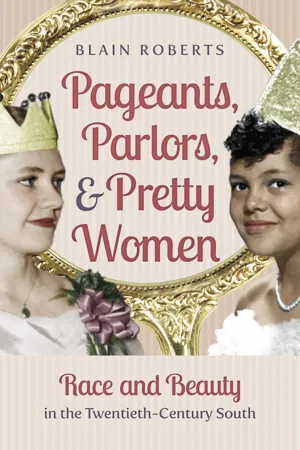
Pageants, Parlors, and Pretty Women
Race and Beauty in the Twentieth-Century South
- 384 pages
- English
- ePUB (mobile friendly)
- Available on iOS & Android
eBook - ePub
About this book
Information
Chapter One
Making Up White Southern Womanhood
The Democratization of the Southern Lady
Like most politicians, Thomas Walter Bickett, the governor of North Carolina from 1917 to 1921, had a habit of delivering the same speech over and over again. One favorite topic was “civic righteousness,” but he also tended to stray into more surprising territory. To all-female Tar Heel audiences, Governor Bickett often spoke on the subject of how to be beautiful: “Be beautiful. You must be. If you cannot be entirely beautiful, then wage an unwearying campaign to be as beautiful as you can be. No woman has a right to be ugly. An ugly woman is a mistake; a misfit; out of joint; out of tune; at war with the law and the purpose of her being. Whenever I see an ugly woman I know that somebody, somewhere, has either sinned or blundered, and the woman has been cheated of her birthright.” Ugliness, he continued, was a “preventable disease. It belongs in the same category with smallpox, tuberculosis and typhoid fever.” Concerned with outward beauty enough to make stump speeches about it, Governor Bickett nevertheless abhorred what he called the “bewildering labyrinth of hats and hairpins . . . flounces and frills, and whalebone and cosmetics.” These were not, to his mind, the secrets to true beauty.
Governor Bickett insisted, instead, that women strive to be natural, a request that revealed his apprehensions about artificial beauty accoutrements, increasingly popular in some parts of the country. “Affectation spoils more faces than smallpox,” Bickett declared. “You simply cannot develop grace and charm in a self-conscious personality. . . . Ours is an age of imitation, of sham. So many things are painted over, or powdered over, or plastered over, or veneered over. Notwithstanding the Pure Food and Drug Act, it is hard to find anything that is exactly what it purports to be.”1His reference to this piece of legislation is telling. Passed in 1906, the act made illegal the manufacture and sale of food and drugs that were “adulterated or misbranded.”2 Made-up women, in Bickett’s mind, were both. Beauty sprang eternal from physical well-being and clean living, not from jars of creams and tubes of lipstick.
In opposing the “labyrinth” of modern beauty products and practices, Governor Bickett was in good company. Many of his contemporaries agreed that they posed a dire threat to virtuous, white southern womanhood and marred the natural beauty that was touted as its defining physical characteristic. For generations, beauty had been understood not so much as a physical entity that could be manipulated at will but as a reflection of female morality and obedience.3 The modern beauty industry, which blossomed in the United States during the years that Bickett served as governor, seemed to challenge this traditional way of thinking. The growing recourse to cosmetics, especially, and to the beauty parlor, to a lesser extent, raised troubling questions about who white southern women were and what they wanted. If beauty was innate, a function of female virtue, what did it mean that a white southern woman might decide to make up her face or bob her hair? Who was she? The fact that a politician attempted to answer these conundrums is revealing. In the interwar South, for a woman to stake out a place in this new corner of consumer culture was not a small act. Habits that, at first glance, seem merely private, even frivolous, had consequences for the southern social order.
To be sure, it would be a mistake to assume that every white southern woman who indulged in new beauty practices did so to make some kind of statement about her place in southern society. At the same time, beauty products are potent cultural symbols, imbued with meanings by those who make, use, and see them. All consumer goods provide “marking services,” a function that is particularly well served by beauty products, which literally mark the body with meaning.4 Regardless of a woman’s motivation, then, many observers of Bickett’s generation interpreted the use of beauty products as a sign of an unforgivable artifice rooted in female rebellion. In the segregated South, moreover, any challenge to male supremacy was inherently a challenge to white supremacy. Modern beauty practices and products carried the potential to upset both. As they debated the meaning of a woman’s desire to pursue beauty in novel ways, what southerners were really grappling with was the region’s relationship to consumer culture and modernity and the sexual and racial changes that they threatened.
Not surprisingly, given pervasive opposition on ideological and moral grounds, cosmetics and beauty parlors were slow to take hold in the South. Further diminishing their appeal were difficulties created by availability, time, access, and purchasing power, issues that become even more stark when we remember that the vast majority of white southern women lived on farms in the late nineteenth and early twentieth centuries. Figuring out how to overcome these hurdles represented a considerable challenge to the manufacturers of beauty products that were springing up throughout the United States in the 1910s, 1920s, and 1930s.
By World War II, cosmetic manufacturers, in particular, had largely succeeded, settling on a strategy that involved a simple but savvy redefinition. Cosmetic companies and their advertising allies marketed cosmetics as key instruments in the construction and maintenance of elite white racial identity.5 This tactic, which strengthened the culture of segregation, had the potential to alleviate concerns about the propriety of cosmetics use. By tying cosmetics to one of the most ubiquitous icons of the Old South, they reframed the new products as traditional, as the very antithesis of modernity. Ironically, this was an approach made possible by the new view of beauty as a physical entity rather than a moral quality.6 Once beauty could be constructed on the body through the use of the right products, even the humblest, and most morally questionable, of southern women could be true southern ladies.
One of the most striking aspects of this story is the conspicuous role of younger southern women. More so than their mothers and grandmothers, high school and college-aged girls wanted to be a part of the exciting world of modern beauty improvements, to experiment with the tools that many feared. Some younger southern women also did not find the aesthetic of whiteness as captivating as cosmetic companies and their female elders might have liked, displaying, instead, a disconcerting attraction to the suntan. Through the pursuit of beauty, younger southern women did not simply exhibit the adventurous proclivities of youth but revealed, in a vivid manner, the disturbing effects of the new forms of self-presentation.
Although it would flourish in the years following World War I, the beauty industry in the United States grew out of humble nineteenth-century origins. Eleven years before the outbreak of the Civil War, the value of toiletries produced in the United States was only $355,000.7 Even then, most toiletries were not beauty products per se, but rather items such as soaps and patent medicines, the latter of which promised to cure everything from nervousness to irritability to kidney trouble. Some manufacturers did market cold creams, face powders, and even rouge and eye makeup, which during the Civil War enjoyed a brief period of popularity among the wealthy. But most elite and middle-class women shunned the use of color since the “painted woman” carried negative associations. Prostitutes had long announced their trade with the visible use of face paint, while actresses, another disreputable set of female professionals, used cosmetics on stage. Natural beauty was the ideal, prized as the manifestation of morality. Cosmetic artifice, by contrast, represented a breach of female propriety.8
In the South, racial slavery and male patriarchy bolstered these proscriptions against paint since ladyhood itself, crucial to antebellum social order, was intensified to the point of caricature.9 As paragons of virtue and submission, southern ladies, precisely because of their innate goodness, were naturally and intrinsically beautiful. Although southern ladies were hardly as numerous as mythmakers would have us believe, the rules that governed their appearance were very real, determining how they—and other women who strayed from the ideal—were judged. A charitable observer of a painted woman in the antebellum South might have argued that she was defying the gender mores that dictated her obedience and her relegation to the private sphere. Commenting on the spirit of wartime rebellion that gripped some of Charleston’s young elite women, for example, Emma Holmes censured two young belles for “rougeing” and blatantly ignoring their elders’ authority.10 Most observers would have remarked that such a woman was brazenly proclaiming her own sexuality, or, at the very least, of questionable character.
The emphasis on natural beauty as the outer sign of inner goodness resulted in an anemic cosmetics market in the nineteenth century, but it hurt aesthetic judgments as well. Some observers attributed beauty to a face when apparently there was none, as was the case with a young Mary Withers, in whom the candid Holmes admitted being “dreadfully disappointed” after having heard so much about her “far famed beauty.” “Perhaps her beauty may grow upon me,” Holmes confided to her diary, “but I expected to be dazzled by its exceeding loveliness.”11 The conflation of beauty with morality could easily lead southerners to ignore physical reality. The concurrent injunction against cosmetic artifice could also lead ladies to draw fine distinctions between which cosmetic practices were acceptable and which were not. New Orleans native Eliza Ripley recalled that during her antebellum girlhood, no young woman of her elite social class used cosmetics, “except rice powder,” which, she carefully added, was “not a cosmetic.”12
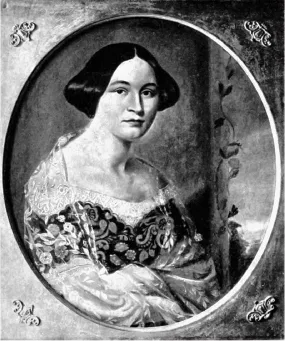
Painting of Eliza Ripley by Theodore Sydney Moïse, ca. 1854. Ripley condemned most cosmetics, except for rice powder, which, she insisted, was not really a cosmetic. From Ripley’s autobiography, Social Life in Old New Orleans (New York: D. Appleton, 1912).
Deeming rice powder acceptable because it helped women protect and even out their white skin, Ripley was unwilling to sanction the use of whitening enamels, which were often lead-based. More importantly, they were seen as a form of paint that artificially masked the face. She mocked a young bride, who hailed from “somewhere up the coast,” for having her face enameled while on honeymoon in Paris. Not only was the practice inherently objectionable; it had a ridiculous result: “[the bride] had to be so careful about using the muscles of the face that she was absolutely devoid of expression. Once, in a moment of forgetfulness or carelessness, she cracked a smile, which cracked the enamel. She returned to Paris for repairs. I saw her on the eve of sailing, and do not know if she ever returned.”13 Ripley’s humorous anecdote reveals the existence of antebellum beauty rules that had quite serious consequences for the women of her social class. In this case, the offending female was metaphorically cast out of society. Her presence, Ripley suggests, was never missed.
That the bride had felt compelled to apply a whitening enamel, however, was the result of another quite grave injunction. As Ripley’s own approval of rice powder indicates, ladies were to protect their white skin from the sun at all costs, a rule the wanton bride had perhaps violated. Rebecca Latimer Felton wrote that young women during her antebellum youth in Georgia “were emphatic on this line” and thus “sun bonnets were always in evidence.”14 Lily-white skin distinguished ladies from the poorer sort who worked in the fields and whose tanned complexion was the marker of their inferior status. Describing a woman named Milly who was the recipient of her family’s charity, Mary Boykin Chesnut stated matter-of-factly: “She was a perfect specimen of the Sandhill tackey race, sometimes called country crackers. Her skin was yellow and leathery; even the whites of her eyes were bilious in color.”15
Most women of Ripley’s and Chesnut’s class who did seek out beauty help did not look to Paris for enamels and paints; they relied, instead, on ingredients that were readily available in their own homes and gardens to make beauty-enhancing concoctions that generally fell within the bounds of respectability.16 Milk, lemon juice, sugar, and chalk could be used in homemade remedies designed to nourish, powder, or whiten the skin, while flowers and vegetables could be used, if a woman so desired, to lightly blush the cheeks. Simple ingredients for simple recipes. It did not take much for a lady to approximate the nineteenth-century ideal of white skin with a hint ...
Table of contents
- Cover Page
- Pageants, Parlors, & Pretty Women
- Copyright Page
- Contents
- Illustrations
- Acknowledgments
- Introduction
- Chapter One Making Up White Southern Womanhood
- Chapter Two Shop Talk
- Chapter Three Homegrown Royalty
- Chapter Four Thrones of Their Own
- Chapter Five Bodies Politic
- Conclusion
- Notes
- Bibliography
- Index
Trusted by 375,005 students
Access to over 1.5 million titles for a fair monthly price.
Study more efficiently using our study tools.
Frequently asked questions
Yes, you can cancel anytime from the Subscription tab in your account settings on the Perlego website. Your subscription will stay active until the end of your current billing period. Learn how to cancel your subscription
No, books cannot be downloaded as external files, such as PDFs, for use outside of Perlego. However, you can download books within the Perlego app for offline reading on mobile or tablet. Learn how to download books offline
We are an online textbook subscription service, where you can get access to an entire online library for less than the price of a single book per month. With over 1.5 million books across 990+ topics, we’ve got you covered! Learn about our mission
Look out for the read-aloud symbol on your next book to see if you can listen to it. The read-aloud tool reads text aloud for you, highlighting the text as it is being read. You can pause it, speed it up and slow it down. Learn more about Read Aloud
Yes! You can use the Perlego app on both iOS and Android devices to read anytime, anywhere — even offline. Perfect for commutes or when you’re on the go.
Please note we cannot support devices running on iOS 13 and Android 7 or earlier. Learn more about using the app
Please note we cannot support devices running on iOS 13 and Android 7 or earlier. Learn more about using the app
Yes, you can access Pageants, Parlors, and Pretty Women by Blain Roberts in PDF and/or ePUB format, as well as other popular books in Social Sciences & North American History. We have over 1.5 million books available in our catalogue for you to explore.