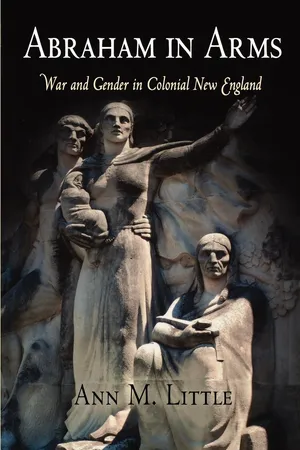
In 1678, the Puritan minister Samuel Nowell preached a sermon he called "Abraham in Arms," in which he urged his listeners to remember that "Hence it is no wayes unbecoming a Christian to learn to be a Souldier." The title of Nowell's sermon was well chosen. Abraham of the Old Testament resonated deeply with New England men, as he embodied the ideal of the householder-patriarch, at once obedient to God and the unquestioned leader of his family and his people in war and peace. Yet enemies challenged Abraham's authority in New England: Indians threatened the safety of his household, subordinates in his own family threatened his status, and wives and daughters taken into captivity became baptized Catholics, married French or Indian men, and refused to return to New England.
In a bold reinterpretation of the years between 1620 and 1763, Ann M. Little reveals how ideas about gender and family life were central to the ways people in colonial New England, and their neighbors in New France and Indian Country, described their experiences in cross-cultural warfare. Little argues that English, French, and Indian people had broadly similar ideas about gender and authority. Because they understood both warfare and political power to be intertwined expressions of manhood, colonial warfare may be understood as a contest of different styles of masculinity. For New England men, what had once been a masculinity based on household headship, Christian piety, and the duty to protect family and faith became one built around the more abstract notions of British nationalism, anti-Catholicism, and soldiering for the Empire.
Based on archival research in both French and English sources, court records, captivity narratives, and the private correspondence of ministers and war officials, Abraham in Arms reconstructs colonial New England as a frontier borderland in which religious, cultural, linguistic, and geographic boundaries were permeable, fragile, and contested by Europeans and Indians alike.
- 272 pages
- English
- ePUB (mobile friendly)
- Available on iOS & Android
eBook - ePub
About this book
Information
Chapter 1
“You dare not fight, you are all one like women”: The Contest of Masculinities in the Seventeenth Century
Come out and fight if you dare: you dare not fight, you are all one like women, we have one amongst us that if he could kill but one of you more, he would be equall with God, and as the English mans God is, so would hee be.
—Pequot warriors quoted by John Underhill, Newes from America (1638)
Most recent scholars of the Pequot War (1636–37) agree that it was a thinly disguised war of conquest. The Pequots were convenient targets, as they had allied with early Dutch settlements in an attempt to dominate Euro-Indian trade in the region, and therefore over the course of the previous several years the Pequots had alienated their Indian neighbors. Thus, resentful fellow Algonquians like the Narragansetts, the Massachusetts, and the Mohegans were eager to ally themselves with the new European power in the region, the recently arrived English, who had established a number of small plantations on Massachusetts Bay and who were eager to expand into the Connecticut River valley.1 The English had established a few permanent settlements in the 1620s around the perimeter of Massachusetts Bay, but their numbers began to swell tremendously only in the 1630s as the decade-long “Great Migration” to New England began.2 With the Pequots weakened by a 1633 smallpox epidemic, and the lucky accident of the murders of a few rogue English traders that were convincingly blamed on the Pequots, the English saw their main chance to take Connecticut.
Throughout most of this short war, the English and their Indian allies engaged in small skirmishes on Block Island and at the new English settlement at Wethersfield, and the Pequots showed themselves capable of effective resistance. Details about even the minor skirmishes in this war were preserved in memoirs by three of the war’s English officers: Captain John Mason, Captain John Underhill, and Lieutenant Lion Gardiner.3 The Pequots had successfully besieged the recently established Fort Saybrook throughout the winter of 1636–37, with Gardiner and only twenty-four people inside—men, women, and children. According to Underhill, who was sent to relieve the fort in early 1637, the Pequots surrounded the fort that spring “and made many proud challenges, and dared [the English] out to fight.” Whether they rose to the bait, or just needed to steal or cultivate corn, ten men ventured out of the fort. They came upon three Pequots, but they had fallen into a trap—as they pursued the three Indians, “an hundred more started out of the ambushments” and nearly surrounded the small company. Some were killed, the others fled to the safety of the fort, but the Pequots were not finished with their rout yet. (Perhaps tellingly, Underhill refuses to give a clear number of the dead and wounded.) The Pequots took the dead English men’s guns and clothing, and pursued the survivors “to the Fort jeering of them, and calling, come and fetch your English mens clothes againe; come out and fight if you dare.” Then the Pequots made their intentions to humiliate English manhood perfectly clear: “you dare not fight, you are all one like women.” After all, hadn’t the English been led into a trap and beaten badly? Hadn’t they fled, leaving their comrades’ bodies in the fields to be stripped of their clothing and weapons by their enemies? Underhill reports no English response to this insult, so the Pequots continued, raising the stakes of their challenge: “we have one amongst us that if he could kill but one of you more, he would be equall with God, and as the English mans God is, so would hee be.” Not only did the Pequots challenge English masculinity by beating them soundly in battle and calling them “women,” but in comparing themselves favorably to the “English mans God,” they challenged English notions of hierarchy. Underhill writes that “this blasphemous speech troubled the hearts of the souldiers, but they knew not how to remedy it in respect of their weaknesse.”4
As this anecdote suggests, colonial warfare was often expressed as a contest between the Indian and English notions of manhood, and the stakes were high. From their earliest encounters with one another, both Indian and English men claimed to be disturbed by the other’s ideas of gender roles, most particularly in the proper performance of manhood. Many scholars have noted that English men who had come to the New World to be farmers were appalled by what they saw as Indian men’s laziness and tyranny over Indian women, who labored in the fields while the men pursued “aristocratic” pastimes like hunting and fishing. Alternately, Indian men thought little of the sort of men who would do women’s work in the fields, and who even seemed to be proud of it.5 But there were in fact large areas of agreement in the gender ideologies of Native Americans and the English, in particular in politics and war.6 For example, Algonquian, Iroquois, and English cultures understood political power as a prerogative of men, and all these societies were characterized by predominantly (if not entirely exclusively) male political leadership. This gendered quality of political power was not incidental, but symbolic of these cultures’ shared understanding that men were the natural leaders of society. When Indian men encountered men who farmed and seemed proud of doing women’s work, and when English men saw men who allowed women to work the land, each side questioned the masculinity of the other. This was not an innocent moment of confusion brought on by a blinding “clash of cultures”; challenging one another’s masculinity was a deliberate political and rhetorical strategy, because in questioning each other’s manhood, they questioned each other’s right to political power as well. Furthermore, underneath this common understanding of manhood and political mastery is the fact that English and Indians were both agricultural peoples who had need of the same resources: land, principally, but also the ability to keep others off of it, and access to harbors and rivers for easy travel and trade. While both the English and the Indians seized on cultural differences to construct a language by which they might define their enemies and describe their grievances with them, the fact remains that the roots of their struggle were material. English newcomers were rivals for the resources that Native North Americans had enjoyed for centuries. Whether men or women farmed the land was ultimately a matter of culture and aesthetics. Whether English people or Indians would claim and secure land for farming was a matter of life and death.7
Accordingly, the conduct of the colonial warfare was especially fraught with challenges to the masculinity of both the English and the Indian combatants. In both cultures, masculinity was defined in part by military success, and political power was often built upon demonstrated military prowess; therefore, men on both sides had something to lose or gain from the outcome of each battle beyond victory for their countrymen and allies.8 Encounters in warfare and in the discourse on warfare make it clear that both English and Indian men understood their masculinity as a complex thing, built on gender of course, but also encompassing qualities like age and status. Being a man meant not only not being a woman, but it also meant being an adult as opposed to an infant, child, or adolescent; for English men it also meant being the head of a household rather than a servant or a slave. Similarly, Indian men put a premium on distinguishing themselves from dogs, useful but servile creatures. Indian men typically shared decision-making within households and kinship groups with adult women, but like English men, they retained almost all control over politics and decisions about war and peace. From the perspectives of both seventeenth-century English and Indian peoples, war was key to the performance of manhood as well as an opportunity to enlarge or protect territorial claims, because manhood and political and economic autonomy were inseparable. Thus, a great deal was at stake when Indian men openly taunted English men for what they saw as their lack of manly courage, or when the English portrayed the Indians as feeble warriors who made great boasts of their bravery but who regularly turned tail on the battlefield. Gender anxieties permeated the wars of the seventeenth century—the Pequot War, King Philip’s War (1675–78), and King William’s War (1688–97)—as English and Algonquian men on the Atlantic coast of New England fought for political and economic control of the region.
These issues first emerged in early encounters after the first permanent English settlement was established in 1620, when the Indians viewed the English as children dependent upon their fatherly care. The contest of masculinities was vitally apparent in the Pequot War, and the rich documentary records of this war establish many themes in this struggle between men that continued through the seventeenth century and into the eighteenth century: English men became enraged by what they saw as illegitimate “pride” and “insolence” in Indian men; they were humiliated by the open mocking Indian men made of English masculinity; and they were affronted by what they saw as feminized, foolish, or childish Indian men exercising political and military power. Furthermore, the English might have been especially sensitive to displays of Indian mastery, as the history of early English settlements demonstrates that they were in fact weak and vulnerable to famine and disease as they adjusted to the climate and landscape of North America. Indian men, for their part, were equally disdainful of the English, whether enemies or allies: English men, ordinarily stooped in the cornfields like women, looked ridiculous in their military accoutrements, drumming and marching in open fields; they evidently preferred savage attacks on noncombatants to engaging warriors; and they frequently abandoned their dead on the battlefield, leaving them to be stripped and scalped. By the last quarter of the century, as King Philip plotted his uprising against English settlement, Indians had the measure of their English enemy and fought not only to preserve their own independence but also to master the English, as they knew the English intended to master them.9
From the start, English and Indian men jockeyed to establish their authority in each other’s eyes. Both English and Algonquian Indian men understood political power as an arena of masculine achievement; accordingly, establishing political authority was done with words and actions that conveyed one’s masculinity.10 Indian and English leaders were eager to demonstrate their independence (as opposed to feminized dependence) and the dependence of others upon them as a means of demonstrating that they were the most consequential men around. This kind of symbolic communication is evident in the first encounters between the Plymouth settlers and Native leadership shortly after the arrival of the English in late 1620. No less a leader than Wampanoag (or Pokanoket) Sachem Massassoit gave the English their first lesson in Indian diplomacy. When a delegation from Plymouth paid a formal diplomatic call on the Wampanoag leader, they rendered him a formal salute with their guns and observed Indian protocol by bringing him gifts, including a coat and a chain for his neck. While William Bradford’s journal portrays this visit initially as a meeting among dignified equals, it becomes clear that the English were in fact supplicants to Massassoit. Although the Wampanoag Indians had been devastated by the smallpox epidemic that had ravaged coastal New England from 1616 to 1618, at a population of around 1,000 they were still stronger and more numerous than the starving English colony of sixty souls who barely survived their first winter and were ill prepared for spring planting. When the English delegation approached the Wampanoags in March of 1621, the sachem assumed the role of a benevolent fatherly host to the English: “For answere to our Message, he told us we were wellcome, and he would gladly continue that Peace and Friendship which was betweene him & us: and for his men they should no more pester us as they had done.” Massassoit established his authority as a recognized leader of the Indians by guaranteeing their future behavior, but perhaps more importantly, he made the English dependent upon his largesse as well, promising to “helpe [the English] with Corne for feed, according to [their] request.”11
Massassoit continued this performance by delivering a long speech, in case the meaning of his previous message was too subtle for these strangers to grasp: “This being done, his men gathered neere to him, to whom he turned himselfe, and made a great Speech; they sometime interposing, and as it were, confirming and applauding him in that he sayd. The meaning whereof was (as farre as we could learne) thus; Was not he Massasoyt Commander of the Countrey about them? Was not such a Towne his and the people of it? and should they not bring their skins unto us?” In the manner of a call-and-response between a Christian minister and his flock, Massassoit’s men responded according to the script: “they answered, they were his & would be at peace with us, and bring their skins to us.” This call-and-response continued as Massassoit rhetorically established his dominion over “at least thirtie places, and their answere was as aforesayd to every one,” his men affirming the truth of his words. The English audience for this performance found the repetition hard to bear: “as it was delightfull [to the Indians], it was tedious unto us.” Perhaps they were uncomfortable being under the benevolent wing of an Indian protector, or perhaps they just didn’t like Massassoit reminding them of his pride of place in the political order. Nevertheless, Massassoit had made his point. Because of the extent of his power, he could guarantee the safety and security of the English plantation—or, if he pleased, he could doom it. Still Massassoit’s performance continued, as “he lighted Tobacco for us, and fell to discoursing of England, & of the Kings Maiestie.” Once again, he revealed much about Native notions of political leadership as he speculated on the strange spectacle of a King without a consort, “marvayling that he would live without a wife.” (King James I’s queen Anne had died in 1619.) As the ritual assertion of Massassoit’s patronage network showed, being a leader was all about the number of one’s dependents. Thus, for a man to call himself a king and not be the head of a complete household was strange to the Wampanoag sachem.12
Both Indians and English people believed that it was well for leaders to receive guests kindly and to entertain them generously.13 This was a function of being a wealthy and powerful leader, as well as a means of extending a patronage network. Although Massassoit was at great pains to assert his devotion to his broad network of supporters, his English guests were not impressed by his hospitality. Not only did they find his performance of his power “tedious,” they found him a poor host. “Late it grew, but victualls he offered none,” they complained. He did however offer them the honor of his bed, as “he layd us on the bed with himselfe and his wife, they at one end and we at the other, it being onely plancks layd a foot from the ground, and a thin Mat upon them. Two more of his chiefe men for want of roome pressed by and upon us; so that we were worse weary of our lodging then of our journey.” The next day the English men were invited to share a very meager meal of two large fish split forty ways by Massassoit and his men. When the English men announced that they would take their leave that day, “[v]ery importunate he was to have us stay with them longer: But wee desired to keepe the Sabboth at home.” Perhaps more immediately, they “feared we should either be light-headed for want of sleepe, for what with bad lodging, the Savages barbarous singing, (for they use to sing themselves asleepe) lice and fleas within doores, and Muskeetoes without, wee could hardly sleepe all the time of our being there; we much fearing, that if wee should stay any longer, we should not be able to recover home for want of strength.” The next day before dawn, they “tooke [their] leave and departed, Massasoyt being both grieved and ashamed, that he could no better entertaine [them].”14 Was Massassoit really “grieved and ashamed” at the poor hospitality he offered? That is doubtful. Perhaps Bradford’s language here was part of an effort by the English to portray Indians as poor, and their leaders as weak and unmanly because of their inability to provide better for their guests. Either way, the English telling of the story ends with Massassoit appearing ridiculous, claiming to control vast reaches of land and men like a king, but then offering his court and guests just a few morsels of boiled fish. Given the hunger in their bellies due to their insufficient planning and hard luck, the English delegation had little cause to criticize Massassoit for his hospitality, especially since their families would be fed only by the largesse of the Wampanoags.
Later in the seventeenth century, the English became even more scathing in their judgment of Indian diplomacy and manhood. Increase Mather consulted Mourt’s Relation in writing A Relation of the Troubles which have hapned in New-England, a history of Anglo-Indian relations published in 1677 in the immediate wake of King Philip’s War, which suggests that he believed that Philip’s uprising may have been rooted in Anglo-Indian diplomatic relations in the 1620s. (This was a reasonable supposition, as Philip was Massassoit’s grandson.)15 Whereas Bradford and his compatriots were content with ridicule, Mather was ready t...
Table of contents
- Cover
- Title
- Copyright
- Contents
- List of Wars of the Northeastern Borderlands, 1636–1763
- Introduction: Onward Christian Soldiers, 1678
- 1 “You dare not fight, you are all one like women”: The Contest of Masculinities in the Seventeenth Century
- 2 “What are you an Indian or an English-man?” Cultural Cross-Dressing in the Northeastern Borderlands
- 3 “Insolent” Squaws and “Unreasonable” Masters: Indian Captivity and Family Life
- 4 “A Jesuit will ruin you Body & Soul!” Daughters of New England in Canada
- 5 “Who will be Masters of America The French or the English?” Manhood and Imperial Warfare in the Eighteenth Century
- Epilogue: On the Plains of Abraham
- Notes
- Index
- Acknowledgments
Trusted by 375,005 students
Access to over 1.5 million titles for a fair monthly price.
Study more efficiently using our study tools.
Frequently asked questions
Yes, you can cancel anytime from the Subscription tab in your account settings on the Perlego website. Your subscription will stay active until the end of your current billing period. Learn how to cancel your subscription
No, books cannot be downloaded as external files, such as PDFs, for use outside of Perlego. However, you can download books within the Perlego app for offline reading on mobile or tablet. Learn how to download books offline
Perlego offers two plans: Essential and Complete
- Essential is ideal for learners and professionals who enjoy exploring a wide range of subjects. Access the Essential Library with 800,000+ trusted titles and best-sellers across business, personal growth, and the humanities. Includes unlimited reading time and Standard Read Aloud voice.
- Complete: Perfect for advanced learners and researchers needing full, unrestricted access. Unlock 1.5M+ books across hundreds of subjects, including academic and specialized titles. The Complete Plan also includes advanced features like Premium Read Aloud and Research Assistant.
We are an online textbook subscription service, where you can get access to an entire online library for less than the price of a single book per month. With over 1.5 million books across 990+ topics, we’ve got you covered! Learn about our mission
Look out for the read-aloud symbol on your next book to see if you can listen to it. The read-aloud tool reads text aloud for you, highlighting the text as it is being read. You can pause it, speed it up and slow it down. Learn more about Read Aloud
Yes! You can use the Perlego app on both iOS and Android devices to read anytime, anywhere — even offline. Perfect for commutes or when you’re on the go.
Please note we cannot support devices running on iOS 13 and Android 7 or earlier. Learn more about using the app
Please note we cannot support devices running on iOS 13 and Android 7 or earlier. Learn more about using the app
Yes, you can access Abraham in Arms by Ann M. Little in PDF and/or ePUB format, as well as other popular books in History & Early American History. We have over 1.5 million books available in our catalogue for you to explore.