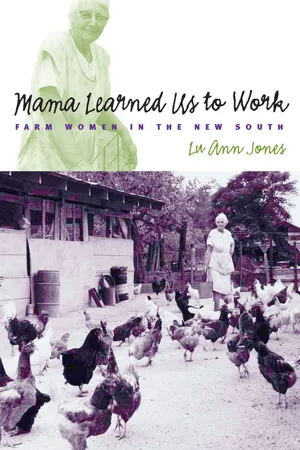
Farm women of the twentieth-century South have been portrayed as oppressed, worn out, and isolated. Lu Ann Jones tells quite a different story in Mama Learned Us to Work. Building upon evocative oral histories, she encourages us to understand these women as consumers, producers, and agents of economic and cultural change.
As consumers, farm women bargained with peddlers at their backdoors. A key business for many farm women was the “butter and egg trade” — small-scale dairying and raising chickens. Their earnings provided a crucial margin of economic safety for many families during the 1920s and 1930s and offered women some independence from their men folks. These innovative women showed that poultry production paid off and laid the foundation for the agribusiness poultry industry that emerged after World War II. Jones also examines the relationships between farm women and home demonstration agents and the effect of government-sponsored rural reform. She discusses the professional culture that developed among white agents as they reconciled new and old ideas about women’s roles and shows that black agents, despite prejudice, linked their clients to valuable government resources and gave new meanings to traditions of self-help, mutual aid, and racial uplift.
- 272 pages
- English
- ePUB (mobile friendly)
- Available on iOS & Android
eBook - ePub
About this book
Information
Chapter One
Rolling Stores
Few strangers crossed the hardscrabble landscape that Harry Crews evoked in his memoir of childhood in south Georgia during the 1930s and 1940s. Crews remembered that the Jewish peddler, driving a team of mismatched mules, “came into [his] little closed world smelling of strangeness and far places.” Bolts of cloth, needles, thimbles, spools of thread, forks, knives and spoons, and a grinding stone that “could sharpen anything,” staples, nails, mule harnesses, “and a thousand other things” filled the inside of the peddler’s wagon. Frying pans, boiling pots, washtubs, and mason fruit jars festooned the outside.1
It was Harry’s mother, Myrtice Crews, who negotiated for these treasures. The peddler “did business almost exclusively with women,” Crews recollected, “and whatever they needed, they could always find in the Jew’s wagon. If they didn’t have the money to pay for what they needed, he would trade for eggs or chickens or cured meat or canned vegetables and berries.” To arrive at a price, the peddler and Crews’s mother performed a ritual of bargaining. No matter how much Myrtice Crews protested “I ain’t got the money,” she often succumbed to the peddler’s invitation to feel a bolt of cloth; and, after more haggling, he might offer to take corn and hay to feed his mules in payment for the fabric. Harry’s mother signaled the end of the transactions when she “silently took two brown chicken eggs out of her apron and gave them to him” in exchange for peppermint balls. “With the candies melting on our tongues,” Crews wrote, “we stood and watched him go, feeling as though we had ourselves just been on a long trip, a trip to the world we knew was out there but had never seen,” a trip financed with the products of his mother’s labor.2
Modest negotiations like those conducted by Myrtice Crews in her backyard occurred routinely during the first half of the twentieth century. Ubiquitous but elusive, transactions with itinerant merchants have been overlooked by scholars who assume that country stores took center stage in the rural New South. Analyzing stories about itinerant commerce rather than treating them as quaint anecdotes enriches the understanding of the New South’s consumer economy and broadens the cast of characters who shaped it. Recent studies demonstrate that southern country stores were economic institutions and social spaces where white men held the upper hand.3 Oral history interviews, reminiscences, regional fiction, and trade literature illuminate a universe of buying and selling where itinerant merchants prevailed, where the farm household was a place of consumption as well as production, and where male dominance and white supremacy might be challenged.
A consideration of itinerant commerce joins a lively historical literature that charts the complex story of how consumer culture spread across the United States. Once preoccupied with middle-class shoppers in the urban Northeast, scholars have discovered that the story’s subplots vary by region, race, gender, and class, revolve around the agency of buyers as well as the power of businesses, and unfold at different times in different places. This look at itinerant commerce focuses less on cultural historians’ questions about theories of consumerism and the meanings of goods than on the concerns of social historians—the nature of buying and selling, the power relationships that defined those transactions, and the context in which they occurred. It highlights human relationships rather then anonymous representatives of the market.4
Several kinds of mobile merchants operated in the rural South well into the twentieth century. Some, like the Jewish peddler of Harry Crews’s youth, were independent entrepreneurs who sold from their packs or wagons. Other itinerants operated what were popularly known as “rolling stores,” portable extensions of permanent businesses. Still other “traveling men” represented large manufacturing firms that offered a diverse line of goods and provided elaborate advice on sales techniques. Two firms whose retailers frequented rural southern homes were the W. T. Rawleigh Company and the J. R. Watkins Medical Company, both headquartered in the upper Midwest but boasting factories and distribution centers all over the United States, with several strategically located to take advantage of southern markets.5
Itinerant merchants extended the world of manufactured goods into the countryside. Although they certainly did business with any willing customer, they appealed to women and African American buyers, who entertained fewer options as consumers than did white men. Itinerant sellers accommodated the needs of black and white farm women, whose patronage of town and country stores was often limited by constraints on their travel and by their discomfort in commercial places where men gathered to do business and visit. Because itinerant merchants took the products of women’s labor in trade, women customers could combine domestic production with consumption in a mix that suited their needs and pocketbooks. Contrary to the assumptions of cultural historians that sellers always had the upper hand, these customers were shrewd buyers rather than easy dupes, and they enjoyed the challenge of bargaining with traders. Besides the goods that filled a peddler’s pack or a sales agent’s sample case, itinerant merchants arrived with news from beyond the immediate neighborhood, a commodity prized by women who kept close to home. Furthermore, African American men found doing business with mobile merchants attractive because what and where itinerants sold provided alternatives to trading with southern country storekeepers whose racist assumptions shaped access to credit and goods.
Itinerant merchants in the New South joined a long line of mobile sellers that began with peddlers. American business practice and lore usually associate peddlers with antebellum Yankee entrepreneurs who sold clocks, tinware, patent medicines, cloth, and notions to country people. In the early nineteenth century, peddlers served an economic purpose as distributors for small-scale manufacturers and importers. But as historian Jackson Lears has argued, they also were the heralds of a nascent consumer culture and touchstones for the anxiety and ambivalence that the spread of a market economy generated. Here today and gone tomorrow, itinerants crossed the boundaries between local neighborhoods and the cosmopolitan world; they represented the “magic” of the marketplace, with its mixture of danger and allure. Peddlers inspired a rich folklore and humor that mirrored the apprehensions that accompanied the quickened pace of nineteenth-century commerce. In literary representations and the popular imagination, peddlers aroused suspicion as outsiders and clever tricksters who supposedly found women, in particular, to be vulnerable to their verbally seductive sales pitches.6
As peddlers extended the market’s reach into the antebellum South, anxieties about both race and gender aroused suspicions. Newspaper editors and storekeepers accused peddlers of “cheating women and children.”7 At least one husband agreed. In 1826, a Georgia man accused peddlers of convincing his young bride “to buy a considerable quantity of store-goods” without his “knowledge or approbation” and was so incensed that he took out a newspaper advertisement warning vendors away from his house for eighteen months.8 Peddlers also stirred distrust among slaveholders. Planters feared that itinerants trafficked with slaves who offered pilfered livestock in trade and worried that peddlers were abolitionists in disguise sowing the seeds of rebellion among bondmen. In the wake of insurrection panics, slaveholders cast skeptical eyes on itinerant merchants who were strangers in their midst. After John Brown’s 1859 raid at Harpers Ferry, for example, whites in several Georgia towns questioned and harassed traveling salesmen from the North, who were thought to sympathize with the abolitionist. An idle remark was enough to provoke a committee of white citizens in Columbus, Georgia, to scrutinize the “many persons from the free States now traveling through our neighborhood for the ostensible purpose of selling books, maps, rat traps, etc.,” and such harassment inspired the salesmen to catch the next train or steamship home.9
What those who study peddlers have ignored—but is implicit in their accounts—is that the harshest critics of itinerants were white men, who constructed unsavory images of peddlers and their female and African American clientele in an effort to control access to the marketplace. Centering the analysis of consumption around gender and consumers’ perspectives, however, places peddlers in a different light. Perhaps peddlers posed a danger because they took their wares to buyers who were not male heads of households. By extending the market, peddlers and their patrons undercut the domestic authority of men. From the vantage point of women and slaves, peddlers were welcomed visitors. The same was true for their postbellum descendants.10
Although the popular literature of the New South perpetuated images of peddlers as duplicitous tricksters, these portrayals camouflage the precarious social conditions of their work. After the Civil War, recent newcomers from Eastern Europe got a foothold in business by peddling in the South. With little capital to invest, immigrant peddlers often catered to poor whites and African Americans, economically marginal figures like themselves. Stereotyped as shady dealers, peddlers were in reality vulnerable salesmen who were easy targets of criminals as they traveled alone hauling merchandise and carrying money. Such was the fate of Francis Brice, an Irish peddler who sold his wares in southeastern North Carolina. In 1878 as Brice passed through a remote marsh, two local men shot him, wrenched a pistol from his hand, and clubbed him with his own walking stick. After stealing Brice’s money, the robbers left him to die. Similar bad fortune befell Samuel Tucker, a Jewish peddler from Richmond, Virginia, whose route traversed the North Carolina Piedmont. During an 1892 selling trip, Tucker sought overnight lodgings in Franklin County and was robbed and murdered where he rested. The culprits tossed his body into a vine-choked ravine, where it went undetected for months.11 As these cases suggest, representing peddlers as tricksters endowed them with more social power than they actually wielded.
Popular mythology also distorts other characteristics of peddlers’ work. Like the itinerant whom Harry Crews remembered, many peddlers became familiar outsiders rather than feared strangers. Though customers surely did not count them as neighbors and frequently associated immigrants with exotic, foreign places, between spring and fall of each year peddlers often traveled predictable circuits that brought them back to the same customers month after month. For example, in the early twentieth century a man known only as “Peddler Black” was a regular visitor in Owen County, Kentucky. While residents later debated his ethnicity and pondered his “mysterious origins,” at least one woman asserted that “he was not a stranger to us.”12
Although general stores had sprouted at nearly every dusty crossroad by the 1880s and 1890s, itinerant merchants continued to find a niche in the New South. Even as railroads connected the region to national markets and the region crawled with drummers who sold wholesale to storekeepers, access to the manufactured goods that expanded briskly after the Civil War varied according to place, race, class, and gender. Members of the new middle class who lived in the South’s burgeoning towns and cities could patronize stores and specialty shops that their country cousins could only imagine. Country stores offered lines of merchandise that ranged from patent medicines to plow points, but peddlers and other sales agents brought their wares right to the homes of customers for whom the rural retail outlets were alien places.13
General stores, as historian Ted Ownby has noted, “were not settings for racial equality.” Nor were they settings for gender equality. Black and white men struck bargains with merchants who provided credit for farm supplies, groceries, and dry goods in exchange for liens on their crops. White men gathered around stoves to play checkers or loafed on porches, passing the time with ribald humor and neighborhood gossip, the conversations sometimes lubricated with whiskey. Although white storekeepers welcomed African American men as customers, they kept a tight fist on credit, monitored their purchases, directed them toward inferior goods, and did little to ease the tensions that black men felt as “conspicuous outsiders.” In the era of Jim Crow, the stores became stages where southerners choreographed steps in a new dance of race relations. Sometimes black and white men mixed freely and without conflict, but all too often African Americans suffered verbal epithets or physical jostling that diminished any joy attached to buying.14
Bastions of male customs and habits, country stores were not particularly hospitable places for women to shop, either. In his classic study of southern country stores, Thomas D. Clark noted that women approached these centers of commerce with reluctance and uneasiness. “They stood near the front door with embarrassed grins on their faces showing clearly mixed feelings of eager curiosity and shocked modesty,” Clark wrote. “They were caught in the unhappy situation of not knowing whether to stay until someone came to serve them or to leave the store.” In the 1930s and 1940s when photographers from the Farm Security Administration (FSA) traveled the back roads of the South, they found men lounging on store porches and gathered inside; women were hardly to be found. The woman who did venture across a store’s threshold might, in William Faulkner’s words, have to pass “the squatting men . . . spitting across the heelgnawed porch” and training their “ranked battery of maneyes” on her.15
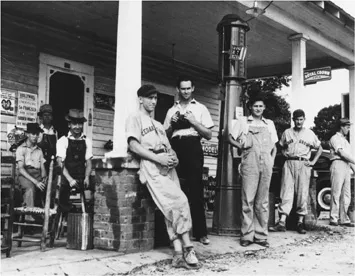
Men at filling station and general store, 1939. (N 85.2.25, Archives and Records Section, N.C. Division of Archives and History, Raleigh)
Practical constraints joined ideology to restrict rural women’s visits to stores. Preoccupied with bearing and rearing children much of their adult lives, rural women simply had less chance to get away from home. Basic household maintenance filled their time. When Sara Brooks was growing up in the Alabama Black Belt during the 1920s, her mother rarely accompanied her father to town on Saturdays. Brooks’s mother reserved the day for cleaning the house, sweeping the yard, and cooking Sunday dinner.16
Although the products of women’s labor often provided the currency for trade, men usually did the shopping. Sara Brooks reported that before her father went to the store, he asked his wife, “‘Now what to get?’ [and] [s]he would write him a little list and give it to him.” In eastern North Carolina, A. C. and Grace Griffin established a similar pattern in the 1930s and maintained it for years. “When we first got married we didn’t have any transportation the first five years,” Grace Griffin explained. “On Saturday morning [A. C.] and his daddy would go to town in the mule and cart and buy the week’s groceries. Then we had a young couple . . . move close to us. . . .He and A. C. would go to town together on Saturday morning a lot of times and each one would carry whatever eggs we had left over from the hens that week and buy the groceries. Well, the pattern was set by the time we got an automobile and I learned how to drive it.”17
The shopping arrangemen...
Table of contents
- Cover Page
- Mama Learned Us to Work
- Copyright Page
- Dedication
- Contents
- Illustrations
- Preface
- Introduction
- Chapter One Rolling Stores
- Chapter Two Anything She Could Sell
- Chapter Three The Chicken Business
- Chapter Four Professional Paradoxes
- Chapter Five Women in the Middle
- Chapter Six From Feed Bags to Fashion
- Notes
- Bibliography
- Index
Trusted by 375,005 students
Access to over 1.5 million titles for a fair monthly price.
Study more efficiently using our study tools.
Frequently asked questions
Yes, you can cancel anytime from the Subscription tab in your account settings on the Perlego website. Your subscription will stay active until the end of your current billing period. Learn how to cancel your subscription
No, books cannot be downloaded as external files, such as PDFs, for use outside of Perlego. However, you can download books within the Perlego app for offline reading on mobile or tablet. Learn how to download books offline
Perlego offers two plans: Essential and Complete
- Essential is ideal for learners and professionals who enjoy exploring a wide range of subjects. Access the Essential Library with 800,000+ trusted titles and best-sellers across business, personal growth, and the humanities. Includes unlimited reading time and Standard Read Aloud voice.
- Complete: Perfect for advanced learners and researchers needing full, unrestricted access. Unlock 1.5M+ books across hundreds of subjects, including academic and specialized titles. The Complete Plan also includes advanced features like Premium Read Aloud and Research Assistant.
We are an online textbook subscription service, where you can get access to an entire online library for less than the price of a single book per month. With over 1.5 million books across 990+ topics, we’ve got you covered! Learn about our mission
Look out for the read-aloud symbol on your next book to see if you can listen to it. The read-aloud tool reads text aloud for you, highlighting the text as it is being read. You can pause it, speed it up and slow it down. Learn more about Read Aloud
Yes! You can use the Perlego app on both iOS and Android devices to read anytime, anywhere — even offline. Perfect for commutes or when you’re on the go.
Please note we cannot support devices running on iOS 13 and Android 7 or earlier. Learn more about using the app
Please note we cannot support devices running on iOS 13 and Android 7 or earlier. Learn more about using the app
Yes, you can access Mama Learned Us to Work by Lu Ann Jones in PDF and/or ePUB format, as well as other popular books in History & North American History. We have over 1.5 million books available in our catalogue for you to explore.