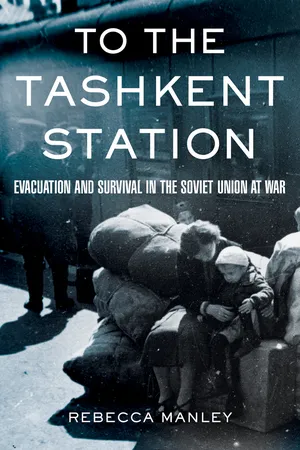
In summer and fall 1941, as German armies advanced with shocking speed across the Soviet Union, the Soviet leadership embarked on a desperate attempt to safeguard the country's industrial and human resources. Their success helped determine the outcome of the war in Europe. To the Tashkent Station brilliantly reconstructs the evacuation of over sixteen million Soviet civilians in one of the most dramatic episodes of World War II.Rebecca Manley paints a vivid picture of this epic wartime saga: the chaos that erupted in towns large and small as German troops approached, the overcrowded trains that trundled eastward, and the desperate search for sustenance and shelter in Tashkent, one of the most sought-after sites of refuge in the rear. Her story ends in the shadow of victory, as evacuees journeyed back to their ruined cities and broken homes. Based on previously unexploited archival collections in Russia, Ukraine, and Uzbekistan, To the Tashkent Station offers a novel look at a war that transformed the lives of several generations of Soviet citizens. The evacuation touched men, women, and children from all walks of life: writers as well as workers, scientists along with government officials, party bosses, and peasants. Manley weaves their harrowing stories into a probing analysis of how the Soviet Union responded to and was transformed by World War II.Over the course of the war, the Soviet state was challenged as never before. Popular loyalties were tested, social hierarchies were recast, and the multiethnic fabric of the country was subjected to new strains. Even as the evacuation saved countless Soviet Jews from almost certain death, it spawned a new and virulent wave of anti-Semitism. This magisterial work is the first in-depth study of this crucial but neglected episode in the history of twentieth-century population displacement, World War II, and the Soviet Union.
eBook - ePub
To the Tashkent Station
Evacuation and Survival in the Soviet Union at War
- 304 pages
- English
- ePUB (mobile friendly)
- Available on iOS & Android
eBook - ePub
About this book
Information
Subtopic
Russian HistoryIndex
History1
CONCEIVING EVACUATION
From Refugee to Evacuee
Population displacement has been a perennial feature of war. In the lands of the former Russian Empire, as elsewhere, successive wars have wrought successive waves of people on the move. One need think only of the flight from Moscow in 1812, immortalized by Tolstoy in his epic War and Peace, to appreciate that wartime population displacement is not a purely twentieth-century phenomenon. Tolstoy’s depiction of Muscovites quitting their homes during the Napoleonic Wars resonates with the contemporary reader in part because the scene is so familiar. For Russians living through World War II, it was eerily so. Almost a century and a half after the events Tolstoy described, history seemed to be repeating itself: in the fall of 1941, Moscow was subject to evacuation, and the city’s inhabitants again took to the roads heading east as enemy forces approached the capital. Although the evacuation of 1941 harked back both to the flight of 1812 and the veritable deluge of refugees during World War I, it was conceptually distinct from the displacements that preceded it. Indeed, as a concept the evacuation was of relatively recent vintage. It was forged in the crucibles of total war and Stalinism and was indelibly marked by the priorities and practices of the Soviet state.
The very term “evacuation” (evakuatsiia) appeared as something of a novelty in 1941. It was, as one memoirist put it, a “terrible and unaccustomed word.” To this writer, a young boy at the time of the German invasion, the word seemed to have “suddenly tumbled down from somewhere.”1 Another memoirist similarly recalled that “until the war we didn’t know the word [evacuation]; in historical novels and films only the word ‘refugee’ was used.”2 “Refugee” (bezhenets) was indeed a familiar term in the Soviet Union of the interwar years. The “refugee” populated not only “historical novels and films,” but living memory. World War I in the Russian Empire had been accompanied by large-scale population displacement, and what contemporaries referred to as the “refugee” had become a common figure. With the outbreak of World War II, however, the term was largely eclipsed. The change in terminology is neatly summed up in the memoirs of Anastasia Sorokina, who, reflecting on her experiences in both wars, noted: “then they called us ‘refugees,’ and now we are ‘evacuees.’”3
The passage from refugee to evacuee reflected an important transformation in the state’s approach to wartime population displacement. Early Soviet refugee policy was formulated against the backdrop of World War I and was predicated on a tacit acceptance of wartime displacement: its primary concern was organizing and providing for the inevitable mass of people who would choose to leave their homes in a future war. In the 1930s, however, it was effectively subsumed by another, and heretofore distinct policy: evacuation. Since World War I, evacuation had been conceived first and foremost as an economic measure, designed to effect the transfer of selected material and human resources to the safety of the rear. The focus on the evacuee as the central figure of wartime population politics reflected a radical rethinking of the premise underpinning state policy. In effect, it constituted a rejection of the very principle of choice. Instead of planning for an already displaced population, evacuation aimed to manage and control displacement itself. The elaboration of a unified approach to population displacement under the rubric of evacuation was a corollary of Stalin’s revolution from above, which thrust the Soviet Union onto a path of rapid industrialization and forced collectivization. It reflected the militarization of Soviet society, the development of new practices of population transfer, and changing practices of war. At issue were not only conceptions about a future war, but basic suppositions about Soviet society and the Soviet state.
THE CRUCIBLE OF TOTAL WAR: REFUGEEDOM AND EVACUATION IN WORLD WAR I
The wartime population policies of the Soviet state were crucially shaped by the experience of World War I. In the lands of the Russian Empire, as elsewhere, the war was a transformative experience that inaugurated an era of increased government involvement in all spheres of life. Faced with the prospect of seemingly indefinite warfare in an industrial era of mass conscription armies, war was reconceived as a struggle not only between opposing armies but also between nations and entire economies. In many respects, the war was a watershed: it gave birth to the concept of total war and to a range of new practices including surveillance, grain requisitions, and rationing. From this crucible, two further phenomena emerged that would lay the groundwork for subsequent Soviet policy on wartime population displacement.4
World War I had confronted the imperial Russian government with a refugee crisis of unprecedented proportions. Within a couple of years, over three million imperial subjects had become refugees as Russian forces retreated and substantial tracts of territory were ceded to the enemy.5 The scale of population displacement was unanticipated. Tsarist authorities, moreover, were completely unprepared. There was no policy in place to deal with refugees; and as the Soviet General Staff later noted of the experience, “the tsarist government conducted no preparatory work” until 1915, when the mass of refugees could no longer be ignored.6 The absence of an imperial refugee policy reflected not only the government’s mismanagement of the war but also the novelty of the phenomenon. Until World War I, refugees were simply not part of military planning. On the eve of the war in Russia, moreover, they were barely part of public consciousness.
Refugeedom had emerged as a distinct and identifiable concept in imperial Russia only in the late nineteenth century. Although Tolstoy’s War and Peace, penned in the latter half of the 1860s, was peopled with numerous refugees, the term itself is nowhere to be found in his oeuvre. Indeed, it was only in 1891 that “refugee” first appeared in a Russian dictionary. In this entry, the refugee was defined as a “fugitive” who had been “compelled” to leave his “homeland, place of service, or of dwelling…by some kind of calamity.”7 According to the dictionary, the Russian term was first used to designate Bosnian civilians who fled the Ottoman Empire in the wake of a brutal repression of tax revolts in 1875. Until the outbreak of World War I, however, the term was used only rarely and appeared neither in the third edition of Dal’s magisterial dictionary of the Russian language, published in the early twentieth century, nor in the multivolume Russian Military Encyclopedia, published only a few years before the war.8 Moreover, when Russia was confronted with a refugee crisis of its own in the mid-1890s, as Armenians streamed across the border from the Ottoman Empire in the wake of a series of massacres, the term applied was not “refugee” but “migrant.” The use of this more general term suggests that at this point there was little consciousness that refugees suffered from any specific plight. Indeed, individuals attempting to raise funds for the displaced Armenians bemoaned the fact that the Russian public failed to distinguish the plight of the Armenian “migrants” from that of Russia’s own peasant “migrants.”9
Not until World War I, in the wake of the displacement of millions of Imperial subjects, did the term “refugee” acquire common currency in Russia. Although today we tend to think of refugees as those who are forced to leave their countries of origin, refugeedom entered onto the Russian stage as a phenomenon denoting not statelessness but homelessness. Indeed, refugees were sometimes referred to as “refugees—homeless people” and were described in a proclamation of a committee convened to care for them as “our civilian inhabitants” dispersed by the war.10 The widespread adoption of a new term signaled both an emergent consciousness of the distinct plight of those displaced by war and a new set of administrative practices designed to deal with the particular problems they posed: refugees frequently clogged essential transit routes—they had to be moved; they were homeless—they had to be resettled; they lacked even the most basic provisions—they had to be clothed and fed.
World War I thus transformed refugeedom into an object of public concern and administrative regulation. In a sense, the war gave birth not simply to a new consciousness of refugeedom, but to the phenomenon itself. Though population displacement was by no means a novel feature of war, its unprecedented scale in World War I stemmed from a new approach to warfare. The refugee crisis was the product not only of flight but of forcible expulsions, a situation reflected in the juridical definition of refugees as people “who have abandoned localities threatened or already occupied by the enemy, or who have been expelled by order of the military or civil authority from the zone of military operations.”11 Although World War I witnessed the expulsion of civilians across Europe, in the Russian case the targets were not only foreign subjects but subjects of the Russian Empire itself.12
The forcible expulsions of World War I were rooted in a new approach to population management elaborated within the military establishment. They were driven in part by concerns about the loyalty of the domestic population, which military authorities separated, in conformity with ethnic markers, into “reliable” and “unreliable” elements. During the war, those deemed “unreliable” were expelled from particularly sensitive regions to preclude the possibility of collaboration with the enemy.13 Russia’s ethnic Germans and Jews, as well as foreign passport holders, were subject to expulsions on these grounds. Expellees were either simply evicted from their homes or, less frequently, deported farther east.14 The forcible removals also stemmed from concerns about the size and strength of the enemy’s labor force. During World War I, German occupying forces on both the Western and the Eastern fronts routinely conscripted civilians for forced labor in defense work. In response, the Russian Army began to remove civilians from territory under threat of occupation, thus depriving the enemy of crucial resources. While pursued only sporadically, these expulsions further swelled the ranks of refugees.15
The recourse to expulsions to win the war of resources underscores the way in which economic concerns were transforming the conduct of war. The principle of removing resources to protect them found its fullest expression in another novel phenomenon born of the war—evacuation. The evacuation of factories, valuables, and specialized workers from the frontline regions to the rear had not been foreseen in any prewar plans. As the chairman of the Evacuation Commission of the Northern Front later recalled, the country was “completely unprepared” for evacuations.16 Only in the summer of 1915 did evacuations begin in earnest, and only in the fall of that year was the “Evacuation Commission” finally established under the auspices of the Special Conference of Defense to oversee the operation.17
Like the term “refugee,” the term “evacuation” entered the Russian language only in the latter half of the nineteenth century.18 Derived from the French évacuation, it initially denoted “the planned dispatch of the wounded and the sick from field hospitals to hospitals in their home country.”19 The term had come into usage in Russia during the Russo-Turkish War of the 1870s, which had witnessed the first large-scale efforts at transporting wounded soldiers far from the theater of war.20 With World War I, “evacuation,” heretofore reserved for soldiers, came to denote the organized transfer of resources to the rear.
The transposition of “evacuation” from an exclusively military domain onto the domestic economy reflected a new consciousness of and systematized approach to the economic problems posed by contemporary warfare. Both the theory and the practice of war had changed. Mass displacement, population expulsions, and the evacuation of resources were all a measure of these changes. Although the tsarist regime did not survive the war, ...
Table of contents
- Acknowledgments
- Note on Translation and Transliteration
- Abbreviations
- Introduction
- 1. Conceiving Evacuation
- 2. The Official Mind of Evacuation
- 3. Evacuations in Practice
- 4. Popular Responses
- 5. The Journey East
- 6. Survival on the Tashkent Front
- 7. “Our War” in Tashkent
- 8. The Return
- Conclusion
Trusted by 375,005 students
Access to over 1.5 million titles for a fair monthly price.
Study more efficiently using our study tools.
Frequently asked questions
Yes, you can cancel anytime from the Subscription tab in your account settings on the Perlego website. Your subscription will stay active until the end of your current billing period. Learn how to cancel your subscription
No, books cannot be downloaded as external files, such as PDFs, for use outside of Perlego. However, you can download books within the Perlego app for offline reading on mobile or tablet. Learn how to download books offline
We are an online textbook subscription service, where you can get access to an entire online library for less than the price of a single book per month. With over 1.5 million books across 990+ topics, we’ve got you covered! Learn about our mission
Look out for the read-aloud symbol on your next book to see if you can listen to it. The read-aloud tool reads text aloud for you, highlighting the text as it is being read. You can pause it, speed it up and slow it down. Learn more about Read Aloud
Yes! You can use the Perlego app on both iOS and Android devices to read anytime, anywhere — even offline. Perfect for commutes or when you’re on the go.
Please note we cannot support devices running on iOS 13 and Android 7 or earlier. Learn more about using the app
Please note we cannot support devices running on iOS 13 and Android 7 or earlier. Learn more about using the app
Yes, you can access To the Tashkent Station by Rebecca Manley in PDF and/or ePUB format, as well as other popular books in History & Russian History. We have over 1.5 million books available in our catalogue for you to explore.