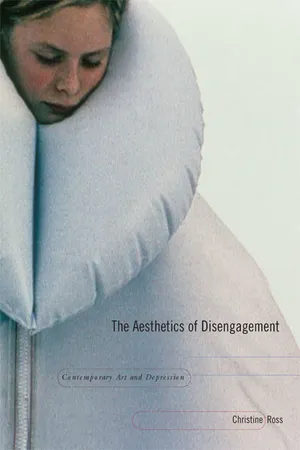
According to the National Institute of Mental Health, more than half of the world's population will have a depressive disorder at some point in their lifetimes. In The Aesthetics of Disengagement Christine Ross shows how contemporary art is a powerful yet largely unacknowledged player in the articulation of depression in Western culture, both adopting and challenging scientific definitions of the condition. Ross explores the ways in which contemporary art performs the detached aesthetics of depression, exposing the viewer's loss of connection and ultimately redefining the function of the image. Ross examines the works of Ugo Rondinone, Rosemarie Trockel, Ken Lum, John Pilson, Liza May Post, Vanessa Beecroft, and Douglas Gordon, articulating how their art conveys depression's subjectivity and addresses a depressed spectator whose memory and perceptual faculties are impaired. Drawing from the fields of psychoanalysis as well as psychiatry, Ross demonstrates the ways in which a body of art appropriates a symptomatic language of depression to enact disengagement - marked by withdrawl, radical protection of the self from the other, distancing signals, isolation, communication ruptures, and perceptual insufficiency. Most important, Ross reveals the ways in which art transforms disengagement into a visual strategy of disclosure, a means of reaching the viewer, and how in this way contemporary art puts forth a new understanding of depression.
- 276 pages
- English
- PDF
- Available on iOS & Android
eBook - PDF
About this book
Information
Topic
ArtSubtopic
Art Theory & CriticismTable of contents
- Contents
- List of Illustrations
- Acknowledgments
- Introduction
- 1. The Withering of Melancholia
- 2. The Laboratory of Deficiency
- 3. Image-Screens, or The Aesthetic Strategy of Disengagement
- 4. Nothing to See?
- 5. The Critique of the Dementalization of the Subject
- Notes
- Index
Trusted by 375,005 students
Access to over 1.5 million titles for a fair monthly price.
Study more efficiently using our study tools.
Frequently asked questions
Yes, you can cancel anytime from the Subscription tab in your account settings on the Perlego website. Your subscription will stay active until the end of your current billing period. Learn how to cancel your subscription
No, books cannot be downloaded as external files, such as PDFs, for use outside of Perlego. However, you can download books within the Perlego app for offline reading on mobile or tablet. Learn how to download books offline
We are an online textbook subscription service, where you can get access to an entire online library for less than the price of a single book per month. With over 1.5 million books across 990+ topics, we’ve got you covered! Learn about our mission
Look out for the read-aloud symbol on your next book to see if you can listen to it. The read-aloud tool reads text aloud for you, highlighting the text as it is being read. You can pause it, speed it up and slow it down. Learn more about Read Aloud
Yes! You can use the Perlego app on both iOS and Android devices to read anytime, anywhere — even offline. Perfect for commutes or when you’re on the go.
Please note we cannot support devices running on iOS 13 and Android 7 or earlier. Learn more about using the app
Please note we cannot support devices running on iOS 13 and Android 7 or earlier. Learn more about using the app
Yes, you can access The Aesthetics of Disengagement by Christine Ross in PDF and/or ePUB format, as well as other popular books in Art & Art Theory & Criticism. We have over 1.5 million books available in our catalogue for you to explore.