- 296 pages
- English
- ePUB (mobile friendly)
- Available on iOS & Android
eBook - ePub
About this book
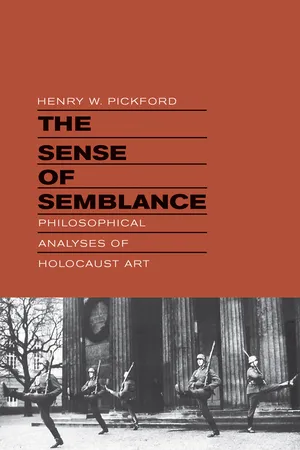
The Sense of Semblance is the first book to incorporate contemporary analytic philosophy in interpretations of art and architecture, literature, and film about the Holocaust. The book's principal aim is to move beyond the familiar debates surrounding postmodernism by demonstrating the usefulness of alternative theories of meaning and understanding from the Anglophone analytic tradition. The book takes as its starting point the claim that Holocaust artworks must fulfill at least two specific yet potentially reciprocally countervailing desiderata: they must meet aesthetic criteria (lest they be, say, merely historical documents) and they must meet historical criteria (they must accurately represent the Holocaust, lest they be merely artworks). I locate this problematic within the tradition of philosophical aesthetics, as a version of the conflict between aesthetic autonomy and aesthetic heteronomy, and claim that Theodor W. Adorno's "dialectic of aesthetic semblance" describes the normative demand that a successful artwork maintain a dynamic tension between these dual desiderata. While working within a framework inspired by Adorno, the book further claims that certain concepts and lines of reasoning from contemporary philosophy best explicate how individual artworks fulfill these dual desiderata, including the causal theory of names, the philosophy of tacit knowledge, analytic philosophy of quotation, Sartre's theory of the imaginary, work in the epistemology of testimony, and Walter Benjamin's theory of dialectical images. Individual chapters provide close readings of lyric poetry by Paul Celan (including a critique of Derridean deconstruction), Holocaust memorials in Berlin, texts by the Austrian quotational artist Heimrad Bäcker, Claude Lanzmann's film Shoah and Art Spiegelman's graphic novel Maus. The result is a set of interpretations of Holocaust artworks that, in their precision, specificity and clarity, inaugurate a dialogue between contemporary analytic philosophy and contemporary art.
Information
Chapter One: Mandelshtam’s Meridian: On Paul Celan’s Aesthetic-Historical Materialism
Ultimately philosophical research must decide to ask what kind of being in general language has. Is it an innerworldly pragmatic tool, or does language have the mode of being of Dasein, or neither of the two? What sort of being is that of language, that it can be ‘dead’?
—Martin Heidegger1
Every sign by itself seems dead. What gives it life?—In use it is alive. Is life breathed into it there?—Or is the use its life?
—Ludwig Wittgenstein2
Important artworks reveal ever new layers, age, grow cold, die.
—Theodor W. Adorno3
The poetry of Paul Celan has played a salient role in the ongoing debate surrounding linguistic meaning and interpretation, even when the stakes of that debate extend beyond the experience or interpretation of artworks altogether. Thus both Jacques Derrida and Hans-Georg Gadamer have written book-length commentaries on selected poems of Celan, and although at odds in their fundamental philosophical commitments, both thinkers find support for and instantiation of their respective views on meaning and understanding in general in their readings of Celan’s poetry in particular.
While the debate of “deconstruction vs. hermeneutics” has received much attention in literary theory and philosophy,4 far less attention has been paid to the exact nature of aesthetic experience in its relationship to nonaesthetic discourses that these philosophical positions presuppose. We can fruitfully situate this question within Adorno’s dialectic of aesthetic semblance, understood as the tension and movement between the poles of aesthetic autonomy on the one hand and heteronomy with the nonaesthetic on the other that characterizes genuine artworks for Adorno. In the specific context of Holocaust art, that dialectic might be best described as moving between the poles of monument (constructing a “fitting” aesthetic artifact while adhering to aesthetic considerations such as coherence, genre, sense, even harmony and beauty) and document (foregoing such aesthetic considerations altogether in favor of factual documentation: names, dates, places, events). In the first extreme (aesthetic autonomy) aesthetic semblance in the sense of “illusion” or “myth” can usurp any reference to nonaesthetic reality, tantamount to dismissing any relevance of historical chronicle to the tasks of representation or commemoration; in the second extreme (referential autonomy) aesthetic semblance is abandoned altogether in favor of factual reconstruction, tantamount to dismissing any relevance of aesthetic construction to the tasks of representation or commemoration. The normative minimalist framework advocated in this study claims that a successful Holocaust artwork will maintain the tension between both poles of the dialectic of aesthetic semblance within aesthetic experience.
Two apparently opposed conceptualizations of aesthetic experience—Idealist and deconstructive aesthetic theories—surprisingly converge in maintaining aesthetic semblance. Traditional Idealist aesthetics holds that the successful artwork is to take up reality’s contingencies and contradictions and harmoniously reconcile them in aesthetic semblance, conventionally centered on the trope of the symbol. It is then merely one step to see the aesthetic reconciliation as a proleptic promise of the utopian possibility of actually reconciling society’s and nature’s antagonisms in what Schiller called the “aesthetic state.”5 Conversely, deconstructive readings of literature by Paul de Man and Jacques Derrida draw on the untotalizability and undecidability of reference in aesthetic semblance to reveal the irreconcilable differences and deferrals of language and linguistic understanding in general. In the first case, art’s specificum is its sublation of difference; in the second case, art’s specificum is its revelation of semiotic différance. In both cases art’s specificity renders it autonomous vis-à-vis everyday, nonaesthetic experience, and in that sense aesthetic semblance remains intact. It is from this sense of aesthetic semblance that Celan will take a significant step back, and toward, as I shall show, a unique form of aesthetic-historical materialism, which in turn fulfills the dual desiderata of the minimalist framework for Holocaust art.
Celan’s retreat from aesthetic semblance, I shall argue, lies in his lyrical dialogism, in which nonaesthetic reference operates within and against aesthetic semblance. Historical and philosophical interests alternate in my exploration of Celan’s lyrical dialogism, the origins of which likely lie in concepts developed by Mikhail Bakhtin in his study of novelistic prose, while de Man’s critique of Bakhtin’s concept of dialogicity from the standpoint of aesthetic semblance initially defines the guiding problems of reference and linguistic understanding which underlie Celan’s ambitions (§1). Celan found a specifically lyrical form of dialogism and address in the essays of his poetic alter ego Osip Mandelstam (§§2–3), concepts that Celan developed in his two most important poetological essays (§§5–6). Against Derrida’s quasi-transcendental construal of linguistic understanding, I draw on work by Wittgenstein and Gareth Evans in arguing for an intersubjective conception of meaning reference having both naturalistic and normative dimensions (§4), and I claim that this theory best elucidates the kind of aesthetic-historical materialism at work in Celan’s poetry (§7), which Gadamer’s implicit Idealism can only dismiss as “occasional” and inessential (§8). I conclude by offering close readings of two Celan poems according to this theory, in which nonaesthetic reference and linguistic understanding operate both within and against aesthetic semblance in order to enact the natural history or “mortality” of the proper-name references (§9).
1. Bakhtin and the Literary Device of Dialogue
In “Discourse and the Novel,” Bakhtin offers an essential criterion for distinguishing the novel from lyric poetry as, one could say, Weberian ideal-types. In terms of speech genres, “the poet is a poet insofar as he accepts the idea of a unitary and singular language and a unitary monologically sealed-off utterance. These ideas are immanent in the poetic genres with which he works.”6 The novel, by contrast, is characterized by “heteroglossia” and “the double-voiced word” such that any monological speech, any singular speaking voice, is relativized and introduced into a dialogue, which, by virtue of its “dialogicity,” cannot be subsumed under a final utterance. The “double-voiced word” is Bakhtin’s term for describing the characteristic discourse of the novel that assumes two speakers involved in an unfinalizable dialogue. By contrast he claims that the poetic trope “cannot presuppose any fundamental relationship to another’s word, to another’s voice. The polysemy of the poetic symbol presupposes the unity of a voice with which it is identical, and it presupposes that such a voice is completely alone with its own discourse.”7 In their lucid summary of Bakhtin’s position, Gary Saul Morson and Caryl Emerson identify the distinctive characteristic of poetic trope—as opposed to nonfinalizable dialogicity—as its referential-representational relationship to an object: “Whether that interrelationship [of meanings in a poetic trope] is understood logically, ontologically, emotively, evaluatively, or in any other way, one is still speaking of the relation of words to their objects. One can discuss its complexity through the theoretical discourse of ‘signified’ and ‘signifier.’”8
However, in his critical review de Man argues that “dialogicity” itself becomes a trope for Bakhtin. After establishing that Bakhtin’s understanding of trope as “an intentional structure directed toward an object” is epistemological, that is, concerned with the referential link between a trope and its meaning or referent,9 de Man counters that “the opposition between trope as object-directed and dialogism as social-oriented discourse sets up a binary opposition between object and society that is itself tropological in the worst possible sense, namely as reification.”10 If I understand de Man correctly, he is observing that Bakhtin equivocates between two meanings of “dialogism.” In the first case, “dialogism” would designate sociality in the sense of what Bakhtin calls “exotopy,” which, if it is not “object-directed” (that is, involving a relationship of reference or representation), does not provide the means for distinguishing anything (and therefore falls into what de Man calls “the categories of precritical phenomenalism”). In the second case “dialogism” would indicate individual voices to the extent that they can be individuated within novelistic discourse, yet in this case those voices would be tropes, object-oriented intentional structures for which Bakhtin provides a rich descriptive poetics. And in this case the problem of aesthetic semblance—the possible suspension of a referential relationship to the nonaesthetic—returns: “It is possible to think of dialogism as a still formal method by which to conquer or to sublate formalism itself. Dialogism is here still a descriptive and metalinguistic term that says something about language rather than about the world.”11
Although Mathew Roberts, whom Morson and Emerson cite affirmatively, maintains that “the ‘confrontation’ of these two theorists cannot occur around a problematic or conceptual opposition immanent to either” because of their “fundamentally different attitudes of the dialogic and hermeneutic epistemologies,”12 perhaps the confrontation can be reformulated as follows. Bakhtin seems to elide the epistemological intricacies of aesthetic semblance by trying to incorporate citation, sidelong-glances, the double-voiced word as events of social reality. De Man claims that within the literary text these devices are just that—literary devices that may represent a many-voiced sociality but which, as representation (mimesis), do not circumvent aesthetic semblance; therefore the analysis of such devices is not...
Table of contents
- Title Page
- Copyright Page
- Contents
- List of Illustrations
- Acknowledgments
- Introduction: The Judgment of Holocaust Art
- 1. Mandelshtam’s Meridian: On Paul Celan’s Aesthetic-Historical Materialism
- 2. Conflict and Commemoration: Two Berlin Memorials
- 3. The Aesthetics of Historical Quotation: On Heimrad Backer’s System nachschrift
- 4. The Aesthetic-Historical Imaginary: On Shoah and Maus
- Conclusion: The Morality of Holocaust Art
- Notes
- Bibliography
Trusted by 375,005 students
Access to over 1.5 million titles for a fair monthly price.
Study more efficiently using our study tools.
Frequently asked questions
Yes, you can cancel anytime from the Subscription tab in your account settings on the Perlego website. Your subscription will stay active until the end of your current billing period. Learn how to cancel your subscription
No, books cannot be downloaded as external files, such as PDFs, for use outside of Perlego. However, you can download books within the Perlego app for offline reading on mobile or tablet. Learn how to download books offline
We are an online textbook subscription service, where you can get access to an entire online library for less than the price of a single book per month. With over 1.5 million books across 990+ topics, we’ve got you covered! Learn about our mission
Look out for the read-aloud symbol on your next book to see if you can listen to it. The read-aloud tool reads text aloud for you, highlighting the text as it is being read. You can pause it, speed it up and slow it down. Learn more about Read Aloud
Yes! You can use the Perlego app on both iOS and Android devices to read anytime, anywhere — even offline. Perfect for commutes or when you’re on the go.
Please note we cannot support devices running on iOS 13 and Android 7 or earlier. Learn more about using the app
Please note we cannot support devices running on iOS 13 and Android 7 or earlier. Learn more about using the app
Yes, you can access The Sense of Semblance by Henry W. Pickford in PDF and/or ePUB format, as well as other popular books in Literature & Art Theory & Criticism. We have over 1.5 million books available in our catalogue for you to explore.