From sapphire, mammy, and jezebel, to the angry black woman, baby mama, and nappy-headed ho, black female iconography has had a long and tortured history in public culture. The telling of this history has long occupied the work of black female theorists—much of which has been foundational in situating black women within the matrix of sociopolitical thought and practice in the United States. Scandalize My Name builds upon the rich tradition of this work while approaching the study of black female representation as an opening onto a critical contemplation of the vagaries of black social life. It makes a case for a radical black subject-position that structures and is structured by an intramural social order that revels in the underside of the stereotype and ultimately destabilizes the very notion of "civil society."
At turns memoir, sociological inquiry, literary analysis, and cultural critique, Scandalize My Name explores topics as varied as serial murder, reality television, Christian evangelism, teenage pregnancy, and the work of Toni Morrison to advance black feminist practice as a mode through which black sociality is both theorized and made material.
eBook - ePub
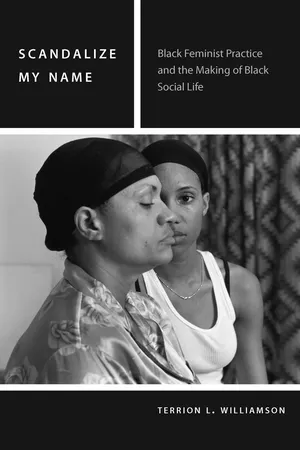
Scandalize My Name
Black Feminist Practice and the Making of Black Social Life
- 184 pages
- English
- ePUB (mobile friendly)
- Available on iOS & Android
eBook - ePub
About this book
Information
Publisher
American Literatures InitiativeYear
2016Print ISBN
9780823274734
9780823274727
eBook ISBN
9780823274741
1
ON ANGER
We lived on Sidell Ave. until 1936. The only thing I can remember about being on Sidell is when my brother Nate was teasing me. I got angry and hit him in the temple with a fork. I had a terrible temper.
—A BRIEF AUTOBIOGRAPHY OF BERNICE L. TURNER
Like my grandmother before me I have been well acquainted with anger my entire life. In her case, it was her older brother, my Uncle Nate, who felt the fullest extent of her wrath, while in my case it was my younger brother, Rufus Jr., who was the most likely recipient of my, shall we say, “displays of temperament” growing up. (Of course, some of this has to do with the fact that siblings are the perfect built-in scapegoats. Who better to project every complicated adolescent feeling onto than someone your parents—who are often the real source of your anger but whom, at least the way I grew up, you could not freely express that to—are going to force to love you no matter what?). Still, it wasn’t until I was in my midtwenties that I first began trying to comprehend my vexed and often perplexing relationship with anger as something more than reactionary (and, ironically, often angry) disavowal. At the time, I was peripherally involved with someone, a black man, who after I told him about my interest in writing on the topic of black women and anger told me that I should not write about said topic because I am “too close” to it. As the argument went, I would not have any veracity if I attempted an argument about angry black women because I am myself an angry black woman, or I would at least be perceived as such by anyone who engaged my work. I should leave all that angry black woman talk to someone else, someone not black and female. Now, I would like to tell you that my response to homeboy was to run down the whole history of black women being deemed unverifiable and his ill extension of that line of thinking, that I told him that thing Audre Lorde said about black women not needing others to speak for us and referred him to Patricia Hill Collins’s discussion of the significance of black women’s thinking about themselves1—except that I really don’t remember what I said, and I’m pretty sure I didn’t give him the telling off he might, by all rights, have deserved. I suppose I didn’t want him to think I was angry.
While hindsight offers up a range of responses to provocations of this sort, I’m not as much interested in a feminist takedown of my would-be provocateur as I am with thinking about the notion of proximity that his “advice” occasioned: What does it mean to be “too close” to anger? How can it be that the nearness of a thing puts it beyond reach? What are the particularities of anger such that its nearness, its acquaintanceship with black female personality, is so vexed as to be potentially impracticable or illegible?
My initial interest in thinking about black women and anger in a sustained way came about as a consequence of reality television. Or, rather, reality television was the initial site where I saw black women’s anger being taken up substantively. I was a law student in 2004 when Omarosa Manigault (then Manigault-Stallworth), the angry black woman par excellence, hit the reality television scene. I knew nothing of her or the show she helped popularize until my father’s youngest sister, my Aunt Sweet, called me all worked up about this black woman on The Apprentice who was taking names. She brokered no fools, she asserted herself without apology, she was undeterred by the discomfort her presence caused others, and what made her especially attractive to my aunt, she was well educated and capable of thriving within a corporate environment—she’d been in graduate school at Howard University and had worked for the Clinton administration before her stint on The Apprentice. By the time I finally tuned in, primarily due to my aunt’s urging, Omarosa was being “fired” from the show after having caused all manner of disruption and being deemed difficult to work with by her teammates—an assessment that, frankly, was not hard to understand. Yet what I came to know as my dalliance with reality television evolved into study is that those early days of Omarosa’s infamy are significant in marking a distinction between the angry black woman she was and the angry black woman she became. Omarosa claimed her cutthroat “strategy” of remaining cold and calculating and not forming personal relationships with her teammates was an effect of her competitive drive and not the entirety of her personality, as she contended was played up by the show to her detriment. That said, she quickly parlayed her failed bid to become the apprentice into a successful career as a reality television personality largely on the strength of her ability to, in her words, “capitalize” on and “exploit” the “naughty girl” image she cultivated by way of The Apprentice. When asked about the claim by one of her fellow contestants, a white man, that the show had made him into a commodity, she countered, “I wouldn’t empower anyone to treat me like a commodity. Sure [producer] Mark Burnett did the editing, and America saw what it saw, but I marketed and packaged the character that’s become Omarosa.”2
These simultaneously dueling and dualing performances of the angry black woman—one that emerges simply as a consequence of being a competitive black woman who is “not here to make friends” and the other that is a deliberate economic strategy—are at the heart of the debate over the authenticity or realness of reality television and its relationship to black women. I became particularly attuned to this debate as I watched the proliferation of reality television at the turn of the twenty-first century and, consequently, the growth of angry black womandom, from America’s Next Top Model (2003–15), which always had at least one, and usually more than one, angry black woman on each successive cycle, to BET’s College Hill (2004–9), which, to the chagrin of many black people, helped inaugurate the angry black woman on black network television, to Flavor of Love (2006–8) and its progeny, which gave us any number of angry black women but none more divisive or entertaining than Tiffany “New York” Pollard, who became the first black woman to star on her own reality show spin-off. What I quickly noted was an appreciable and completely relevant concern about to what extent the behind-the-scenes production affects the way women on these and similarly styled shows behave on screen and whether the angry black woman is but another product of corporate interests that comes at the expense of black folks—even if, as in the case of Omarosa, some black people are involved in and benefit from the arrangement.
In the ensuing years since my initial foray into reality television, and as the genre has come to dominate television programming, the angry black woman has also become, in all of her neck-swiveling, punch-throwing, tongue-lashing glory, a favorite whipping girl of black cultural commentators of all stripes—from print and television journalists to armchair critics and academics to reality-television personalities themselves. Several years after my Aunt Sweet unwittingly helped inaugurate my interest in black women on reality television, which I continued to cultivate upon entering graduate school, I temporarily went to live with her and her two then-teenage daughters during a fellowship leave. I finally had other people, black women no less, to watch television with again. But by this time black reality television, that is, reality shows that feature primarily black casts and target black audiences, had become both a programming mainstay and particular target of black animus, and my aunt had joined the ranks of those who could not abide the behavior of black people, and (angry) black women in particular, on “those shows” (leaving aside for the moment that more than once it was my aunt who caught me up on the goings on of The Real Housewives of Atlanta), while my own position had morphed from disinterest to dis-ease to something bordering on compulsion. Although it is not my intention here to go into an exposition of black women’s complex relationship with reality television—a relationship that is ultimately rooted in an extensive history that transcends the form3—I do want to briefly outline the concerns of my aunt and many others regarding the presence of black women on reality television that help occasion the current discussion.
The arguments made against the angry black woman of reality television typically fall into one of three modes of “stereotype discourse,” or the concern over whether particular mediated images or texts, one, conform to foregoing, historically contingent, stereotypes of black people and, two, correspond to the lives and experiences of those they potentially stand in for or purport to represent. According to the protectionist mode of stereotype discourse, the angry black woman is a problem because she makes black folks, particularly black women, look bad. As heir apparent of the noxious Sapphire, whose embodiment in the form of one Ernestine Wade was eventually, and inevitably, expelled from television by the presumptive leaders of the race, the angry black woman must also be done away with in order to protect against the (further) denigration of blackness. Consequently, petitions are sometimes circulated and letters are sometimes written demanding certain shows or cast members deemed offensive be taken off the air in the name of the greater good. Alternatively, those whose thinking is more in alignment with the additive mode argue that the primary problem with the angry black woman is that she is the dominant representation of black women. Thus the solution is not to attempt to petition away every image of every angry black woman but to introduce other images of black women that can broaden out black female representation. Finally, adherents to the reformative mode, which may or may not work in conjunction with either of the other two modes, suggest the problem is that black women’s anger is misunderstood. The angry black woman is ultimately a misrepresentation of black women’s authentic anger, which at the very least is the consequence of their continued racial and sexual marginalization. Under this mode the angry black woman has the potential to be useful but only if properly contextualized as the outcome of black women’s justifiable anger at the conditions of their lives.
Despite the different approaches, within each mode of stereotype discourse, whether protectionist, additive, or reformative, the angry black woman represents an immoral sociality that must be abolished, diluted, or reformulated—that is, made distant in one way or another—in order for black female representation, and ultimately black women, to attain positive value. But what might it mean to refuse positivity, to refuse to back away from or alter anger, to consider anger neither as righteous nor as detriment but as critical posture? That is to say, what if rather than starting from the position of denial, we start from the position of claim? To take up anger in this way is an anxiety-producing proposition, in the first place, because it risks being misunderstood either as complicity with an all-too-common reductionism of black female behavior as pathological deviance or as an excuse for that same alleged deviance. But the second and more immediate reason it initially invoked my own anxiety has to do with something Lorde wrote about in her own discussion of “our angers”:
But by and large, we avoid open expression of them, or cordon them off in a rigid and unapproachable politeness. The rage that feels illicit or unjustified is kept secret, unnamed, and preserved forever. We are stuffed with furies, against ourselves, against each other, terrified to examine them lest we find ourselves in bold print fingered and named what we have always felt and even sometimes preferred ourselves to be—alone.4
Accordingly, what it means for me to take up anger as critical posture is to take up myself and, even more importantly, my relationship to other black women. The angst is not that I do not have the capacity to write about black women’s anger or even that I will be taken for an angry black woman but that I am never not taken for an angry black woman, and I know instinctively that excavating the meaning and consequence of this takenness requires something more than defense. While the angry black woman is by no means a new millennium formulation, her presence on reality television newly exposes the raw nerve that is the juncture between black women and anger, and I suspect that it is precisely because of my own positionality that I have had some difficulty accessing the “something more” in the face of this exposure. I am experienced in stereotype discourse. I am trained to recognize the residue of particular historical formulations of black female identity and to use my “platform” to call out any depictions that conform to this undoubtedly racist, sexist history. It is a necessary training, without which I could not have authored this text, among any number of other activities essential to my personal and professional livelihood. But it is also a training that neither begins nor ends in the academy and is supplemented by my external or other experience. Yet the dismissal and denigration of this experience, which is fundamentally rooted in my relationship to the place and people I come from, my natal community, is often the prerequisite for and outcome of “higher” learning.
The effects of this disengagement are readily apparent in the varying conversations I have had over the years with black people about reality television. Almost without exception, when I have conversations with academics or other people, like my aunt, who are invested in certain academic protocols even if they do not labor within the academy itself, talk quickly turns to representation (How does this form make us look?), production (How “real” is this form, and who is responsible for it?), and the consequences of the intersections between the two. I have often found these to be compelling and useful conversations from which I have learned a great deal. They are also often shrouded in disclaimer: if these individuals watch reality television at all, and often they claim not to, there are limits to what they will watch or it is merely as “guilty pleasure” or “escapism” and not something they take at all seriously. In contrast, when I have conversations with other people, usually friends and family members in informal settings, who are less indebted or exposed to “the cultures of the learned,”5 they may have similar concerns about representation and production, but these concerns are more usually asides to the primary conversation, which tend to have more to do with the substance of the thing under consideration—the plots, the relationships between characters, their own personal connection to or feelings about the plots and characters—than with the conditions or effects of their making. I have also found these to be compelling and useful conversations from which I have learned a lot, and because people in this latter group are generally less concerned with critiquing the form than the content, they are better equipped to attend to the essence of black women’s anger than the categorization, qualification, or legislation of the angry black woman. That is to say, they are more likely to assume the relationship between black women and anger without consequently naming anger as something from which black women should necessarily hold themselves apart. This often shows up in conversations about what black women will and won’t take, how they do and do not behave, and in response to the act...
Table of contents
- Cover
- Half Title
- Series Announcement Page
- Title Page
- Copyright
- Dedication
- Contents
- Introduction: Back to Living Again
- 1. On Anger
- 2. Getting Happy
- 3. The Way It Is
- 4. Baby Mama
- 5. In the Life
- Afterword: We Gon’ Be Alright
- Acknowledgments
- Notes
- Index
- Series Page
Trusted by 375,005 students
Access to over 1.5 million titles for a fair monthly price.
Study more efficiently using our study tools.
Frequently asked questions
Yes, you can cancel anytime from the Subscription tab in your account settings on the Perlego website. Your subscription will stay active until the end of your current billing period. Learn how to cancel your subscription
No, books cannot be downloaded as external files, such as PDFs, for use outside of Perlego. However, you can download books within the Perlego app for offline reading on mobile or tablet. Learn how to download books offline
Perlego offers two plans: Essential and Complete
- Essential is ideal for learners and professionals who enjoy exploring a wide range of subjects. Access the Essential Library with 800,000+ trusted titles and best-sellers across business, personal growth, and the humanities. Includes unlimited reading time and Standard Read Aloud voice.
- Complete: Perfect for advanced learners and researchers needing full, unrestricted access. Unlock 1.5M+ books across hundreds of subjects, including academic and specialized titles. The Complete Plan also includes advanced features like Premium Read Aloud and Research Assistant.
We are an online textbook subscription service, where you can get access to an entire online library for less than the price of a single book per month. With over 1.5 million books across 990+ topics, we’ve got you covered! Learn about our mission
Look out for the read-aloud symbol on your next book to see if you can listen to it. The read-aloud tool reads text aloud for you, highlighting the text as it is being read. You can pause it, speed it up and slow it down. Learn more about Read Aloud
Yes! You can use the Perlego app on both iOS and Android devices to read anytime, anywhere — even offline. Perfect for commutes or when you’re on the go.
Please note we cannot support devices running on iOS 13 and Android 7 or earlier. Learn more about using the app
Please note we cannot support devices running on iOS 13 and Android 7 or earlier. Learn more about using the app
Yes, you can access Scandalize My Name by Terrion L. Williamson in PDF and/or ePUB format, as well as other popular books in Social Sciences & Communication Studies. We have over 1.5 million books available in our catalogue for you to explore.