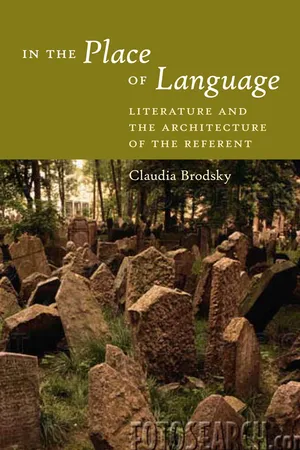
The "place" in the title of Claudia Brodsky's remarkable new book is the intersection of language with building, the marking, for future reference, of material constructions in the world. The "referent" Brodsky describes is not something first found in nature and then named but a thing whose own origin joins language with materiality, a thing marked as it is made to begin with. In the Place of Language: Literature and the Architecture of the Referent develops a theory of the "referent" that is thus also a theory of the possibility of historical knowledge, one that undermines the conventional opposition of language to the real by theories of nominalism and materialism alike, no less than it confronts the mystical conflation of language with matter, whether under the aegis of the infinite reproducibility of the image or the identification of language with "Being."
Challenging these equally naive views of language - as essentially immaterial or the only essential matter - Brodsky investigates the interaction of language with the material that literature represents. For literature, Brodsky argues, seeks no refuge from its own inherently iterable, discursive medium in dreams of a technologically-induced freedom from history or an ontological history of language-being. Instead it tells the complex story of historical referents constructed and forgotten, things built into the earth upon which history "takes place" and of which, in the course of history, all visible trace is temporarily effaced. Literature represents the making of history, the building and burial of the referent, the present world of its oblivion and the future of its unearthing, and it can do this because, unlike the historical referent, it literally takes no place, is not tied to any building or performance in space.
For the same reason literature can reveal the historical nature of the making of meaning, demonstrating that the shaping and experience of the real, the marking of matter that constitutes historical referents, also defers knowledge of the real to a later date. Through close readings of central texts by Goethe, Plato, Kant, Heidegger, and Benjamin, redefined by the interrelationship of building and language they represent, In the Place of Language analyzes what remains of actions that attempt to take the place of language: the enduring, if intermittently obscured bases, of theoretical reflection itself.
- 192 pages
- English
- ePUB (mobile friendly)
- Available on iOS & Android
eBook - ePub
About this book
Information
PART I
Goethe’s Timelessness
“to stand with a free people upon a free foundation”
[“auf freiem Grund mit freiem Volke stehn”]
[“auf freiem Grund mit freiem Volke stehn”]
FAUST, in Faust II
1. Faust’s Building:
Theory as Practice
WITH THE EXCEPTION of the remarkable discussion of Faust by Marshall Berman, whose classic, still searing dialectical analysis of modernity as both constitutive and destructive of history, concluding with Robert Moses’ devastation of the Bronx, departs from “the tragedy of development” defined for Berman in Goethe’s play, scant if any critical notice has been made of the fact that, of all the acts of transgression Faust commits over the duration of his colorful drama, it is neither seduction, nor desertion, nor even murder that brings about his wager’s loss.1 The erotic “pull” of “the eternal feminine” and contrasting pastoral fealty of Philemon and Baucis may offer the most fertile ground for commentary on Faust’s impassioned trajectory, but it is a decidedly impersonal act that brings the eventful course of his actions to an end. Sitting before the sea toward the close of Faust II, a world-weary Mephisto at his side, Faust regards natural phenomena—here, the repetitive “play” of the advancing waves (“With time the play repeats itself” [Die Stunde kommt, sie wiederholt das Spiel] [Faust II, IV.10209])—with the same contemptuous impatience he had reserved for verbal phenomena in Faust I. The thrust of Faust’s final complaint reflects and reverses his first and, in that inverted symmetry, the arc of development spanning both plays first appears revealed. For, standing with Wagner before the city gate at the opening of Faust I, the disgruntled scholar had described as “a beautiful dream” the natural scene he now rejects: “I rush to drink the [goddess’s] eternal light, / Before me the day and behind me the night, / The sky above me and under me the waves. / A beautiful dream” [Ich eile fort, ihr ew’ges Licht zu trinken, / Vor mir den Tag und hinter mir die Nacht, / Den Himmel über mir und unter mir die Wellen. / Ein schöner Traum] (Faust I, 1086–89). “Waves” rolling “below” him, and “the sky above,” it is no longer the uselessness of human learning and knowledge that inspires Faust’s anger (“Precisely what we don’t know, is what we could use / And what we do know, is of no use” [Was man nicht weiss, das eben brauchte man, / Und was man weiss, kann man nicht brauchen] [Faust I, 1066—67]) in Faust II, but rather nature’s inhuman lack of vision and ambition, the “purposeless power of unbound elements” [zwecklose Kraft unbändiger Elemente], “wave conquering wave . . . and nothing accomplished” [Da herrschet Well’ auf Welle . . . und es ist nichts geleistet] (Faust II, IV.10216–17).
Just as Faust’s earlier idealization of the pure dynamism of nature has turned in time to disenchantment with its “purposeless power,” so the very mental faculties he had once discounted as impotent now inspire him. Recognizing his separateness from nature as the positive source of an unnatural power—the intertwined abilities to analyze and act upon the “given” relations of force in nature rather than give oneself to them,2 Faust “swiftly forms plans” [Da fasst’ ich schnell im Geiste Plan auf Plan] (Faust II, IV.10227) to do for nature what she cannot do for herself. He will now divert, store and distribute the undirected “streams” of energy he “strove” to experience immediately in Faust I (1676, 1720, 1742) so as to arrive, by means of those natural energies, at an entirely artificial end, a monument not to nature’s powers but to man’s supernatural ability to turn them about, to yield a certain independent end by intervening in and altering the continuum of cause and effect. Faust’s plans would submit “the unbound elements” of nature to new operations and configurations, funneling the formless dynamism of tidal waters into mechanically sealed containers—canals for shipping—and forming matter by building dams to retrieve ocean breakfront for useable land. Rejecting the instability of the natural power he sees before him, a power always in the course of moving on, negating at every moment its own visible formations, Faust would now coerce substance from force, form from movement, extant ground from what “is” not.
Always violent in their proposals, husbanders of nature never come bidden. By turns persuasive and despotic, they ply, undermine, compel: their plans, viewed without measure as the material realization of reason itself, mean to subordinate whatever or, by the same token, whomever it is that “stands” in their way. Having performed the roles of husband and progenitor on the small and large stage with Gretchen and Helen, Faust now turns from all mimetic and allegorical theater of action to an inimitable scene and its creation, a project, rather than play, of inhuman scope: the reworking of the physical contours and qualities of the given world itself. The dream of experiencing nature as if part of nature’s own flowing, motive force (“to flow through nature’s veins” [durch die Adern der Natur zu fliessen] [Faust I, 619]), of being one with the very energy of infinite change (“only restless activity truly occupies man” [nur rastlos betätigt sich der Mann] [Faust I, 1759]), is replaced by the opposing dream of imposing permanent change through external means, of transforming nature’s fluidity into enclosed liquid masses, and ebbing, visible surfaces into durable solids. Faust’s final act on earth is just that: the founding of a new ground, or ungrounded foundation, upon the earth itself. His “land-reclamation” project does not truly aim to reclaim, nor even to replace or resituate. It would instead establish, out of natural repetitive movement and displacement, their opposite: a place which is an origin, an origin which is a place.3
Thus Faust’s original desire, for the immediate, contingent experience of sensuous reality, becomes the will to construct the independent basis for all such experience, an origin anterior to the origin of desire, an absolutely necessary or noncontingent place.4 Faust attempts to achieve on and by means of the earth what Plato’s interlocutors, unable to define justice in terms of individual experience and perception, are led by his Socrates to view on the nonanalogous model of the state. Socrates’ disingenuous comparison of the individual and the organized city as equivalent embodiments of justice distinct merely in scale (or, to recall Socrates’ graphic metaphor, as a single text written in “small” and “large letters”) replaces the irresolvable problem of knowing just human practice with an organized fiction precluding epistemological quandaries: a purely theoretical polis whose machine-like workings exclude, precisely, the human element, the ability “to imitate all things” [mimeisthai panta chremata] personified by, but not limited to, the poets explicitly banished in Republic, Bk. III.5 Just as Socrates’ new city, according to Socrates’ prescriptive theory, will remain free from contingency as long as its constituent elements maintain their prescribed relations, neither transgressing nor exchanging their particular formal functions (erga), so Faust’s constitution, from newly configured elements, of an original or fully independent, concrete place doubles as the project for a polis ontologically prior to the need for speculative political theory. Faust’s “plans” give rise to a basis for human activity that, from the outset, need never reflect on acting justly, for this is a basis or ground as independent of natural change as it is of human history. It is thus, in the most forceful (and anti-social) sense of those terms, a new or “free ground” for “a free people to stand on” [auf freiem Grund mit freiem Volke stehn] (Faust II, V.11580), a people literally, empirically set apart from the consequential, if often ontologically ungrounded events historical life entails: a people as free of those chains of historical steps and missteps as it is dependent, in its own existence, on the construction of a previously nonexistent ground.
Like Plato’s philosopher-king compelled from a cave of illusory shadow-play to stand in and see the light of the sun, Faust conceives of a place made by force from which the Good may finally be perceived, for, of all the forms of “the intelligible world”—so Plato’s Socrates—“the Good is the last to be seen.”6 But whereas Socrates makes clear he considers practice inferior to theory as a means of grasping the true reality of intelligible forms, and that his conception of the well-functioning city may instruct us about justice exactly because it is a theoretical conception, “formulated in words” rather than “realize[d] . . . in practice,” Faust demands the complete and immediate identity of thought and action, theory and practice.7 If, for Plato’s Socrates, the true measure of “things . . . described in theory” is never and can never be whether they “exist precisely in practice,” for Goethe’s Faust there is and can be no theory, properly speaking: there is and there can only be realization, and that realization must itself be material.8 That is to say, it must be built: structural rather than individual, hard rather than human, a thing of substance rather than either mimesis or speculation. Faust’s “newest world” [neust(e) Erde (Faust II, V.11566)], like Plato’s theoretical state, establishes an origin in architectonic form, the one extracted from physical matter, the other “formulated in words.” Yet for Faust to see his construction project realized, actually to see the origin of what was not before—a new time embodied in the founding of a new earth—his architectonic design must be put into practice, must be made earthly architecture, now: construction must reflect conception as if its own simultaneous mirror image. For in the passage of time between the design and realization, the thinking and building, of a thing, the architectonic moment of its origin is lost, or, rather, loses its identity: once reflected upon, that conceptual moment is doubled, re-enacted, repeated differently in time. This elision of the new into the old, of an architectonic vision into the painstaking making of architected matter, is precisely what Faust strives to avoid. Speed and immediacy are the inherently violent requirements for the forced subordination of architecture to architectonics:
What I have thought, I rush to realize;
Only the word of the master has weight.
Up from your camps, you slaves! Man for man!
Let that which I boldly conceived be seen!
Grab the tools! Stir shovel and spade!
What has been staked out must immediately come to pass.
On strict orders, rash industry
Wins the loveliest prize;
For the greatest work to be realized
A thousand hands need but one mind.
Only the word of the master has weight.
Up from your camps, you slaves! Man for man!
Let that which I boldly conceived be seen!
Grab the tools! Stir shovel and spade!
What has been staked out must immediately come to pass.
On strict orders, rash industry
Wins the loveliest prize;
For the greatest work to be realized
A thousand hands need but one mind.
[Was ich gedacht, ich eil’ es zu vollbringen;
Des Herren Wort, es gibt allein Gewicht.
Von Lager auf, ihr Knechte! Mann für Mann!
Lasst glücklich schauen, was ich kühn ersann!
Ergreift das Werkzeug! Schaufel rührt und Spaten!
Das Abgesteckte muss sogleich geraten.
Auf strenges Ordnen, raschen Fleiss
Erfolgt der allerschönste Preis
Dass sich das grösste Werk vollende
Genügt ein Geist für tausend Hände] (Faust II, V.11501–11510)
Des Herren Wort, es gibt allein Gewicht.
Von Lager auf, ihr Knechte! Mann für Mann!
Lasst glücklich schauen, was ich kühn ersann!
Ergreift das Werkzeug! Schaufel rührt und Spaten!
Das Abgesteckte muss sogleich geraten.
Auf strenges Ordnen, raschen Fleiss
Erfolgt der allerschönste Preis
Dass sich das grösste Werk vollende
Genügt ein Geist für tausend Hände] (Faust II, V.11501–11510)
Having “conceived” of a “work” whose design is itself a conception of matter, a work producing not a particular building but a general ground or foundation for building, Faust’s is the ruling “mind” for which “a thousand hands” labor in synch, and these synecdochic movers of matter are not only mindless and faceless, but bodiless. Enslaved to the “shovel and spade” they animate, the final conduits of an internal physical power they supply, these “hands” are nothing in themselves but bunches of expendable digits, rudimentary means, akin to their arithmetic namesakes, for performing another’s will. Faust’s conception of the “ground” for “a free people” yields a violently instrumentalist (“Ergreift das Wekzeug!”), thoroughly dehumanizing practice because this “master”-builder acts at once as Socrates and Socrates’ hypothesized philosopher-king. His own is the “mind,” which envisions a new earth and oversees its realization.9
Such an identification of theory with practice, idealized in theory, proves worse than murderous in practice. For, in striving to supplant the temporal difference between the two—“Let that which I boldly conceived be seen”—Faust’s attempt to render theory “immediately” material must exploit an assembled labor force in a manner unbefitting animals. Extracting energy at all hours and in absolute disregard for the life of its individual repositories, Faust neither intends nor, what is worse, conceives the change that the prosecution of his project imposes upon the corporal economy of the exploitation of labor. For the immediacy of result required by Faust’s labor project excludes from its execution even the minimal rational requirement of maintaining the life of the enslaved, favoring in the stead of the rational, a pure consumption of labor, one that effectively supplants labor (the real product alienated from a subject and converted into exchange value by an economy geared instead toward capital accumulation) with the fundamentally anti-economic principle of pure work (lacking a subject of alienation and medium of accumulation whatsoever), which is to say, work which equates to absolute corporal expenditure, work unto death. Individuals die but not so the force of work, which, as the pure, abstract form of labor, provides Faust with an operational concept free from human referents, a self-defining idea as noncontingent as the concrete place Faust would have such force make.10
A theory that conceives of itself as a praxis requires pure, universally applicable force, not limited, cognitive particulars, and in order to perform its identity with praxis it proceeds per force, with haste. The product it yields must appear unprecedented even by conception if that product, while thoroughly artificial, is nonetheless to be viewed as entirely self-identical: as a replacement of pre-existing natural relations that seems instead to pre-date rather than replace these. The ordered removal and consequent, if unplanned, murder of Philemon and Baucis—Faust to Mephistopheles: “So go and get rid of them [literally: “put them aside”]!” [So geht und schafft sie mir zur Seite!] (Faust II, V.11275)—recalls and revises, now as wholly innocent of sensory entrapment and seduction, the deathly consequences of Gretchen’s plight in Faust I: the condemnation of provincial individuals in the context of a building project is specifically not the by-product of corporeal desire satisfied and spent. It is rather violence committed with a view to aesthetic absolutism, Faust’s stated desire to “see” and “oversee” “all [he] has done” from a single, dominating perspective, i.e., “in one view” (“To see, all that I have done/To oversee with one glance / the masterpiece of the human spirit” [Zu sehn, was alles ich getan, / Zu überschaun mit einem Blick / Des Menschengeistes Meisterstück], [Faust II, V.11246–48]), that motivates the destruction of the aged couple.11 As discussed later in this study, the introduction and “setting aside” of the importunely located “Philemon” and “Baucis” present a perfectly complementary inversion of Goethe’s historically precedent use of these conventional pastoral names: “Philemon, with his Baucis” first appear in Die Wahlverwandtschaften (Chapter One of Part Two), as the narrator describes the pleasant, purely visual effect of Charlotte’s removal of all evidence of the location of the dead from the community graveyard.12
In direct contrast to their mention in Goethe’s novel, in Faust II the classically derived Philemon and Baucis represent not complaisant spectators of, but temporal obstacles to the completion of a fully self-present or exclusively aesthetic “masterwork.” Like their common history and residence in a “space” defined only by the presence of “linden trees” [Lindenraum], embodiments of nature that, while similarly classical in origin, are also equally visually obstructive—Faust: “My high estate, it is not pure / The linden-space with the brown built thing / and decaying little church is not mine” [Der Lindenraum, die braune Baute, / Das morsche Kirchlein ist nicht mein] (Faust II, V.11156–8)—the shared death of Philemon and Baucis, and grisly report of their incineration alongside linden trees s...
Table of contents
- Cover Page
- Title Page
- Copyright Page
- Dedication
- CONTENTS
- Acknowledgments
- Preface
- Introduction Signs of Place
- PART I Goethe’s Timelessness
- PART II Built Time
- AFTERWORD Gravity: Metaphysics of the Referent
- Footnotes
Trusted by 375,005 students
Access to over 1.5 million titles for a fair monthly price.
Study more efficiently using our study tools.
Frequently asked questions
Yes, you can cancel anytime from the Subscription tab in your account settings on the Perlego website. Your subscription will stay active until the end of your current billing period. Learn how to cancel your subscription
No, books cannot be downloaded as external files, such as PDFs, for use outside of Perlego. However, you can download books within the Perlego app for offline reading on mobile or tablet. Learn how to download books offline
Perlego offers two plans: Essential and Complete
- Essential is ideal for learners and professionals who enjoy exploring a wide range of subjects. Access the Essential Library with 800,000+ trusted titles and best-sellers across business, personal growth, and the humanities. Includes unlimited reading time and Standard Read Aloud voice.
- Complete: Perfect for advanced learners and researchers needing full, unrestricted access. Unlock 1.5M+ books across hundreds of subjects, including academic and specialized titles. The Complete Plan also includes advanced features like Premium Read Aloud and Research Assistant.
We are an online textbook subscription service, where you can get access to an entire online library for less than the price of a single book per month. With over 1.5 million books across 990+ topics, we’ve got you covered! Learn about our mission
Look out for the read-aloud symbol on your next book to see if you can listen to it. The read-aloud tool reads text aloud for you, highlighting the text as it is being read. You can pause it, speed it up and slow it down. Learn more about Read Aloud
Yes! You can use the Perlego app on both iOS and Android devices to read anytime, anywhere — even offline. Perfect for commutes or when you’re on the go.
Please note we cannot support devices running on iOS 13 and Android 7 or earlier. Learn more about using the app
Please note we cannot support devices running on iOS 13 and Android 7 or earlier. Learn more about using the app
Yes, you can access In the Place of Language by Claudia Brodsky in PDF and/or ePUB format, as well as other popular books in Literature & German Literary Criticism. We have over 1.5 million books available in our catalogue for you to explore.