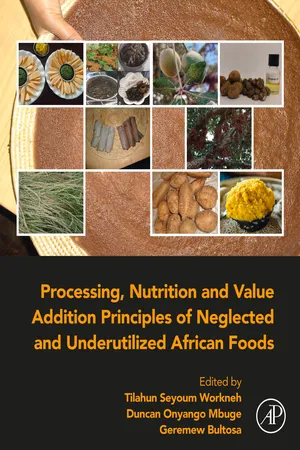
eBook - ePub
Processing, Nutrition and Value Addition Principles of Neglected and Underutilized African Foods
- 594 pages
- English
- ePUB (mobile friendly)
- Available on iOS & Android
eBook - ePub
Processing, Nutrition and Value Addition Principles of Neglected and Underutilized African Foods
About this book
Africa's agroclimatic conditions are conducive to a diverse array of indigenous foods, from vegetables, fruits, and spices to fungi, insects, and roots. However, scientific documentation of traditional preservation, processing and value addition of these species and their potential to heal and nourish, is not well known to the global population. Processing, Nutrition and Value Addition Principles of Underutilized African Foods introduces traditional methods of processing and preserving indigenous foods from Africa while reporting on the commercial potential, and nutritional constituents that contribute to a more healthful society and a sustainable planet. Written by a collaboration of authors from different parts of Africa and around the world, Processing, Nutrition and Value Addition Principles of Underutilized African Foods explores the neglected and underutilized agricultural and botanical diversity of Africa. Authors show how certain species such as African nightshades, sourplum, monkey oranges, ancient grains, edible insects and more, can have health, nutrition and functional benefits while contributing to a sustainable global food system and potentially helping combat food insecurity. The taxonomy of each neglected species will be discussed along with distribution, planting area, yield and loss, and waste. The book also provides a comprehensive view of the societal attitudes towards these foods and delves into the reasons behind their neglect and underutilization, despite their inherent health benefits.
- Explores traditional neglected and underutilized agricultural and botanical diversity of Africa
- Highlights foods' health, nutrition and functional benefits and contribution to a sustainable global food system
- Addresses preparation, preservation, processing and value addition of indigenous foods
- Emphasizes global potential of indigenous foods for wider applications such as food insecurity
- Offers cultural and societal perceptions surrounding traditional African foods that are often sidelined in modern diets
Information
Subtopic
Food ScienceTable of contents
- Title of Book
- Chapter 1.1. Neglected and underutilized crops of Africa: Diversity and distribution
- Chapter 1.2. Neglected and underutilized crops of Africa: Challenges and opportunities
- Chapter 1.3. Good agricultural practices of water yam production
- Chapter 1.4. Loss and waste of neglected and underutilized foods in Africa
- Chapter 2.1. Amaranth leaves and seeds nutrients and bioactive compounds potential for nutrition and health
- Chapter 2.2. Nutritional potential and commercial viability of a traditional Nigerian snack Kumbam produced from maize (Zea mays) and groundnut (Arachis hypogea) blends
- Chapter 2.3. Exploring the commercialization of nutrient-dense Moimoi and Akara made from cowpea (Vigna unguiculata) and Moringa oleifera seed flour blends
- Chapter 2.4. Advances in preservation and transformation of starchy African tubers: Current status, challenges, and opportunities
- Chapter 2.5. Nutritional quality and health benefits of okra (Abelmoschus esculentus L.): Ethiopian indigenous vegetable
- Chapter 2.6. Determination of phytochemicals in sweet potatoes from the PNG University of Technology farm and selected varieties from the Lae main market
- Chapter 2.7. Processing, nutrition, and value-addition principles of African Black Nightshade (Solanum nigrum) leafy vegetables
- Chapter 2.8. Africa Girgir (Eruca sativa): Nutritional composition and bioactive compounds
- Chapter 2.9. Samma (Urtica simensis) leaves nutrient composition and its potential health benefits
- Chapter 2.10. Nutritional content, phytochemicals, and biological activity in leafy vegetables
- Chapter 2.11. Food and nonfood applications of the African moringa plant (Moringa stenopetala)
- Chapter 2.12. Nutritional and cultural significance of green gold pumpkin leaves and seeds in Africa
- Chapter 2.13. Aflatoxin formation in African leafy vegetables
- Chapter 3.1. Citron watermelon (Citrullus lanatus var. citroides) physicochemical properties and its use in the indigenous food products
- Chapter 3.2. The orphan crop, Kei apple (Dovyalis caffra) is native and growing in the Kei river of Eastern Cape, South Africa
- Chapter 3.3. Direct and indirect contribution of fig (Ficus sur Cv. Forssk) fruits to food security in Ethiopia
- Chapter 3.4. Drying and utilization of pumpkin (Cucurbita maxima and C. pepo) flesh flour for cookie production
- Chapter 3.5. Distribution of African wild cucumbers and their potential use in the food and pharmaceutical industries
- Chapter 4.1. Industrial potential of Anchote (Coccinia abyssinica), an endemic tuber to Ethiopia: Nutritional antinutritional profiles and product development
- Chapter 4.2. Nutrition, processing, value addition, and health benefit of taro (Colocasia esculenta L.)
- Chapter 4.3. Edible freshwater macrophyte (Nymphaea lotus) of Africa: Potential and prospect as food source
- Chapter 4.4. Africa figl (Raphanus sativus) nutritional composition and bioactive compounds
- Chapter 4.5. Water yam processing, nutritional composition, and quality
- Chapter 5.1. Teff (Eragrostis tef) and composite flour injera-potential toward mainstream global baked product
- Chapter 5.2. Impact of grain fermentation and malting time on proximate composition and mineral content of flour from Aksum finger millet (Eleusine coracana) that used for Ethiopian Injera making
- Chapter 5.3. Functional properties of roasted bishoftu fenugreek seed (Trigonella foenum graecum L.) varieties grown in Oromia Regional State, Ethiopia
- Chapter 5.4. Unlocking the potential of local oats composition, indigenous processing, and functional properties
- Chapter 6.1. Karkade (Hibiscus sabdariffa) nutritional composition and bioactive compounds
- Chapter 6.2. Bambara groundnut (vigna subterranean) nutrition, processing, health benefits, and value addition
- Chapter 6.3. Mongongo/manketti (Schinziophyton rautanenii (schinz) fruits and seeds nutrients and bioactive compounds, indigenous use and value addition
- Chapter 7.1. Consumption of fish in tropical Africa and its role in sustainable agrifood system
- Chapter 8.1. Harvesting, processing, nutrition and utilization of Shea nut tree caterpillars (Cirina buytrosperm)
- Chapter 9.1. Utilization of wild fungi as food and medicine in Africa
- Chapter 10.1. Nutritional properties, health benefits and impact of drying on quality of different sweet potato varieties
- Chapter 11.1. Empowering communities: The importance of underutilized, nutrient-rich indigenous crops in Sub-Saharan Africa
- Chapter 11.2. Cocoyam for food security in Kenya: Insights into production, postharvest practices and consumption
- Chapter 12.1. Sustainable food packaging innovations for securing the traditional food systems in Africa
- Chapter 12.2. Nutritional, functional and sustainability of shiro: An Ethiopian pulse-based culinary and its global potential
- Index
Trusted by 375,005 students
Access to over 1.5 million titles for a fair monthly price.
Study more efficiently using our study tools.
Frequently asked questions
Yes, you can cancel anytime from the Subscription tab in your account settings on the Perlego website. Your subscription will stay active until the end of your current billing period. Learn how to cancel your subscription
No, books cannot be downloaded as external files, such as PDFs, for use outside of Perlego. However, you can download books within the Perlego app for offline reading on mobile or tablet. Learn how to download books offline
Perlego offers two plans: Essential and Complete
- Essential is ideal for learners and professionals who enjoy exploring a wide range of subjects. Access the Essential Library with 800,000+ trusted titles and best-sellers across business, personal growth, and the humanities. Includes unlimited reading time and Standard Read Aloud voice.
- Complete: Perfect for advanced learners and researchers needing full, unrestricted access. Unlock 1.5M+ books across hundreds of subjects, including academic and specialized titles. The Complete Plan also includes advanced features like Premium Read Aloud and Research Assistant.
We are an online textbook subscription service, where you can get access to an entire online library for less than the price of a single book per month. With over 1.5 million books across 990+ topics, we’ve got you covered! Learn about our mission
Look out for the read-aloud symbol on your next book to see if you can listen to it. The read-aloud tool reads text aloud for you, highlighting the text as it is being read. You can pause it, speed it up and slow it down. Learn more about Read Aloud
Yes! You can use the Perlego app on both iOS and Android devices to read anytime, anywhere — even offline. Perfect for commutes or when you’re on the go.
Please note we cannot support devices running on iOS 13 and Android 7 or earlier. Learn more about using the app
Please note we cannot support devices running on iOS 13 and Android 7 or earlier. Learn more about using the app
Yes, you can access Processing, Nutrition and Value Addition Principles of Neglected and Underutilized African Foods by Tilahun Seyoum Workneh,Duncan Onyango Mbuge,Geremew Bultosa in PDF and/or ePUB format, as well as other popular books in Technology & Engineering & Food Science. We have over 1.5 million books available in our catalogue for you to explore.