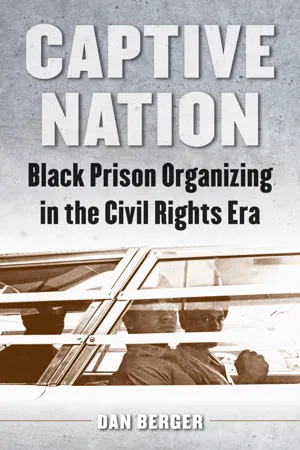
In this pathbreaking book, Dan Berger offers a bold reconsideration of twentieth century black activism, the prison system, and the origins of mass incarceration. Throughout the civil rights era, black activists thrust the prison into public view, turning prisoners into symbols of racial oppression while arguing that confinement was an inescapable part of black life in the United States. Black prisoners became global political icons at a time when notions of race and nation were in flux. Showing that the prison was a central focus of the black radical imagination from the 1950s through the 1980s, Berger traces the dynamic and dramatic history of this political struggle.
The prison shaped the rise and spread of black activism, from civil rights demonstrators willfully risking arrests to the many current and former prisoners that built or joined organizations such as the Black Panther Party. Grounded in extensive research, Berger engagingly demonstrates that such organizing made prison walls porous and influenced generations of activists that followed.
- 424 pages
- English
- ePUB (mobile friendly)
- Available on iOS & Android
eBook - ePub
About this book
Information
Topic
Scienze socialiSubtopic
Diritto penaleChapter One: The Jailhouse in Freedom Land
We in the nonviolent movement have been talking about jail without bail for two years or more. The time has come for us to mean what we say and stop posting bond. . . . This will be a Black baby born in Mississippi and thus, wherever he is born, he will be born in prison. I believe that if I go to jail now it may help hasten that day when my child and all children will be free—not only on the day of their birth but for all their lives.
—DIANE NASH, public statement on her refusal to cooperate with the court system (1961)
—DIANE NASH, public statement on her refusal to cooperate with the court system (1961)
It was unlike any testimony the committee had heard before. Then again, there was little typical about the August 1964 Democratic National Convention. Gathered in Atlantic City, the Democratic Party was experiencing the most profound political challenge imaginable as a group of black Mississippians, most of them tenant farmers, worked to unseat the openly white supremacist delegation of that state. The Mississippi Freedom Democratic Party formed officially on April 24 of that year, emerging from years of tireless work by civil rights activists in the Sunflower State. Four months after it began, the Freedom Democrats shook the national Democratic Party to its core. They gathered in front of the 110-person credentials committee to argue that they, not the all-white delegation of Mississippi Democrats that had also made the trek to New Jersey, should be seated as the state’s voting members of the convention. The Freedom Democrats submitted to the committee between four and five thousand briefs in support of their position; for their part, the regular Democrats filed only sixty briefs and denied all claims of black disenfranchisement.
It was not the briefs that captured the nation’s attention. Rather, it was the testimony of Fannie Lou Hamer, a forty-seven-year-old sharecropper. In just eight minutes, Hamer offered a vivid portrait of life in the apartheid South. She described a life of confinement and brutality. Hamer told the committee and the assembled media of the vicious violence she had encountered a year earlier in the Montgomery County Jail in Winona, Mississippi. Hamer and four others had attempted to desegregate the bathroom and café at the bus station on June 9, 1963. Police arrested them for their efforts. Police had kicked and cursed at Hamer as they arrested her and had subsequently beaten young activists June Johnson and Annell Ponder. James West and Hamer had received beatings from other prisoners, acting on orders from the police. Two black male prisoners had beaten Hamer all over her body with blackjacks, in the process attempting to remove her clothes so that their blows would land directly on her skin and so that the abuse would be amplified by the specter of sexual assault. After the beating, Hamer’s skin was like “raw cowhide.”1
Hamer testified that the five activists had survived the assaults through their faith and determination and by singing freedom songs. She concluded her short speech with a pointed indictment: “If the Freedom Democratic Party is not seated now I question America. Is this America, the land of the free and the home of the brave, where we have to sleep with our telephones off the hook because our lives be threatened daily, because we want to live as decent human beings in America?”2
The violence that Mississippi jailers inflicted on Hamer and her fellow activists was nothing new to the southern prison system. The county jail where the civil rights activists were beaten sits seventy miles from Parchman prison farm, which had for nearly a century been notorious for its brutality. Parchman rivaled Louisiana’s Angola Prison, which sits on the grounds of a former plantation, as the harshest prison in a land of harsh prisons. Since the end of Reconstruction, southern prisons had earned a reputation as sites of extreme racial violence. The fall of abolition democracy by 1877 ushered in an era of racial retrenchment that saw increasing authority vested in institutions of policing and punishment. The criminal justice system became a vital implement through which whites tried to discipline black workers. These developments were constitutive, not coincidental. Embedded in the southern Democrats’ dismantling of Reconstruction was the criminalization of black civic and political life.3
Beginning in the late nineteenth century and backed by the investment of northern capital, southern businesses (especially industrial but also agrarian) used black “criminals” the way they once had used black slaves. Black men and women continued to serve as a reservoir of cheap labor. Arguably even less concerned for the health of their captive workers now than under slavery, southern elites enforced a brutal regime of forced labor that violently punished even the slightest transgressions with imprisonment. Black prisoners resisted as they could, often through individual acts of sabotage or self-mutilation. The convict leasing system—dubbed by one recent chronicler the “re-enslavement of black Americans”—continued until World War II. Convict leasing was the premier element that made the southern legal apparatus—from the police to the courthouse and the prison—a formidable foundation of the Jim Crow South. Even after the practice of convict leasing subsided, the southern criminal justice system remained a bastion of white supremacy.4
Until the civil rights movement challenged the foundations of the Jim Crow order, the criminal justice system openly coerced black labor and enforced white supremacy. As journalist Douglas Blackmon reports, “More than 12,500 people were arrested in Alabama in 1928 for possessing or selling alcohol; 2,735 were charged with vagrancy; 2,014 with gaming; 458 for leaving the farm of an employer without permission; 154 with the age-old vehicle for stopping intimate relations between blacks and whites: adultery.”5 Throughout the first half of the twentieth century, whites freely terrorized blacks through the law—with economic reprisals, with political disenfranchisement—and then used the law to evade punishment. White extralegal violence against blacks, especially brutal throughout the southern Delta, was so pervasive as to be functionally and sometimes even technically legal. At the same time, whites could challenge any act of black civic life, no matter how constitutionally protected, without fear. The level of violence, both legal and extralegal, against black southerners was so immense that it took a great degree of support from northern black communities, whose members had fled the region during the Great Migration, for the civil rights movement to achieve success in the South.6
Criminalization and incarceration provided the ideological basis for white supremacy from the end of slavery forward, not just in the South but nationally. Across the country, white elites held that “segregation maintains law and order, while integration breeds crime.” Indeed, as political scientist Naomi Murakawa puts it, “The U.S. did not confront a crime problem that was then racialized; it confronted a race problem that was then criminalized.”7 The management of race increasingly transpired through the language and policy of crime. The specter of interracial marriage had long been white supremacists’ rationale for using carceral as well as extralegal force to maintain their way of life.8 Yet as black activists became more emboldened in pursuit of their freedom dreams, their violations of segregationist laws “only further reinforced the idea that black civil rights activists were disrespectful agitators and deliberate lawbreakers.”9 Law and order, the rallying cry of segregation, would become the language of American politics writ large.
As the South modernized white supremacy, it made increasing use of incarceration. From Virginia and Georgia to Florida and Texas, southern states used their jail cells to aggregate racial injustice. The most spectacular abuses, however, occurred in Mississippi and neighboring Alabama—two states that would become central battlegrounds in the fight over civil rights in the mid-twentieth century. In a region becoming known globally for its gruesome spectacles of white supremacy, Alabama and Mississippi stood out with regard to the horrific histories of convict leasing and mob violence. Across the twentieth century, deep, abiding connections persisted between the police and the extrajudicial infrastructure of white supremacist violence in the form of the Ku Klux Klan. Indeed, both the police and the Klan constituted elements of the “police power,” the broadly conceived capacity of state agents to punish in the name of enforcing public order.10
The police power entails policing, laws, and the institutions that regulate social norms. It is a question of governance in the service of state power. While this capacious notion of the police power has preoccupied a range of legal thinkers since the eighteenth century, its importance in the United States increased in the aftermath of slavery. The Thirteenth Amendment prohibited slavery “except as punishment for a crime, whereof the party shall have been duly convicted.” This wording wrote slavery into law in the form of penal punishment, thereby providing the framework for replacing the era of Radical Reconstruction with the era of Jim Crow racial subjugation.11
The prison and the larger carceral system of which it was a part proved a central component of black life in the twentieth century. And between 1955 and 1965, the combination of black civil disobedience and white civil disorder continually converged around the jail cell.
Both black liberationists and white segregationists saw the prison as holding the key to a larger social order, though they differed about whether that order should be rooted in universal human equality or governed by white supremacy. Segregationists relied on imprisonment as a crucial element of the police power, using the law to do in practice what Cold War anticommunism did as ideology: punish, stigmatize, and divide.12 Black activists, meanwhile, boldly endeavored to remake the prison into a site of liberation. The movement interrupted the most haunting power of imprisonment, the stigma of criminality, and instead made it synonymous with moral authority. These efforts to amplify and to interrupt the police power echoed in the years to come: as white elites experimented with mass incarceration, black activists learned the potency of dramatic action against confinement. The battles in southern cities and jail cells established some of the parameters that would later come to define the struggle in prisons around the country.
Consequently, the best place to know freedom was where it was most elusive. For the civil rights movement, jail served many purposes: it was a rite of passage, a form of community, and a tool for political mobilization. Imprisonment was so common to the civil rights movement that historians often take it for granted. Movement partisans breathed an air thick with the threat of incarceration, earning their stripes by surviving a night or more in jail.13
This intimacy with incarceration was part of a larger battle over the meaning of freedom in postwar America. White power brokers and black activists—North and South, pacifist and otherwise—took up the issue of legality and criminality to battle over morality. This shared investment in the legal system as a site of contestation ultimately yielded the prison movement of the late 1960s and 1970s. For the prison to emerge as a site of political struggle, the wider criminal justice system of which it was a part needed to be problematized. And the civil rights movement did just that. The emergence of revolutionary prisoners such as George Jackson and Assata Shakur owes as much to civil rights activists Martin Luther King Jr. and Fannie Lou Hamer as it does to stalwart nationalists such as Malcolm X and Audley “Queen Mother” Moore.
For all its talk of integration, the southern civil rights movement broadcast the seeds of nationalism, or at least a certain protonationalism that can be seen in its direct-action approach to prison. In their effort to fill the jails, activists put forth a face of unshakable black (and multiracial) unity in the face of white authority. King’s consistent plea for unity among the civil rights organizations, including a willingness to downplay certain strategic differences, demonstrated a nationalistic willingness to sublimate difference for the sake of political and racial unity. Civil rights organizations positioned this unity as a necessary antidote to the captivities of the state. As a result, direct action united the civil rights movement with the burgeoning Black Power movement. Both shared a black nationalist notion of racial oppression and racial solidarity in the face of overwhelming state repression. For all their philosophical and political differences, then, both the Southern Christian Leadership Conference (SCLC) and the Nation of Islam (NOI), among others, defined blackness in this era as a condition of captivity.
Speaking on the first night of the Montgomery Bus Boycott in 1956—and in his first mass movement speech—King claimed to speak for all black people “tired of going through the long night of captivity. And now we are reaching out for the daybreak of freedom and justice and equality.”14 Student Nonviolent Coordinating Committee (SNCC) leader Diane Nash echoed this theme of black captivity five years later. Facing jail, the pregnant Nash said that all black children are “born in prison.” Echoing the fill-the-jails ethos of the moment, Nash proclaimed that her willingness to “go to jail now . . . may help hasten that day when my child and all children will be free.”15 Nash refused the judge’s patriarchal benevolence, saying she would rather serve two years in prison than pay a fine or appeal her sentence. Not wanting to contravene the bizarre algorithm of the South’s gendered racism, the judge “simply declined to impose the two-year sentence. Nash ended up serving only ten days in jail for refusing to move to the side of the courtroom reserved for blacks.”16
This notion of blackness as uninterrupted confinement is typically associated with a later phase of northern Black Power that developed a theory of “internal colonialism” that characterized black people as a nation captive within a nation, defined either as a “white nation” or simply the American nation. The NOI, the Black Panther Party, the Republic of New Afrika, and similar groups deserve credit for popularizing a notion of racial confinement. Yet southern civil rights activists also engaged this line of reasoning; SNCC leader Stokely Carmichael recalled that “‘nationalism’ was no exotic import from Northern ghettoes, but indigenous to the southern communities out of which [SNCC activists] came.”17 Their entanglements with the most dreaded southern institution facilitated their ideas that race and freedom were grounded in a carceral experience.
The fact that women civil rights activists could be attacked with the same vitriol and incarcerated at the same rate as their male counterparts lent credence to civil rights activists’ nationalistic claims: all black people, and certainly those who challenged white supremacy, were being incarcerated. And in the South more than the North, this short-term mass incarceration meant that black women who fulfilled certain standards of respectability could emerge as symbols of black radicalism. This gendered politics of respectability was bound up with the South’s sexual citizenship, where black women experienced racism in the form of sexual violence at the hands of white men. By refusing to be bullied in the streets by police or vigilantes, by exiting the domestic sphere and embracing potential assault through incarceration, black women activists such as Rosa Parks and Diane Nash demonstrated a subversive respectability. Their organizing allowed for the creation of mid-1970s defense campaigns focusing on black women who challenged sexual violence, such as Joan Little and Dessie Woods. These subsequent campaigns thrived without attempting to appeal to middle-class notions of respectability.18
This enthusiasm for direct action became a bedrock principle of activism for years to come. In writings from and about jail, civil rights groups contributed to an American theory of antiracist revolution that sought to polarize racial injustice. That polarization, toward which Black Power theorists of armed struggle also worked, proved central in other political struggles against white supremacy. The civil rights movement, therefore, initiated a broader spectacular politics that the Black Power movement would later take up and take in new directions. Southern pacifists and other civil rights workers, not Black Power militants, first selected bombast and spectacle as an orientation for promo...
Table of contents
- Cover Page
- Captive Nation
- Copyright Page
- Dedication
- Epigraphs
- Contents
- Illustrations
- Preface
- Abbreviations
- Introduction
- Chapter One: The Jailhouse in Freedom Land
- Chapter Two: America Means Prison
- Chapter Three: George Jackson and the Black Condition Made Visible
- Chapter Four: The Pedagogy of the Prison
- Chapter Five: Slavery and Race-Making on Trial
- Chapter Six: Prison Nation
- Epilogue: Choosing Freedom
- Notes
- Bibliography
- Acknowledgments
- Index
Trusted by 375,005 students
Access to over 1.5 million titles for a fair monthly price.
Study more efficiently using our study tools.
Frequently asked questions
Yes, you can cancel anytime from the Subscription tab in your account settings on the Perlego website. Your subscription will stay active until the end of your current billing period. Learn how to cancel your subscription
No, books cannot be downloaded as external files, such as PDFs, for use outside of Perlego. However, you can download books within the Perlego app for offline reading on mobile or tablet. Learn how to download books offline
We are an online textbook subscription service, where you can get access to an entire online library for less than the price of a single book per month. With over 1.5 million books across 990+ topics, we’ve got you covered! Learn about our mission
Look out for the read-aloud symbol on your next book to see if you can listen to it. The read-aloud tool reads text aloud for you, highlighting the text as it is being read. You can pause it, speed it up and slow it down. Learn more about Read Aloud
Yes! You can use the Perlego app on both iOS and Android devices to read anytime, anywhere — even offline. Perfect for commutes or when you’re on the go.
Please note we cannot support devices running on iOS 13 and Android 7 or earlier. Learn more about using the app
Please note we cannot support devices running on iOS 13 and Android 7 or earlier. Learn more about using the app
Yes, you can access Captive Nation by Dan Berger in PDF and/or ePUB format, as well as other popular books in Scienze sociali & Diritto penale. We have over 1.5 million books available in our catalogue for you to explore.