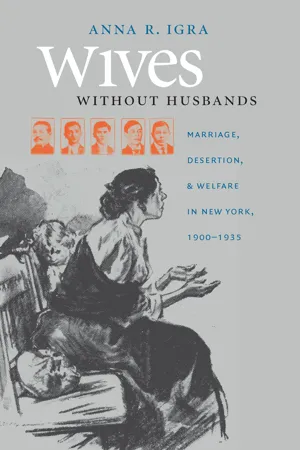
Shedding new light on contemporary campaigns to encourage marriage among welfare recipients and to prosecute “deadbeat dads,” Wives without Husbands traces the efforts of Progressive reformers to make “runaway husbands” support their families. Anna R. Igra investigates the interrelated histories of marriage and welfare policy in the early 1900s, revealing how reformers sought to make marriage the solution to women’s and children’s poverty.
Igra taps a rich trove of case files from the National Desertion Bureau, a Jewish husband-location agency, and follows hundreds of deserted women through the welfare and legal systems of early twentieth-century New York City. She integrates a broad range of topics, including Americanization as a gendered process, breadwinning as a measure of manhood, the relationship between consumer culture and social policy formation, the class dimensions of family law, and the Jewish community as a source of welfare policy innovation. Igra analyzes the history of antidesertion reform from its emergence in social policy debates, through the establishment of domestic relations courts, to Depression relief programs. She shows that early twentieth-century reformers, by attempting to make instrumental use of poor people’s intimate relations, anticipated welfare policies in our own time that promote marriage as an answer to poverty.
eBook - ePub
Wives without Husbands
Marriage, Desertion, and Welfare in New York, 1900-1935
- 184 pages
- English
- ePUB (mobile friendly)
- Available on iOS & Android
eBook - ePub
About this book
Information
Topic
Scienze socialiSubtopic
Storia nordamericanachapter 1
They Need Not Become a Burden to the State
In this country it is not possible for a healthy man to throw all work and worry about making a living onto his wife while he goes idle . . . , as one sees in every town and city in Russia. The court will compel such a man to do his duty to his wife and children just as his wife desires.
The Americans, who are the most civilized people in the world, treat their women with the greatest respect and tenderness. The Talmudic sages teach us also to appreciate and respect our women to the highest degree, but the circumstances of our dark lives in the European diaspora made many men impractical people and idlers, accustomed to living from the toil and care of their wives. In this free land that kind of behavior won’t do. Here the man must work and the woman stay at home, run the house, and raise the children.
—Educational Alliance, 1903
At the turn of the twentieth century, a Jewish immigrant could learn what it would mean to become an American by reading the Yiddish pamphlet Sholom Aleykhem tsu Immigranten (Welcome, Immigrants), published by the Educational Alliance. Between the opening explanation of the rights of Americans under the Constitution and the closing patriotic songs (the national anthem and “Columbia, the Gem of the Ocean”), the tract instructed new arrivals about the differences between the Old World and the New. The Educational Alliance, a Jewish settlement house in New York City, considered it essential for eastern European immigrants to know that a proper Jewish American husband supported his domesticated wife.1
Nonsupport, the Educational Alliance implied, was a throwback to a less civilized place and time. The pamphlet framed immigration as a movement from darkness to light and urged eastern European Jews to adopt “enlightened” American middle-class gender ways. Doing so would not necessitate abandoning Jewish tradition, it claimed, but would instead allow for the fulfillment of ancient prescriptions. A family deserter therefore betrayed both American expectations and those of his own people.
Emphasizing breadwinning as a core component of American manhood was by no means unique to the Educational Alliance or the Jewish community. Nor was the equation of middle-class gender norms with “civilization.”2 Indeed, Jewish family reformers were able to galvanize the campaign against desertion in New York precisely because other Progressives shared such values. They built on a long-standing middle-class ideal of men as providers that was increasingly shared by working-class men. Before coming to the United States, Jewish men had already encountered the image of the male breadwinner as a sign of modernity. Jewish charity workers, like their Catholic counterparts, participated in solidifying this masculine ideal through their work with immigrants.3
Among ethnic groups absorbing an influx of new immigrants, Jews were unusual in the attention they gave to desertion. The Catholics who did address desertion as a public issue tended to belong to the Society of St. Vincent de Paul, an all-male organization particularly concerned with male behavior. The major Catholic charities dealt with deserted families on an individual basis, but they did not define desertion as a distinct social problem requiring major policy initiatives. In contrast, Jews campaigned against desertion in their community and at the same time pressed for it to receive priority on the agenda of American Progressive reform.
The greater Jewish emphasis reflected the way desertion as a communal concern developed abroad and crossed the Atlantic with immigrants. Perhaps more significantly, the composition of the immigrant population presented the established American Jewish community with both opportunities and potential problems. Unlike many immigrant groups, Jewish arrivals comprised entire families of men, women, and children. Clearly, the Educational Alliance viewed this as an opportunity to reconstruct gender. But the possibility also existed that immigrant men would remain unreconstructed. Anxious American Jews envisioned the many Jewish women and children who would be left destitute and potentially dependent on charity. A large and visible dependent Jewish population, they believed, would threaten both future immigration and the acceptance of Jews by their host country.
REMAKING JEWISH GENDER
Two million eastern European Jews entered the United States in the decades between approximately 1880 and the First World War. The majority came from the Russian Empire, where most had been confined to the twenty-five western provinces that constituted the Pale of Settlement. Leaving behind increasing economic hardship and antisemitism, they came to stay. They were met by an American Jewish community itself made up of relatively recent immigrants. Between 1830 and 1870, approximately 150,000 Jews came to the United States from central Europe seeking political emancipation and economic opportunity.4 Their story had been one of remarkable upward mobility, and by the time the eastern Europeans arrived, they had built a substantial middle class. The eastern European newcomers, in their vast numbers, heightened the visibility of Jews in America just as the community was facing resurgent antisemitism and nativism. Motivated by a sense of kinship as well as trepidation about the effect of the immigrants on American public opinion, more established Jews sought to protect, aid, and uplift the new arrivals.5 The National Desertion Bureau (NDB), an agency that aimed to regulate the behavior of working-class Jewish husbands, reflected the interaction between the philanthropic and Americanizing impulses of the established community and the legacy that the newcomers brought with them from eastern Europe.
The post-1880 Jewish immigration was a family affair. Compared to other immigrant groups, eastern European Jews had a more even sex ratio and a higher proportion of children. Over half traversed the ocean in complete family groups, while others sent someone ahead—typically a husband or a daughter—who brought the rest over within two or three years.6 There were very few “birds of passage”—men who, like many Italian immigrants, came without their families and planned to return home after working and saving in the United States. Jews came to stay—and most of them stayed in New York City, where by 1915 they constituted one-fourth of the population.7 Relatives and landsleit (immigrants from the same place) eased the transition to their new home, and charities instructed immigrants on how to adjust to American ways of work and family.
Immigration neither “uprooted” immigrant Jews from a stable, traditional society nor completely “transplanted” their eastern European way of life.8 Jews in eastern Europe were already experiencing rapid change before coming to the United States. In the last decades of the nineteenth century, they faced worsening economic conditions, aggravated by occupational and residential restrictions, and dislocations caused by the beginnings of industrialization in the Russian Empire. Those who emigrated were primarily skilled urban artisans facing rapid downward mobility, not rural peasants. In the United States, they adapted to available opportunities by parlaying their manufacturing experience into jobs in the garment industry and other consumer goods industries.
Culturally as well as economically, immigration represented neither an abandonment of tradition in favor of modernity nor the wholesale relocation of an age-old way of life. Even before eastern European Jews had crossed the ocean, many had begun to reassess their lives as Jews, as men and women, and as family members. New literary and intellectual currents encouraged the development of secular perspectives, instead of or in combination with traditional Judaism. The Russian government interfered with the rabbinate and fomented distrust of communal leaders charged with implementing oppressive government policies, contributing to the fragmentation and decline in rabbinic authority. Changing economic conditions only aggravated the challenges to Jewish mores and ways of life, including marriage and family life, that loosened the control that rabbis, communal leaders, and parents exercised over the young. These developments contributed to the sense of instability that was captured in a domestic metaphor: the “crisis in the family” that became a topic of debate in eastern European Jewish communities in the era of mass migration.9
Jews in nineteenth-century Russia had both emotional and material incentives to form families. They married for love, affection, and companionship, even when parental control over the match precluded free choice of a partner.10 In Jewish culture, a woman fulfilled her highest calling by marrying and caring for her children and her husband; a spinster’s life was difficult and considered pitiful. Men were obligated to marry under rabbinic law. Though a man could excel in other arenas—for example, by becoming an accomplished scholar—marriage also provided many advantages. First, there was the dowry provided by his wife’s parents for his use during the marriage (it was to be returned to the wife in the event of a divorce). Whether it was a sum of money or a stake in a business, the dowry contributed to the couple’s ability to maintain themselves and their children. A husband might also receive kest—a number of years when his wife’s parents supported him in their home while he continued his Talmudic education or learned a trade. While the move to the wife’s family home could generate some tension and a longing for his own parents, a young man could profit materially from a match.11
Only rarely, however, did a Jewish husband enjoy the luxury of remaining a Talmudic scholar supported by his wife and her family. Most men scrambled to make a living. Jewish artisans were employed seasonally, often steadily for only ten or twelve weeks a year, and making ends meet was a constant struggle for all but a small elite. Therefore it usually took more than one person to maintain a family. When a man married, he gained an economic partner in his wife, who would make a critical contribution to their family’s survival. Although legally men were responsible for supporting their wives and children, in fact couples typically formed what Susan Glenn has aptly designated a “breadwinning partnership.”12
Jewish women took on the essential tasks of housekeeping and caring for children. They developed the arts of bartering and bargaining in order to stretch the family’s income. In addition, women engaged in a range of gainful activities. The most common occupation for married women was petty commerce—peddling goods in the marketplace, from house to house, and even on the road, traveling from town to town. Women’s contributions to the family economy also included production for the market, typically in the sweatshop style of domestic manufacturing of goods then sold by middlemen. In the 1870s, the Singer sewing machine became a fixture in many Jewish homes in the Pale, transforming them into small garment shops in which women worked alongside their husbands and children. Women made clothing and bedding, baked bread, and cultivated small gardens of “Jewish fruits”—carrots, beets, onions, and cucumbers. Often they sold a portion of what they produced. Other occupations for women included shopkeeping, taking in washing, midwifery, matchmaking, hand sewing, rolling and baking matzah for Passover, and working at the mikvah (ritual bath).13 Knowing how crucial the woman’s contribution to family support would be, young men and their parents typically sought a prospective wife with commercial talent, especially one who spoke the local language in addition to Yiddish.14
While shared responsibility for family support among Russian Jewish families was customary, it was not uncontroversial. In the nineteenth century, an intellectual elite influenced by the Haskalah developed a critique of Jewish gender arrangements. The Haskalah was the Jewish “enlightenment” initiated by eighteenth-century western European Jewish intellectuals who sought to reconcile Judaism with modernity. “Enlightened” eastern Europeans caricatured traditional Jewish marriage as a loveless, commercial venture imposed on very young people by insensitive and calculating parents.15 They represented themselves as protectors of exploited Jewish womanhood, advocating the expansion of female education and the withdrawal of wives from the income-producing portion of their “double day.”
Maskilim—the Haskalah’s self-conscious modernizers of eastern European Jewry—urged husbands to support their wives. Some maskilim viewed wives’ participation in the economy as degrading, associating women’s marketplace activity with crass deportment and even promiscuity.16 Other maskilim turned their harshest criticism on men, accusing them of overburdening their wives with both domestic and income-earning work.17 The Yiddish novelist Shomer (the future father-in-law of NDB chief counsel Charles Zunser) contrasted his productive mother Hadassah to his unenlightened father. Hadassah was known for her “knowledge of arithmetic and four languages,” while his Talmud scholar father was “one of the study hall regulars with their hands in their pockets who despise all work and fail at every trade.”18 To his female readers, Shomer offered a critique of such gender arrangements and an alternative vision of loving marriages in which women could depend on their enlightened husbands. The pamphlet Sholom Aleykhem tsu Immigranten, which characterized Russian Jewish men as “idlers, accustomed to living from the toil and care of their wives,” echoed maskilic criticism of Jewish husbands.
Some of the ideals of the Haskalah coincided with changes occurring in the Jewish community in the second half of the nineteenth century. Their idealization of marriage for love instead of money, with a partner freely chosen, was echoed in the Yiddish popular literature of the second half of the nineteenth century and in the vision of young Jews embracing new political and social currents. When presented with the opportunity, Jewish women increased their education—though not necessarily with the sole aim of becoming refined wives and mothers. As new industries offered work to young people, the marriage age rose and couples became more capable of setting up independent households without an extended stay with the wife’s parents. However, the maskilim’s attack on the participation of women in the marketplace had little pragmatic effect. Particularly after 1881, as Russian Jews faced more severe economic restrictions and increased antisemitism, women’s economic role remained essential to the mass of impoverished families.19 The male breadwinner ideal would take hold among immigrants to the United States, but in eastern Europe it had only limited resonance.
Although eastern European Jewish marriages involved an economic partnership, they were not necessarily characterized by a harmonious unity of interest. Indeed, the divorce rate signaled the existence of marital dissatisfaction: among Jews it was higher than among any other European group. (Only Americans had a higher divorce rate.) Jewish law, the primary arbiter of family relations in nineteenth-century Russia, allowed divorce on broad grounds, including mutual incompatibility. Under Jewish law, only the husband could initiate a divorce, but it was normally complete only after the wife accepted the ghet (divorce certificate) before two witnesses. However, some men managed to evade the latter requirement, leaving their wives technically married but without husbands. These women were agunot—like women whose husbands died without two witnesses, disappeared, or married non-Jews—“chained women” unable to remarry. The high divorce rate and the plight of the agunah contributed to the “crisis” in the Jewish family that concerned maskilim and also many in the Orthodox rabbinate who were otherwise their foes.20...
Table of contents
- GENDER & AMERICAN CULTURE
- Title Page
- Copyright Page
- Table of Contents
- Acknowledgements
- Introduction
- chapter 1 - They Need Not Become a Burden to the State
- chapter 2 - The Creation of an Antidesertion System in New York
- chapter 3 - Ambivalent Breadwinners and the Public Purse
- chapter 4 - Bread Givers: From Desertion to the National Desertion Bureau
- chapter 5 - Desertion and the Courts
- chapter 6 - Deserted Women and Social Welfare Policy
- epilogue
- notes
- bibliography
Trusted by 375,005 students
Access to over 1.5 million titles for a fair monthly price.
Study more efficiently using our study tools.
Frequently asked questions
Yes, you can cancel anytime from the Subscription tab in your account settings on the Perlego website. Your subscription will stay active until the end of your current billing period. Learn how to cancel your subscription
No, books cannot be downloaded as external files, such as PDFs, for use outside of Perlego. However, you can download books within the Perlego app for offline reading on mobile or tablet. Learn how to download books offline
Perlego offers two plans: Essential and Complete
- Essential is ideal for learners and professionals who enjoy exploring a wide range of subjects. Access the Essential Library with 800,000+ trusted titles and best-sellers across business, personal growth, and the humanities. Includes unlimited reading time and Standard Read Aloud voice.
- Complete: Perfect for advanced learners and researchers needing full, unrestricted access. Unlock 1.5M+ books across hundreds of subjects, including academic and specialized titles. The Complete Plan also includes advanced features like Premium Read Aloud and Research Assistant.
We are an online textbook subscription service, where you can get access to an entire online library for less than the price of a single book per month. With over 1.5 million books across 990+ topics, we’ve got you covered! Learn about our mission
Look out for the read-aloud symbol on your next book to see if you can listen to it. The read-aloud tool reads text aloud for you, highlighting the text as it is being read. You can pause it, speed it up and slow it down. Learn more about Read Aloud
Yes! You can use the Perlego app on both iOS and Android devices to read anytime, anywhere — even offline. Perfect for commutes or when you’re on the go.
Please note we cannot support devices running on iOS 13 and Android 7 or earlier. Learn more about using the app
Please note we cannot support devices running on iOS 13 and Android 7 or earlier. Learn more about using the app
Yes, you can access Wives without Husbands by Anna R. Igra in PDF and/or ePUB format, as well as other popular books in Scienze sociali & Storia nordamericana. We have over 1.5 million books available in our catalogue for you to explore.