On October 3, 1873, the U.S. Army hanged four Modoc headmen at Oregon’s Fort Klamath. The condemned had supposedly murdered the only U.S. Army general to die during the Indian wars of the nineteenth century. Their much-anticipated execution marked the end of the Modoc War of 1872–73. But as Boyd Cothran demonstrates, the conflict’s close marked the beginning of a new struggle over the memory of the war. Examining representations of the Modoc War in the context of rapidly expanding cultural and commercial marketplaces, Cothran shows how settlers created and sold narratives of the conflict that blamed the Modocs. These stories portrayed Indigenous people as the instigators of violence and white Americans as innocent victims.
Cothran examines the production and circulation of these narratives, from sensationalized published histories and staged lectures featuring Modoc survivors of the war to commemorations and promotional efforts to sell newly opened Indian lands to settlers. As Cothran argues, these narratives of American innocence justified not only violence against Indians in the settlement of the West but also the broader process of U.S. territorial and imperial expansion.
eBook - ePub
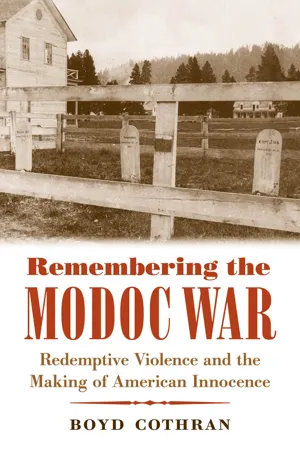
Remembering the Modoc War
Redemptive Violence and the Making of American Innocence
- 264 pages
- English
- ePUB (mobile friendly)
- Available on iOS & Android
eBook - ePub
About this book
Information
Chapter One: The Sensational Press
Shortly after three o’clock in the morning on January 20, 1873, the telegraph wires out of Yreka came alive with alarming news for the American public. A courier had arrived to report that Lieutenant Colonel Frank Wheaton and his four hundred soldiers and volunteers had been defeated by perhaps as few as fifty Modoc fighters armed with muskets and revolvers. Wheaton, supported by howitzers, had intended his attack to dislodge the Modocs from their makeshift village along the southern shore of Móatokni É-ush, or Tule Lake, where they had been based since the army’s failed attempt to arrest them in November. But dense fog rendered the artillery useless and hindered communications. And the Modocs’ intimate knowledge of the perplexing lava beds, their ancestral home, had allowed them to fend off their attackers without suffering a single casualty. A local correspondent for the San Francisco Chronicle broke the story: “A Disastrous Assault on Capt. Jack’s Camp. The Troops Repulsed With Great Loss . . . No Indians Reported Killed . . . Long and Bloody Campaign Predicted.”1 Within a week, newspapers throughout the country published similar accounts. By the end of the month, multiple reporters were en route to this remote corner of northern California to cover what would become one of the most deadly and costly Indian wars ever fought by the United States.2
“Who are the Modocs, and what is the Modoc war?,” asked the Boston Evening Journal after publishing reports of fighting in the Klamath Basin.3 When violence erupted in the region, few Americans had heard of either the Modocs or the Klamath Basin. Between January 1873, when the war became a national story, and April, when the death of General Edward R. S. Canby transformed it into an international sensation, intense newspaper coverage familiarized readers throughout the country with the region’s history and informed them about the current state of Indian affairs there. Publishers, editors, journalists, and commentators debated the causes and origins of the conflict. Journalists covered it in great detail. But the changing nature of the Gilded Age newspaper industry meant that political muckraking and shameless self-promotion dominated early coverage, while Indigenous perspectives and more nuanced explanations were marginalized.
The economics of political partisanship defined the newspaper industry in many ways throughout the nineteenth century. Prior to the Civil War, the vast majority of American newspapers were firmly aligned with political parties. Indeed, parties often subsidized the operations of newspapers by providing lucrative government printing contracts as part of the spoils system or even directly paying publishers, editors, and reporters for their loyalty. And politicians got what they paid for. Editors and journalists shaped news stories, features, and editorial commentary to appeal to partisan audiences and unabashedly spread the party’s creed to readers. As one nineteenth-century journalist explained, “The power of the press consists not in its logic or eloquence, but in its ability to manufacture facts, or to give coloring to facts that have occurred.”4
In the 1830s and 1840s, the penny press revolution of James Gordon Bennett’s New York Herald and Horace Greeley’s New York Tribune began to change the marketplace for news. Partisanship remained strong, especially in smaller markets and in some weeklies. But in larger cities, the difficult aftermath of the Civil War and the grim realities of southern Reconstruction led to the rise of sensationalism and scandal in daily reporting. Indeed, the 1860s and 1870s were a period of greater journalistic independence as newspapers increased their circulation and outgrew their financial dependence on political parties. They replaced partisan sloganeering with boasts about their ideological independence and their editorial reach. As they professionalized, the number of newspapers increased. By 1875, the northern states alone had an estimated six thousand independent journals.5 Partisanship remained an important aspect of the Gilded Age press, but the industry was undergoing significant change.
Even as this process was still under way, the shift away from political patronage left publishers more dependent on circulation revenue, and the competition for readers was fierce. Publishers and editors drove their reporters to pursue sensational stories with greater intensity. And they boasted about every scoop and every scandal they could claim to have uncovered. The New York Times, for example, became famous for its 1870–71 campaign against William “Boss” Tweed and his Tammany Hall political machine. The New York Herald similarly garnered wide publicity in 1872 when James Gordon Bennett Jr. sent reporter Henry Morton Stanley to Africa to find Scottish missionary David Livingstone. Fed on a steady diet of political brinkmanship, cowboy adventures, railroad scandals, and salacious Indian wars, the increasing sensationalism of the era’s newspaper industry combined with the fierce partisanship of many papers to shape coverage of events such as the Modoc War.
My aim here is to explore how the dynamics of the Gilded Age newspaper industry shaped and influenced historical understandings of the Modoc War as the conflict unfolded. But it cannot be a straightforward and objective account of historical events. Embedded within my analysis is a critique of the era’s media marketplace and its relationship to historical memory. Indeed, though clichéd, the axiom that “journalists write the first draft of history” should not be forgotten. Journalists, after all, report on history in the making. They influence how a given community relates to its past or whether it remembers certain events at all. This was especially true in the mid-nineteenth-century United States, when the primary locus of American mythmaking shifted from popular novels to popular journalism.6 This process changed how historical events were remembered. Indeed, the press became a kind of historical memory sausage factory in which, according to Richard Slotkin, “the raw material of history was immediately processed, conflated with ideology and legendry, and transformed into myth.”7 In other words, newspapers created, represented, transmitted, preserved, and promoted collective constructions of historical events as they unfolded, informing the American populace and influencing policy decisions.
This chapter and the next tell the story of the Modoc War through the lens of the Gilded Age newspaper industry to understand how, from the very beginning, the conflict became embedded with narratives of American innocence. It did so in three overlapping phases that at times blended together. In the first, partisanship combined with the federal government’s contentious Indian policy after the Civil War to expose the violence inherent in the Grant administration’s approach to Indian affairs. Competing explanations emphasized the social, cultural, and economic origins of the conflict but in each case reinforced notions of American innocence. The second phase of coverage corresponded with the arrival of journalists from across the country and the establishment of the Modoc peace commission in early February. Finding little to cover and stymied by the commission’s secrecy, journalists turned to self-promotional stunts and exaggerated or fabricated sensationalism. These methods of reporting the news had their costs and consequences. By focusing on political scandals and masculine feats of journalistic prowess, the press advanced arguments for American innocence that marginalized the Modocs’ motivations and obscured Native perspectives even as they complicated and undermined efforts at peace. The third phase of coverage, marked by a spectacle of extreme racial violence, erupted following Canby’s death on April 11, 1873 and is considered in greater detail in the next chapter. But first we must consider how the war started and how partisan newspapers exacerbated an already volatile situation.
ON THE MORNING of November 29, 1872, according to subsequent newspaper accounts, Captain James Jackson, with about thirty-five soldiers from Fort Klamath and a troop of around forty citizens from the nearby town of Yulalóna8 (Linkville) arrived at the complex of Modoc villages along the banks of Kóketat (Lost River). Captain Jack’s Modoc village was located on the south side, along a sharp bend in the river. About half a mile downstream, a second, smaller village was located on the opposite side of the river. Farther downstream was a cluster of cabins occupied by recently arrived Euro-American settlers. Relations between the Modocs and their non-Indigenous neighbors were tenuous, to say the least. In 1864, Jack and the other Modocs had relocated onto the Klamath Reservation. But when the federal government failed to deliver the promised supplies, the Modocs had left the reservation and repudiated the treaty.9 Returning to live near their traditional winter villages along the Lost River, many found jobs working for local farmers and ranchers. But some Euro-American settlers wanted the fertile land along the Lost River. By January 1872, these settlers were pressuring the federal government to arrest Jack and force him and his followers to return to the Klamath Reservation, insisting that the Modocs uphold the requirements of the treaty.10 In late November, Thomas B. Odeneal, the newly appointed superintendent of Indian affairs in Oregon, requested the assistance of the military. And shortly thereafter, Captain Jackson received his orders: “You are directed to remove the Modoc Indians to Camp Yainax on Klamath Reservation, peaceably if you can but forcibly if you must.”11
Captain Jackson arrived in Jack’s village and caught the Modoc headman unprepared. With winter approaching and no real desire to fight, Jack initially agreed to return to the reservation. He understood how to negotiate these tense situations. Jack had spent years working with Euro-American settlers, and many of his female relatives had married those settlers. Jack and the other Modocs often visited the town of Yreka, where they worked, traded, and socialized. They even attended holiday celebrations there and joined in saving the settlement when a major fire broke out on the Fourth of July 1871. Like many Klamath Basin Indians, Jack wore American-made shirts and trousers, and like many of the Modocs, he spoke English.12
Jack and the other Modocs were prepared to cooperate to some degree. But the situation at Jack’s Lost River village turned violent when a scuffle broke out between Lieutenant Frazier A. Boutelle and Chĭkclĭkam-Lupalkuelátko, a Modoc Indian more commonly known by the colorful nickname Scarface Charley. Shots were fired, though accounts differ about who fired first. And in the ensuing battle, the Modocs escaped their villages, seeking refuge among the Lava Beds south of Móatakni É-ush. Although Jack and most of his followers made off with minimal fighting, a group of Modocs from the second village fled downriver, attacking homesteads along the northern and eastern shores of Móatakni É-ush and killing at least fourteen settlers.13 By evening, news of the botched arrest and deadly aftermath had reached Yreka.
Eager to report any incident of Indian violence, newspapers published their stories before confirming rumors. As a result, confusing and contradictory accounts characterized early reports of what exactly had happened. In page 1 stories, the Daily Alta California claimed that the soldiers had killed eighteen Indians, while the Sacramento Daily Union reported the number of casualties at fifteen. The fight was described as a “desperate one” in which “nearly all the women and children and some of the warriors and a number of horses were captured.” Other newspapers reported that U.S. soldiers had killed Captain Jack.14 But if the narrative initially portrayed the Lost River fight as an early morning raid on an Indian village, the story shifted as additional details emerged. When news of the settlers’ deaths reached the newspapers, various reporters and editors revised their previous assessments. “The Red-Skins Taking Vengeance on White Settlers,” announced the Hartford Daily Courant, which also declared, “News from the scene of war between the United States troops and the camp of the Modocs shows the trouble is much more serious than at first indicated.”15
News of the killings spread and tensions escalated as journalists reported on or editors reproduced in full stories that appeared in other publications. Within a few days, newspapers from New York to San Francisco were decrying the “Modoc Massacre” as a “Reign of Terror.”16 Many commentators called for a military response: “The people of Oregon are becoming apprehensive of a general outbreak of the Indians,” reported the New York Times, which added, “Under these circumstances it behooves the people of Oregon and Washington Territory to be on their guard, and the Government should at once increase the military garrisons throughout the threatened district.”17 Those nearer the Klamath Basin tended to criticize the army for its inaction. “The Modoc war, in the northern part of California, has continued for a longer time than Germany took to overrun France,” grumbled the Gold Hill News in an early January reference to the Franco-Prussian War. “There is something ludicrous,” asserted the southern Oregon paper, “in a small band of sixty or seventy warriors thus setting the United States at defiance.”18
Public outcry and calls for military action in the press were consistent with the contradictory and contentious nature of federal Indian policy in the 1870s. Following the Civil War and the end of slavery, erstwhile abolitionists such as Lucretia Mott and Wendell Phillips turned their attention to the plight of American Indians and the U.S. Army’s strategy of warfare against Indigenous communities in the American West. They advocated a more benign approach to the “Indian question” that sought to remove control of federal Indian policy from the hands of corruptible bureaucrats in favor of the presumably incorruptible oversight of Christian missionaries. Under the pretense of pursuing more peaceful relations with the continent’s Indigenous peoples, Congress adopted an approach that favored the establishment of reservations where Indian wards would be far removed from white settlement and under the guidance of Christian missionaries, at least in theory. In this way, Indians might eventually ...
Table of contents
- Cover Page
- Remembering the Modoc War
- Copyright Page
- Dedication
- Contents
- Figures
- Prologue: A Tour of the Lava Beds
- Introduction: Marketplaces of Remembering
- Part One: Reporting
- Part Two: Performing
- Part Three: Commemorating
- Epilogue: Exchanging Gifts with the Dead
- Notes
- Bibliography
- Acknowledgments
- Index
Trusted by 375,005 students
Access to over 1.5 million titles for a fair monthly price.
Study more efficiently using our study tools.
Frequently asked questions
Yes, you can cancel anytime from the Subscription tab in your account settings on the Perlego website. Your subscription will stay active until the end of your current billing period. Learn how to cancel your subscription
No, books cannot be downloaded as external files, such as PDFs, for use outside of Perlego. However, you can download books within the Perlego app for offline reading on mobile or tablet. Learn how to download books offline
We are an online textbook subscription service, where you can get access to an entire online library for less than the price of a single book per month. With over 1.5 million books across 990+ topics, we’ve got you covered! Learn about our mission
Look out for the read-aloud symbol on your next book to see if you can listen to it. The read-aloud tool reads text aloud for you, highlighting the text as it is being read. You can pause it, speed it up and slow it down. Learn more about Read Aloud
Yes! You can use the Perlego app on both iOS and Android devices to read anytime, anywhere — even offline. Perfect for commutes or when you’re on the go.
Please note we cannot support devices running on iOS 13 and Android 7 or earlier. Learn more about using the app
Please note we cannot support devices running on iOS 13 and Android 7 or earlier. Learn more about using the app
Yes, you can access Remembering the Modoc War by Boyd Cothran in PDF and/or ePUB format, as well as other popular books in History & North American History. We have over 1.5 million books available in our catalogue for you to explore.