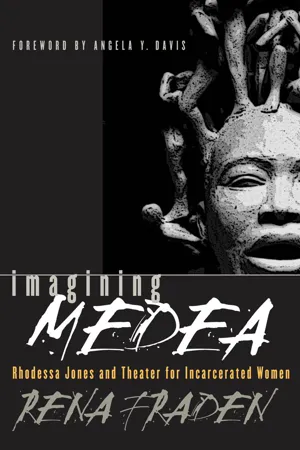
“This ain’t no Dreamgirls,” Rhodessa Jones warns participants in the Medea Project, the theater program for incarcerated women that she founded and directs. Her expectations are grounded in reality, tempered, for example, by the fact that women are the fastest growing population in U.S. prisons. Still, Jones believes that by engaging incarcerated women in the process of developing and staging dramatic works based on their own stories, she can push them toward tapping into their own creativity, confronting the problems that landed them in prison, and taking control of their lives.
Rena Fraden chronicles the collaborative process of transforming incarcerated women’s stories into productions that incorporate Greek mythology, hip-hop music, dance, and autobiography. She captures a diverse array of voices, including those of Jones and other artists, the sheriff and prison guards, and, most vividly, the women themselves. Through compelling narrative and thoughtful commentary, Fraden investigates the Medea Project’s blend of art and activism and considers its limits and possibilities for enacting social change.
Rhodessa Jones is co–artistic director of the San Francisco–based performance company Cultural Odyssey and founder of the Medea Project: Theater for Incarcerated Women. An award-winning performer, she has taught at the Yale School of Drama and the New College of California.
- 272 pages
- English
- ePUB (mobile friendly)
- Available on iOS & Android
eBook - ePub
About this book
Information
CHAPTER 1
A Counter Epic
Making the Medea Project
I would be nothing more than a memory or a bitch with a bad attitude if I hadn’t found acting. . . . Yeah, theater is my religion. I’ve been baptized in the applause and it saved my life. But if you’re blessed enough to climb up on the platform and say, “Over here! Everybody look at me!” then you damn well better have something to say.
—Rhodessa Jones, quoted in Snider, “Just Say Rho!”
In Rhodessa Jones, the creator and director of the Medea Project, the women in the project have a life story they can use as a counter against the traditional, predictable, plots usually attached to women of her class and her race. In certain ways, Rhodessa Jones’s life conforms to the lives of many of the women she has met in jail: African American, born into a poor family, an unwed mother at an early age, with no college education. And yet she is always aware that she has escaped their fate. Jones was born in Florida in 1948 to a large African American family of migrant laborers. She is the eighth of twelve brothers and sisters. She remembers living in migrant camps, the sounds of Saturday night dances and music, watching performances that seemed like vaudeville. One of her brothers was a great dancer, other family members sang, she was a comic. In the 1950s, the family settled on a farm near Rochester, New York, where the schools were good. Rhodessa and some of her siblings started a singing group; another brother, Bill T. Jones, kept dancing.1 Someone was always reading: her father, Zane Grey; a brother, D. H. Lawrence and Henry Miller. Both her father and her mother were strong presences in the family. She describes the lack of tolerance for loafing and whining: if she was sitting around, her mother would hand her a broom; if she did something her father thought was wrong, there wouldn’t be time for an explanation. She recognizes her parents’ influence in the way she directs:
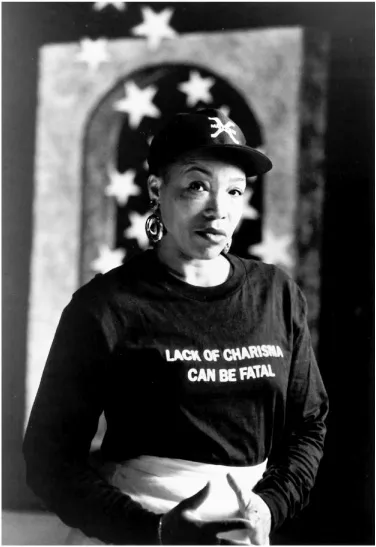
Rhodessa Jones. Photograph by Diane McCurdy, 1992
I am a terrible taskmaster. I’m really hard and I demand a lot. I really do. I’m very demanding. I think I take after my father. He was a wonderful, sweet, benevolent daddy, but also, my god, if you did something wrong. He didn’t talk to you, he went and got his belt or his switch, and he came and got you. There was no warning. You could be playing and he would say,
“Come here. You.” And it wasn’t going to be, “I have to talk to you.” No. He would pick you up and go Whack. Whack, whack, whack, whack. “Now don’t do that again. If I ever hear you doing that again you’ll get that again. You understand?” And that would be it. My mother would rant for two days, but my father was scarier. He would just tear you up. And there was no crying. “I don’t want to hear no crying. Because you should have been crying when you were doing it.” Whatever it was. I think, on some level, I’m like that inside. I don’t beat up on people physically. I’m hard, but I’m also very tender. There are people who just push you.
I was not allowed to act up in my mother’s house. There was no acting up with my mother. No petulance, pouts, storming. No. And there wasn’t any talking about it. “You pull in that lip. Get it together.” And she also believed in work. “Go do something. You feeling sad? Bad? Go in there and clean up that kitchen. Go clean out the basement. Work.” My mother said, “If you won’t work, you’ll steal.” And my father said, “If you’re going to be a thief, you better be a damn good one. Because if you get in trouble, I can’t help you. I am a poor man.” It becomes a part of you. I’m not saying that’s always good. But the other side of it is I learned I could wield a mighty sword. At the same time, I would never cut your head off because you’re my family. I couldn’t do this work without these people letting me manipulate them, letting me mold them, letting me challenge them. I couldn’t do it without people trusting and believing in me.
It’s like Harriet Tubman. You pull out the gun and say, “We’re going on. We’re doing this or I’m going to kill you.” And at a point you don’t get to quit. You don’t get to quit after a point.
Now fifty, Jones exudes both warmth and discipline, a respect for keeping busy and hard work, and no self pity. She is filled with stories about her mother and father, their complicated relationship, the responses of her sisters and brothers to the family. While her mother believes her sons must be protected and respected, her mother expects her daughters to be caretakers, and Rhodessa Jones, because she is an artist, is seen as someone who has lots of free time to take care of others. It isn’t a Norman Rockwell family, by any stretch of the imagination, but Jones understands the strengths and roles everyone plays with a kind of wry bemusement. Her family is big and her own attachments have been various and multiple. She draws strength from her love stories and her family; they seem to justify the vibrant, charismatic, philosophical person she has grown into. She is someone who likes to stop and ask people for directions, at which point she can be warmed by a stranger’s generosity, but not surprised by a racist response. At least part of the power she exudes in the Medea Project comes from the way she inhabits the role of grand diva and simple country girl at the same time. She is always aware of herself as a leader, director, but also part of a family. Her power isn’t simply unidirectional; rather, she understands that people must give consent: “they let me manipulate them, let me mold them, let me challenge them.” The work she does simulates a family, but the Medea Family is a strictly voluntary one.
At sixteen, Jones was pregnant and gave birth to a baby girl. She had grown up with the whole range of popular cultural female role models. Some of them provided her with alternatives to motherhood:
Cosmopolitan was my Bible. Helen Gurley Brown. She was my hero. She had an afternoon talk show on TV, and wrote Sex and the Single Girl. There was something about her whole rap that attracted me. It was my secret life. I was going to take up the mantle. I was going to be beautiful, sexy, exciting. I remember Jacqueline Bisset said, “If I ever had a kid, I’d put it on my hip and I’d give it the ride of its life.” I identified with these women. Marilyn Monroe. I always felt she was incredibly funny. I remember sitting in the back of my boyfriend Dickie’s Fairlane convertible and hearing that Marilyn Monroe was dead and feeling sad about that. It was right up there with hearing Barbra Streisand first sing “People,” and hearing the news about Malcolm X dying. I remember exactly where I was when that happened. When Sam Cooke died, I was very pregnant. My daughter was born a month later. I wept so. I wept for myself. What’s going to happen to me? Because this was not what I planned. I couldn’t formulate it, but I know I was thinking that. In every bit of my body. Looking at the women in my family who were married and thinking, “I’m not going to do this.” They were saying, “Who do you think you are? You’re already saddled with a kid.” But my brain said to my body, “No more. We’re not going to get pregnant any more.”
Helen Gurley Brown, Marilyn Monroe, Barbra Streisand were women who signaled to Jones not complacency and domesticity but cosmopolitan experience, a wider world than the one her sisters lived in. Her brother, Azel, who was working in a bank and also writing plays for the Living Arts Theater, a commune in Rochester, introduced her there, and she saw at once an alternative to the way she had been brought up. Men cooked along with the women. Everyone helped put together performances. Made up mostly of young white people, the Living Arts Theater was a place where racial and gendered expectations could be exploded. The experimental theater she found at an early age helped her to define difference against class, racial, and gendered expectations.
At the same time, she met and fell in love with a young Irish man, Dennis John Patrick Riley. When another brother, serving time in Attica, was injured during the uprising there, in reaction, and in the peripatetic ways of the sixties, Jones and Riley planned to move to South America. They got as far as Costa Rica and stayed for a year, but when her daughter became ill, they moved to San Francisco. Her brother Azel was there, and together with their brother Bill T. they formed a theatrical troupe called the Jones Company.2 At the same time she was dancing with her brothers and sisters, she also joined the feminist collective, Tumbleweed, run by Teresa Dickinson, a former Merce Cunningham dancer. Tumbleweed’s style was very athletic, improvisational, and political. And as the only black woman in the collective Jones got a fair amount of attention:
I remember going with Tumbleweed to Portland, Oregon, to Reed College. And being the only black woman in this very feminist audience who had come to see these dancers. Teresa was very macho. We flew through the air. We were gymnasts. Teresa Dickinson was one of the first women to talk about strength in women. I remember looking at magazines with Teresa, and Teresa would say, “Yeah, Rhodessa, but she has no strength. She might be beautiful but look at her frame, the spine.” She was that kind of teacher to me. I’d always been very strong but I’d been taught to be ashamed of my muscular arms, my skinny body, my skinny bone and muscle body. Which is part cultural too, because I come from a culture where you’re supposed to have a little fat on you. My mother would say, “You need a little of cushion on your pocket.” Which means you should be a bit plump around your vagina. “The softer the cushion, the better the pushin,’” was what the men said. This is the kind of stuff I used to grow up hearing. At the same time I met Teresa, who said it is better to be strong. “A good dancer is a dancer with a sense of carriage and a sense of alignment which has to do with the strengthening of the spine, thus the strengthening of the stomach muscles so that the back is strong.” We were doing gymnastics. We were doing calisthenics. We were doing rope work. We were learning how to use our own natural weight as a part of body building. This was long before it was fashionable to have a great butt and great shoulders.
Also we were contact, improvisational artists, so we were lifting each other, which was totally provocative for young women who were coming out of the closet, young women who believed in a certain kind of woman power. We were amazons. We really were.
At the same time I was the only black woman. So whatever I said, people were hanging on every word. And I didn’t know a lot about the dance world. I did not have a degree from an art institute. The dancing I had done had been in the fields and in my backyard and in the jukebox room with my brothers and sisters. And that was very natural. As an African American girl growing up in the late 50s, 60s, you had better learn how to dance. Also I worked in potato fields. I worked in orchards. I got in a lot of trouble in ballet classes. I thought I was being mistreated. Teachers expected with the frame I had that I was just a slouchy, lazy student. Because obviously, they thought, I had a lot of ballet training. I couldn’t have been that strong and with that form without it.
I remember in those days being on display all the time. That was very life affirming for me. I was someone. I was something. People wanted to hear what I had to say. And I did have a different voice. My experience was very different. I had already known a lot of life. I had a daughter. What was I? Twenty-three, twenty-four? My kid was already eight years old. I was beautiful. I didn’t comb my hair. I had dreads before dreads were popular. All of those things. These were the germs, the germinations of my political artistic ideas which have flowered.
Out of this mixture of feminism, of dance collectives, of her body formed in the fields and by popular music, she began to tell her own life story. The only black woman in Tumbleweed and the only woman who still was dancing in her family dance troupe, Jones moved easily between and among different groups. It was her difference that interested others—her black race, her hair, her body—and together these began to be her subject.
But she wasn’t making any money. In order to support her daughter, whom she was raising by herself, she began to work as an erotic dancer in the San Francisco district known as the Tenderloin. There, the business of sex was transacted, in her case, through storytelling. As she stood or sat in a glass room, the men would speak their sexual fantasies to her and in order to keep them dropping quarters into the box she would respond as they wished her to, dancing or talking, anything to keep them pumping the money in. The fantasies were often violent and racially ugly, though there were sweet encounters too. Listening to their stories, reading Anaïs Nin, Virginia Woolf, and Doris Lessing at the time, and thinking about her responses, she began to write the stories and her thoughts down. The writing became her first solo and full-length piece, The Legend of Lily Overstreet, work that got her recognized as a serious artist in her own right. “After I made Lily Overstreet, I became a bona fide artist. I had a place in the culture,” Jones has said.3 In Lily, she reenacts, sometimes naked, the things she said in that glass box and what was said to her. In the reconstituted performance in the theater of the initial performance in the peep show, her body, as an instrument of control, is centrally staged. Jones has said that for her, “The subject matter is always sex and women as sex objects. I se...
Table of contents
- Cover Page
- Imagining Medea
- Copyright Page
- Dedication
- CONTENTS
- ILLUSTRATIONS
- FOREWORD
- PREFACE
- INTRODUCTION
- CHAPTER 1 A Counter Epic
- CHAPTER 2 To Be Real
- CHAPTER 3 Prison Discourse
- CHAPTER 4 Community Work
- APPENDIX
- NOTES
- BIBLIOGRAPHY
- INDEX
Trusted by 375,005 students
Access to over 1.5 million titles for a fair monthly price.
Study more efficiently using our study tools.
Frequently asked questions
Yes, you can cancel anytime from the Subscription tab in your account settings on the Perlego website. Your subscription will stay active until the end of your current billing period. Learn how to cancel your subscription
No, books cannot be downloaded as external files, such as PDFs, for use outside of Perlego. However, you can download books within the Perlego app for offline reading on mobile or tablet. Learn how to download books offline
Perlego offers two plans: Essential and Complete
- Essential is ideal for learners and professionals who enjoy exploring a wide range of subjects. Access the Essential Library with 800,000+ trusted titles and best-sellers across business, personal growth, and the humanities. Includes unlimited reading time and Standard Read Aloud voice.
- Complete: Perfect for advanced learners and researchers needing full, unrestricted access. Unlock 1.5M+ books across hundreds of subjects, including academic and specialized titles. The Complete Plan also includes advanced features like Premium Read Aloud and Research Assistant.
We are an online textbook subscription service, where you can get access to an entire online library for less than the price of a single book per month. With over 1.5 million books across 990+ topics, we’ve got you covered! Learn about our mission
Look out for the read-aloud symbol on your next book to see if you can listen to it. The read-aloud tool reads text aloud for you, highlighting the text as it is being read. You can pause it, speed it up and slow it down. Learn more about Read Aloud
Yes! You can use the Perlego app on both iOS and Android devices to read anytime, anywhere — even offline. Perfect for commutes or when you’re on the go.
Please note we cannot support devices running on iOS 13 and Android 7 or earlier. Learn more about using the app
Please note we cannot support devices running on iOS 13 and Android 7 or earlier. Learn more about using the app
Yes, you can access Imagining Medea by Rena Fraden in PDF and/or ePUB format, as well as other popular books in Social Sciences & Theatre. We have over 1.5 million books available in our catalogue for you to explore.