In 1963, as Betty Friedan’s Feminine Mystique appeared and civil rights activists marched on Washington, a separate but related social movement emerged among American Catholics, says Mary Henold. Thousands of Catholic feminists — both lay women and women religious — marched, strategized, theologized, and prayed together, building sisterhood and confronting sexism in the Roman Catholic Church. In the first history of American Catholic feminism, Henold explores the movement from the 1960s through the early 1980s, showing that although Catholic feminists had much in common with their sisters in the larger American feminist movement, Catholic feminism was distinct and had not been simply imported from outside.
Catholic feminism grew from within the church, rooted in women’s own experiences of Catholicism and religious practice, Henold argues. She identifies the Second Vatican Council (1962–65), an inspiring but overtly sexist event that enraged and exhilarated Catholic women in equal measure, as a catalyst of the movement within the church. Catholic feminists regularly explained their feminism in terms of their commitment to a gospel mandate for social justice, liberation, and radical equality. They considered feminism to be a Christian principle.
Yet as Catholic feminists confronted sexism in the church and the world, Henold explains, they struggled to integrate the two parts of their self-definition. Both Catholic culture and feminist culture indicated that such a conjunction was unlikely, if not impossible. Henold demonstrates that efforts to reconcile faith and feminism reveal both the complex nature of feminist consciousness and the creative potential of religious feminism.
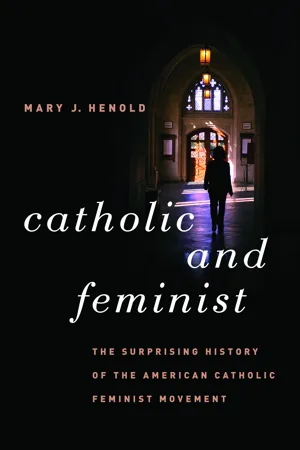
eBook - ePub
Catholic and Feminist
The Surprising History of the American Catholic Feminist Movement
- 304 pages
- English
- ePUB (mobile friendly)
- Available on iOS & Android
eBook - ePub
Catholic and Feminist
The Surprising History of the American Catholic Feminist Movement
About this book
Information
Topic
Theology & ReligionSubtopic
Christian Denominations1 Origins
When the woman seeks herself the metaphysical mystery is extinguished, for in uplifting her own image she destroys the one that is eternal.
—Gertrud von Le Fort, The Eternal Woman
—Gertrud von Le Fort, The Eternal Woman
In a 1965 article for the Catholic magazine Marriage, a Redemptorist priest named Henry Sattler asked a question he believed to be of monumental importance for the welfare and salvation of mankind: “Why Female?” He asked his readers, primarily young wives, to ponder why God created both man and woman. Sattler acknowledged “procreation” as the obvious answer but sought an additional theological reason for woman’s existence. He concluded that “towards the activity of God in grace all of mankind is feminine,” that is, humans, like women, are expected to surrender their will freely and face God with an attitude of “receptive surrender.” He explained, however, that “[man] is too busy doing things to surrender. So God gave him dependence-in-the-flesh—woman” as a daily reminder.1
Imagine you are a Catholic woman circa 1965. In the middle of a hectic day, you plop down on the sofa and pick up a Catholic magazine. It could be Marriage, or Ave Maria, or Catholic Digest. Imagine reading that your chief goal in life should be the surrender of your will (not to mention your body and your personality). Now imagine the thousands of ulcers in the thousands of stomachs of American Catholic women told just one too many times that they represent “dependence-in-the-flesh.” Long before women’s ordination came to dominate the agenda of Catholic feminists, a fundamental desire burned deep in the guts of innumerable Catholic women. As God as their witness, they would never again pick up a Catholic magazine to be assaulted by a know-it-all priest’s theological justification for “Woman.”
Read enough articles like “Why Female?” and the emergence of a Catholic feminist movement ceases to be such a mystery. But this understanding does not explain why Catholic feminism appeared when it did. After all, American Catholic women had been exposed to arguments such as Sattler’s dating back to at least the mid-nineteenth century.2 Why would this generation become the first to challenge such gender prescriptions publicly and on a large scale? To understand why, one must pinpoint with greater accuracy when Catholic feminism actually came into being in the United States. I date the emergence of Catholic feminism in the “second wave” of American feminism, that is, during the resurgence of feminism in the sixties and seventies, specifically, to 1963. This claim runs contrary to popular perceptions about the movement’s history. Those scholars who discuss the movement’s origins tend to date the appearance of Catholic feminism to the late sixties and early seventies, not the early sixties.3
Such an assumption is not far-fetched. Most of the major Catholic feminist organizations were established in the seventies, the period also of the rise of collective activism. For the most part, these organizations formed after the pioneering liberal and radical feminists of the larger second-wave feminist movement had arrived on the scene but roughly at the same time that popular and media interest in the movement reached its peak, in the first half of the seventies. One might then conclude that Catholic feminism was an offshoot of the larger feminist movement, an effort to take feminist principles and apply them to the religious sector. But what if Catholic feminism was not a by-product of a trendy and highly publicized movement in full flower but instead came into being in the early sixties, without a readily established feminist vocabulary, ideology, or agenda to build upon and with little if any connection to the larger national movement? If this was true, how would we need to reassess the history of Catholic feminism and, indeed, of second-wave feminism itself?
In fact, the first Catholic feminists began to make their presence known in 1963, the same year that Betty Friedan’s The Feminine Mystique was released and several years before the formation of the National Organization for Women (NOW) or the emergence of the American radical feminists. A search of Catholic periodicals reveals nearly forty Catholic women writing openly feminist articles or letters to the editor between 1963 and 1970. I make this claim not as a misguided attempt to vie for the title of first feminists of the second wave, but to challenge the concept of Catholic feminism as an offshoot of secular feminism. Catholic feminists have unexpected origins that from the beginning mark them as substantially different from nonreligious feminists within the larger feminist movement.
They are different because, in large part, Catholic feminism was not imported into the church; it grew organically within Catholicism. So feminism is not, as many in the church would like to claim, a contagion brought in from outside to corrupt the faith. Nor is it a late-blooming form of feminism solely inspired by the actions of secular feminists. Rather, Catholic feminism was born of women’s experiences as Catholics, their wrestling with the injustices, inconsistencies, and inspirations of their own faith tradition, as well as exposure to and participation in feminist and nonfeminist activism outside the church. They were not just feminists who happened to be Catholic. Their feminism itself was Catholic.
These early origins explain so much about Catholic feminism as it developed over its first twenty years, as will be shown throughout this study. It explains, for example, why Catholic feminists so often used Catholic language, symbols, scripture, and social teachings to describe the nature of their feminism. So, too, it explains why liturgy became a central theme of Catholic feminist activism and why Catholic feminists focused on priestly vocation not simply as a goal to be won, but also as the call to serve. Finally, it suggests an explanation for why so many Catholic feminists chose not to leave Catholicism entirely, despite their deep ambivalence toward the church. The following chapter begins this exploration into Catholic feminists themselves, and their distinctive approach to feminist consciousness and activism, but before we can fully analyze the nature of their feminism, we need to know from whence it came.
RELIGIOUS OR SECULAR ORIGINS?
Consider Joan Workmaster, a Catholic laywoman who became a feminist in the sixties. When asked to describe the origins of her feminism, Workmaster named both secular and Catholic influences. She believed her participation in civil rights and peace demonstrations helped lead her toward feminism, and by the early seventies she was an avid reader of Ms. Magazine, both traditional explanations for feminist consciousness. But she named as the greatest influence her involvement in campus ministry at her Catholic women’s college and, specifically, liturgical changes after the Second Vatican Council that encouraged women’s participation.4 Marsie Sylvestro, another Catholic laywoman, dated her consciousness-raising to experiences in her Catholic high school. She vividly recalls the day her teacher, a woman religious, rounded up the class and marched them out to hear the revolutionary Angela Davis speak on the quad at Yale.5 Their experiences as Catholic women among other Catholic women at a time of renewal, while not the only influence, played the most significant role in the development of their feminism.
Catholic feminists shared many of the same influences with other feminist women of faith and with secular feminists. In the sociological climate of the late fifties and early sixties, middle-class Catholic women experienced “the feminine mystique” much like other white American women of their class did. Claimed one such woman in a 1961 letter to the left-leaning Catholic weekly Commonweal: “Exhortations to find oneself in the bosom of the family can not hide the conflict [between maternity and intellect] nor convince women who are suffering as a result of it that they are not suffering.”6 Catholic women who were tired of trying to be “happy little wives and mothers” (as another Catholic woman memorably phrased it in 1955) read and were influenced by Betty Friedan’s book when it appeared in 1963. Participation in the civil rights, student new left, and peace movements, often cited as major factors in the development of feminist consciousness among secular movement leaders, appears to have had an impact on some of the first Catholic feminists as well.
But evidence from the Catholic feminist movement suggests that these influences were limited. First, surprisingly few Catholic feminist writers and activists mentioned The Feminine Mystique. If its publication sparked the first generation of Catholic feminist writings, authors would have discussed it more frequently. When a researcher suggested to Elizabeth Farians, one of the first Catholic feminist activists, that her life had been changed by reading Betty Friedan, Farians replied, “Right, well, she didn’t change my life. I mean she didn’t open my eyes. … Oh [I read her book] but what I meant was that was not what made me a feminist.”7 Those who did write about the book found it enlightening, but they also criticized its bias against Catholicism. More significant, the first Catholic feminist writers pursued questions of faith as central to their understanding of feminism. Belief in and commitment to the transcendent as a means of ending oppression was a theme absent in Friedan’s work.8
As for the impact of protest and reform movements in the sixties, they too were influential. The most prominent Catholic feminist to connect her experiences in the civil rights movement to the development of her feminism is theologian Rosemary Radford Ruether. Margaret Ellen Traxler, cofounder of the National Coalition of American Nuns, also identified the civil rights movement as a major influence, as did Maria Riley, a participant in the civil rights and antiwar movements. But, again, too few writers and activists cited them as major influences to credit them with the development of the Catholic feminist movement.9
Perhaps most important, Catholic feminists in the sixties and early seventies were relatively isolated from the larger feminist movement; their writings were self-referential and rarely mentioned the major secular organizations, events, and leadership. This can be explained, in part, by the larger movement’s reaction to institutional religion in this period. The liberal and radical feminist strands that emerged in America in the sixties were not particularly welcoming of feminists who claimed their faith as a primary motivator for their activism or who showed strong ties to their faith traditions. Such a reaction probably stemmed from secular feminists’ eagerness to condemn the perpetuation of sexism by institutional religions. This wariness, if not outright hostility, seemed to last into the early seventies. NOW could be an exception; among its founders was a Catholic sister, Mary Joel Read, and a year after its founding, NOW organized its task force on women and religion that welcomed religious feminist activists and their concerns.
Yet among NOW’S leadership were many nonreligious women who seemed hostile toward the idea of encouraging religious feminism. As the pioneering religious feminist Elizabeth Farians recalled, many members of the NOW board “… didn’t think religion was important. … Some of them were ex-Catholics; they were very turned of by religion.” An Episcopalian feminist, Georgia Fuller, who later went on to head NOW’S Task Force on Women and Religion, recalled the hostility of nonreligious feminists in the early years: “But there were only one or two feminist sisters with whom I could share my faith. Only one or two could understand that I gave classes in self-defense as a Christian; that I wrote testimony and fact sheets naming rape a political crime as a Christian; that I struggled, sometimes with high visibility, with the internal fighting of a turbulent new movement as a Christian. Yes, I was a closet Christian! For in the early seventies, god was indeed dead for feminists.”
Jewish feminists also sensed reluctance on the part of secular feminists to recognize their specificity and their desire to integrate their Jewish and feminist identities. Jewish feminist Letty Cottin Pogrebin asked “why Jewish women are validated by the Women’s Movement when we trudge through Judaic subcultures ruffling beards with our demands for reform but not when we bring Jewish consciousness back the other way into feminism.” In addition, anti-Semitism was perpetuated by both secular and Christian feminists well into the eighties.10
For radical feminists, exodus generally emerged as the main theme when discussing religion and especially Catholicism. An extreme example of radical feminists’ hostility toward the Catholic Church in the movement’s early years was Ti-Grace Atkinson’s 1971 speech at Catholic University. Atkinson, a former NOW officer and leader of the radical feminist exodus from NOW in the late sixties, accused the church of “conspiracy to imprison and enslave women,” after which she proclaimed, “Motherfuckers! … The struggle between the liberation of women and the Catholic Church is a struggle to the death. So be it!”11 Such a climate would not have attracted many non-radical Catholic feminists who, in this period, were self-consciously committed to integrating Catholicism and feminism.
If Catholic feminists had only loose connections to the larger movement in the early years, and their participation in civil rights and new-left activism also was limited, then what else explains their emergence? The history of American Catholicism in the twentieth century does suggest some possibilities. While some Catholic women did participate in the first wave of Catholic feminism (i.e., the woman suffrage movement), that participation was very limited and does not seem to have a direct link to the origins of a Catholic feminist movement in the second wave.12 As numerous scholars have argued, however, Catholic feminism has roots in a variety of Catholic women’s initiatives and groups founded in the United States as early as the thirties. For example, a variety of lay groups in the Catholic counterculture from the thirties onward, such as the Catholic Worker and Friendship House, laid the groundwork for a critique of church power and control from a position of loyalty. They also provided an American precedent for claiming Catholicism as a rationale for social change. In particular, three movements in the antitriumphalist wing of the Catholic community during this period can be labeled as direct antecedents of American Catholic feminism: the Grail, the Christian Family Movement (CFM), and the emergence of the “new nuns.” While not explicitly feminist prior to the seventies, these movements provided opportunities for women to lead, theorize, and devote themselves to reform inspired by the Gospels.
Founded in 1940, the Grail was an exclusively female movement designed to train women as “lay apostles” who would bring Christ’s work and message into the modern world. The Grail welcomed young women eager to be trained in the lay apostolate, a means of dedicating one’s life to Chr...
Table of contents
- Cover Page
- Catholic and Feminist
- Copyright Page
- Dedication
- Contents
- Illustrations
- Acknowledgments
- Introduction
- 1 Origins
- 2 Demythologizing Ourselves
- 3 No Cakes in Hands Unless Ideas in Heads
- 4 The Spirit Moving
- 5 The Love of Christ Leaves us No Choice
- 6 Making Feminism Holy
- 7 A Matter of Conversion
- 8 Sustained Ambivalence
- Epilogue 1980–1986
- Notes
- Bibliography
- Index
Trusted by 375,005 students
Access to over 1.5 million titles for a fair monthly price.
Study more efficiently using our study tools.
Frequently asked questions
Yes, you can cancel anytime from the Subscription tab in your account settings on the Perlego website. Your subscription will stay active until the end of your current billing period. Learn how to cancel your subscription
No, books cannot be downloaded as external files, such as PDFs, for use outside of Perlego. However, you can download books within the Perlego app for offline reading on mobile or tablet. Learn how to download books offline
Perlego offers two plans: Essential and Complete
- Essential is ideal for learners and professionals who enjoy exploring a wide range of subjects. Access the Essential Library with 800,000+ trusted titles and best-sellers across business, personal growth, and the humanities. Includes unlimited reading time and Standard Read Aloud voice.
- Complete: Perfect for advanced learners and researchers needing full, unrestricted access. Unlock 1.5M+ books across hundreds of subjects, including academic and specialized titles. The Complete Plan also includes advanced features like Premium Read Aloud and Research Assistant.
We are an online textbook subscription service, where you can get access to an entire online library for less than the price of a single book per month. With over 1.5 million books across 990+ topics, we’ve got you covered! Learn about our mission
Look out for the read-aloud symbol on your next book to see if you can listen to it. The read-aloud tool reads text aloud for you, highlighting the text as it is being read. You can pause it, speed it up and slow it down. Learn more about Read Aloud
Yes! You can use the Perlego app on both iOS and Android devices to read anytime, anywhere — even offline. Perfect for commutes or when you’re on the go.
Please note we cannot support devices running on iOS 13 and Android 7 or earlier. Learn more about using the app
Please note we cannot support devices running on iOS 13 and Android 7 or earlier. Learn more about using the app
Yes, you can access Catholic and Feminist by Mary J. Henold in PDF and/or ePUB format, as well as other popular books in Theology & Religion & Christian Denominations. We have over 1.5 million books available in our catalogue for you to explore.