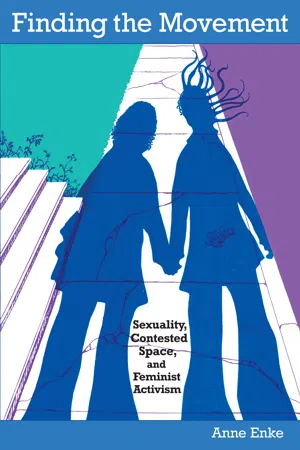
Finding the Movement
eBook - PDF

Finding the Movement

Sexuality, Contested Space, and Feminist Activism

  1. English
  2. PDF
  3. Available on iOS & Android
eBook - PDF

Finding the Movement

Sexuality, Contested Space, and Feminist Activism

About this book

In Finding the Movement, Anne Enke reveals that diverse women's engagement with public spaces gave rise to and profoundly shaped second-wave feminism. Focusing on women's activism in Detroit, Chicago, and Minneapolis-St. Paul during the 1960s and 1970s, Enke describes how women across race and class created a massive groundswell of feminist activism by directly intervening in the urban landscape. They secured illicit meeting spaces and gained access to public athletic fields. They fought to open bars to women and abolish gendered dress codes and prohibitions against lesbian congregation. They created alternative spaces, such as coffeehouses, where women could socialize and organize. They opened women-oriented bookstores, restaurants, cafes, and clubs, and they took it upon themselves to establish women's shelters, health clinics, and credit unions in order to support women's bodily autonomy.

By considering the development of feminism through an analysis of public space, Enke expands and revises the historiography of second-wave feminism. She suggests that the movement was so widespread because it was built by people who did not identify themselves as feminists as well as by those who did. Her focus on claims to public space helps to explain why sexuality, lesbianism, and gender expression were so central to feminist activism. Her spatial analysis also sheds light on hierarchies within the movement. As women turned commercial, civic, and institutional spaces into sites of activism, they produced, as well as resisted, exclusionary dynamics.

Frequently asked questions

Yes, you can cancel anytime from the Subscription tab in your account settings on the Perlego website. Your subscription will stay active until the end of your current billing period. Learn how to cancel your subscription.
At the moment all of our mobile-responsive ePub books are available to download via the app. Most of our PDFs are also available to download and we're working on making the final remaining ones downloadable now. Learn more here.
Perlego offers two plans: Essential and Complete
  • Essential is ideal for learners and professionals who enjoy exploring a wide range of subjects. Access the Essential Library with 800,000+ trusted titles and best-sellers across business, personal growth, and the humanities. Includes unlimited reading time and Standard Read Aloud voice.
  • Complete: Perfect for advanced learners and researchers needing full, unrestricted access. Unlock 1.4M+ books across hundreds of subjects, including academic and specialized titles. The Complete Plan also includes advanced features like Premium Read Aloud and Research Assistant.
Both plans are available with monthly, semester, or annual billing cycles.
We are an online textbook subscription service, where you can get access to an entire online library for less than the price of a single book per month. With over 1 million books across 1000+ topics, we’ve got you covered! Learn more here.
Look out for the read-aloud symbol on your next book to see if you can listen to it. The read-aloud tool reads text aloud for you, highlighting the text as it is being read. You can pause it, speed it up and slow it down. Learn more here.
Yes! You can use the Perlego app on both iOS or Android devices to read anytime, anywhere — even offline. Perfect for commutes or when you’re on the go.
Please note we cannot support devices running on iOS 13 and Android 7 or earlier. Learn more about using the app.
Yes, you can access Finding the Movement by Finn Enke, Daniel J. Walkowitz in PDF and/or ePUB format, as well as other popular books in Social Sciences & North American History. We have over one million books available in our catalogue for you to explore.

Table of contents

  1. Contents
  2. About the Series
  3. Acknowledgments
  4. Introduction
  5. Part One: Community Organizing and Commercial Space
  6. Part Two: Public Assertion and Civic Space
  7. Part Three: Politicizing Place and Feminist Institutions
  8. Notes
  9. Bibliography
  10. Index