In this landmark work, Thomas Tweed examines nineteenth-century America’s encounter with one of the world’s major religions. Exploring the debates about Buddhism that followed upon its introduction in this country, Tweed shows what happened when the transplanted religious movement came into contact with America’s established culture and fundamentally different Protestant tradition.
The book, first published in 1992, traces the efforts of various American interpreters to make sense of Buddhism in Western terms. Tweed demonstrates that while many of those interested in Buddhism considered themselves dissenters from American culture, they did not abandon some of the basic values they shared with their fellow Victorians. In the end, the Victorian understanding of Buddhism, even for its most enthusiastic proponents, was significantly shaped by the prevailing culture. Although Buddhism attracted much attention, it ultimately failed to build enduring institutions or gain significant numbers of adherents in the nineteenth century. Not until the following century did a cultural environment more conducive to Buddhism’s taking root in America develop.
In a new preface, Tweed addresses Buddhism’s growing influence in contemporary American culture.
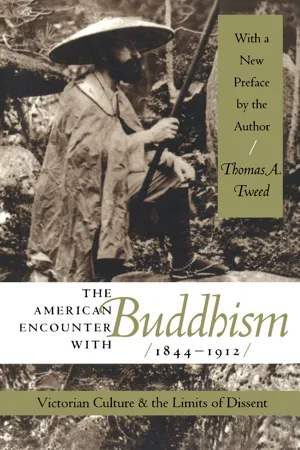
eBook - ePub
The American Encounter with Buddhism, 1844-1912
Victorian Culture and the Limits of Dissent
- 280 pages
- English
- ePUB (mobile friendly)
- Available on iOS & Android
eBook - ePub
The American Encounter with Buddhism, 1844-1912
Victorian Culture and the Limits of Dissent
About this book
Information
Topic
Theology & ReligionSubtopic
North American HistoryChapter One: “The Seeming Anomaly of Buddhist Negation”
The American Conversation about Buddhism, 1844–1877, and the Contours of Mid-Victorian Culture
In 1873 James Clement Moffat (1811–80), the professor of church history from Princeton Theological Seminary, published the second volume of his Comparative History of Religions. In that volume he highlighted the ways in which Buddhism was a “singular belief.” The Buddhist tradition, he asserted, seeks to abandon “all conception of individuality.” Buddhists yearn for “salvation by death” since they hope for the annihilation of the self in nirvana. Buddhists seem to focus on negation in other ways too, he claimed: “The radical pantheism of the Brahmans [Buddha] ignored, and supplied its place with nothing.” Although his followers deified him, the Buddha himself was an atheist: “his own teaching . . . took no notice of beings called gods.” For several decades before Buddhism became an option for the spiritually disillusioned, Moffat and other Americans participated in a public conversation about the nature and value of the religion. After 1858 or so that discourse focused on the alleged doctrinal distinctiveness of Buddhism. To put it differently, mid-century European scholars were increasingly inclined to employ a language of otherness and a rhetoric of negation to describe many of its most basic beliefs. Buddhism was “strange” and “singular.” Its doctrines were not only “atheistic” and “nihilistic” but also “quietistic” and “pessimistic.” As expected, American contributors to the discussion responded in various ways to the European accounts. Some ignored them completely. Many accepted them uncritically. Yet most felt that they had to come to terms with those Buddhist teachings that seemed to challenge some of the most fundamental beliefs and values of Victorian culture in America. But this tendency to emphasize Buddhist distinctiveness—and the concomitant inclination to seek explanations for its alleged divergence—was much less pronounced in the early Victorian period as the conversation about the Buddha and Buddhism opened.1
THE AMERICAN CONVERSATION, 1844–1857: DEEMPHASIZING DISTINCTIVENESS
As I have suggested, the American discussion opened in 1844 when Peabody translated a Buddhist text from the French for a Transcendentalist magazine and Salisbury gave his influential lecture on Buddhism at the American Oriental Society. Both Peabody and Salisbury had been influenced by the work of Burnouf, one of the first great European Buddhist scholars. A few American academic scholars contributed to the midcentury conversation, but they did not play nearly as great a role as they would after the emergence of the modern American university and the rise of American Buddhist studies. Until the 1880s, then, most of the voices in the discussion were those of European interpreters of various sorts and American mainline Protestants, foreign travelers, and religious liberals. Most, although not all, American members of this community of discourse were educated male New Englanders of British and Protestant heritage. Many Protestant participants were foreign missionaries who had knowledge of one or more of the languages relevant to the study of Buddhism. The liberals—Unitarians, Transcendentalists, and Free Religionists—often had some sympathy for the tradition but little or no knowledge of the original languages.2
These American interpreters helped to form impressions of Buddhism by speaking and writing. I focus on the discourse in books and, especially, magazines. Contributions to that conversation appeared in general interest periodicals, the American Oriental Society’s journal, mainline Protestant publications, and Unitarian, Universalist, Transcendentalist, and Free Religionist magazines. Of course, characterizations of Buddhism varied according to the religious perspective of the author, but during the early-Victorian era American authors of varying views tended to minimize the singularity of its teachings. Western accounts in general tended to emphasize parallels between Buddhism and “heathenism” and Buddhism and Catholicism. Most interpreters agreed that the Buddha and his followers expressed universal religious inclinations, even if they did so in pathetically childish or dangerously demonic forms. In fact, this is one of three patterns that held among Western interpreters of Asian religions, with some variations, from the beginning of systematic contact until the middle of the nineteenth century. Buddhism also tended to receive less attention than other non-Christian traditions—Confucianism, Islam, and, by the late eighteenth century, Hinduism. Finally, although there were prominent exceptions, most accounts of Buddhism were hostile.3
The reports of early European missionaries, for example, followed—and helped to establish—these patterns. Jacinto Orfanel (d. 1622), the Spanish Dominican, arrived in Japan in 1607. This was just after Christian influence had reached its zenith there and just before the edicts against Christianity began to be passionately enforced again. Orfanel was arrested for preaching Christianity fourteen years later, and a crowd of approximately sixty thousand gathered in Nagasaki to watch as he burned at the stake in the “Great Martyrdom” on 10 September 1622. But during the years before Japanese hostility to missionaries and other foreigners peaked, Orfanel had an opportunity to observe living Buddhism. Like many other sixteenth- and seventeenth-century Catholic missionaries in East Asia, he sent reports back to Europe. He reported, for example, that “the Japanese are much addicted to their idolatries.” Cosme deTorres (d. 1570), who labored in the mission field in Japan for twenty years, made further distinctions: “There are some people who worship an idol called Shaka [Sakyamuni Buddha] . . . other people worship an idol called Amida [Amida Buddha].” The Portuguese Jesuit Gaspar Vilela (d. 1572) even claimed that followers of Japanese Shingon Buddhism worship the devil. But the point was the same: although some aspects of practice and organization suggested Catholic parallels—the missionaries found a pope, monks, rosary beads, and penitential rites—Japanese Buddhists could be lumped with “idolaters” or “heathens” from other false traditions around the world.4
New England liberals were slightly more positive toward the tradition, but their writings fit these interpretive patterns established much earlier. They have a deserved reputation as leaders in the American discovery of Asian traditions. But liberals actually devoted comparatively little attention to Buddhism before the 1860s. The emerging scholarship about India appeared in magazines they read—Asiatik Researches (1788–1839), Edinburgh Review (1802–30), Monthly Anthology (1803–11), and Christian Disciple (1813–23)—and the reports of Ram Mohan Roy’s (1772–1833) “conversion” to Unitarianism generated excitement about India as a mission field. These developments and others focused the attention of pre-Civil War liberals in and around Boston on Hinduism. In general, if they wrote or read about Asian religions between the 1780s and the 1860s, these New Englanders tended to focus on India and Hinduism, Persia and Islam, or, to a lesser extent, China and Confucianism. For example, although he demonstrated the tolerant tone and inclusive theory for which Unitarians became noted, even as late as 1859 James T. Dickinson hardly mentioned Buddhism in three long articles on Asian culture and religion for The Christian Examiner.5
The most comprehensive interpretation of Asian religions, and Buddhism in particular, offered by a New England liberal between 1844 and 1857 was Lydia Maria Child’s (1800–1880) The Progress of Religious Ideas through Successive Ages. Child, the author of two popular novels and an influential antislavery book, was disappointed to find that Progress brought neither increased popularity nor noticeable influence. Thomas Wentworth Higginson (1823–1911), her friend, later tried to provide an explanation: “The disappointment was no doubt due partly to the fact that the book set itself in decided opposition, unequivocal though gentle, to the prevailing religious impressions of the community. It may have been, also, that it was too learned for a popular book and too popular for a learned one.” Child’s sources were, as her friend put it, “second rate”; but the book apparently was just learned enough to bore. Apparently, it also was just sympathetic enough to non-Christian traditions to offend.6
Child failed to acknowledge the precedent or mention the earlier book, but in many ways her volumes were informed by an approach that was similar to Hannah Adams’s in Alphabetical Compendium (1784): Child announced that she aimed at “complete impartiality.” Of course, Child’s religious perspective still colored her interpretations. Her views were influenced by Unitarianism—her brother was a Unitarian clergyman and a Harvard Divinity School professor—but she also showed inclinations toward Transcendentalism, Swedenborgianism, Free Thought, mysticism, and, especially after her husband died, Spiritualism. As she explained in a letter to Higginson toward the end of her life, her views changed over the years. She grew less comfortable with Christianity and more drawn to, among other things, Spiritualism. But, as she suggested in this letter from 1877, Child’s faith had been more traditionally Christian when she wrote her survey of religions. And at that time she had presupposed the essential unity of all religions. Both commitments informed her description of the “progress of religious ideas.”7
In volume two, after surveying Asian religions and Judaism and before considering Christianity and Islam in volume three, she concluded that all major religions share several basic ideas: “God, the Soul, the Creation of the World, its Destruction and Renovation, a Golden Age of holiness to come in the far-off Future, were common among all the nations of antiquity.” This was not surprising, she suggested: “A general resemblance in ideas on these subjects might be expected, because human nature is everywhere the same, and in all ages has had the same wants and the same aspirations, and been liable to the same infirmities.” Child then offered illustrations of these essential beliefs among the religions, but she completely ignored Buddhism in doing so. This does not mean that she gave up in the effort to fit that tradition into her characterization of the nature and history of religion. In fact, in her interpretation of Buddhism she not only employed categories like God, soul, and creation—none of which has obvious parallels in “orthodox” Buddhism in South or East Asia—but also at points used Christian concepts and language. This tendency is discernible, for example, in her discussion of the Buddha. Child described him as a “Heavenly spirit” who left “Paradise.” Filled with compassion for the “sins” of mankind, he “took suffering upon himself that it might expiate their crimes and mitigate the punishment they must inevitably undergo.” She knew that “European writers had brought the charge of atheism” against Buddhism. Child, nonetheless, presented the Buddhist conception of ultimate reality in terms of Hindu pantheism and described the final goal as a mystical union with “God” or a mystical absorption into the “Original Source of Being; which the Buddhists name The Void.” That word “Void” might have caused a few of her readers to pause, but this potentially bracing language was buried beneath the piles of Christian parallels and the stacks of contrary assertions. It goes almost unnoticed. That, presumably, was the way Child wanted it. Almost two decades after this work was published she gave Higginson a copy of the Dhammapada, a key Buddhist scripture. Later she also might have read the scholarly accounts that increasingly emphasized Buddhist distinctiveness. In that earlier book, however, she, like other liberals, tended to deemphasize Buddhism and harmonize it with other non-Christian, and even Christian, traditions.8
In one of her early letters from Burma, a New England woman with very different religious sensibilities, Ann Haseltine Judson (1789–1826), offered her first impressions of the Buddhists she encountered when she and her husband arrived to preach the Christian gospel. “If we were convinced of the importance of missions before we left our native country,” she wrote, “we now see and feel their importance, as well as their practicability. We could then picture to ourselves the miserable situation of heathen nations; but we now see a whole populous empire, rational and immortal like ourselves, sunk in the grossest idolatry, given up to follow the wicked inclinations of their depraved hearts, entirely destitute of any moral principle, or the least spark of true benevolence.” Her husband’s letters to colleagues at home and his official reports to the corresponding secretary of the American Baptist Mission were not much more sympathetic toward the Buddhist tradition. But at least both Ann Judson, the first female to leave America for a mission field, and her husband, the first American missionary in a Buddhist nation, offered some description of the religion. In fact, American missionaries, and their European counterparts whose writings appeared in American magazines, devoted more attention to Buddhism than the liberals. There were differences in temperament and perspective among missionaries, but most of the accounts presented to American readers before 1858 also tended to present Buddhism as one more instance of heathenism and its misguided worship of false deities. Few praised the tradition, and few interpretations seemed to challenge fundamental assumptions. Yet the situation called for pity and compassion rather than defensiveness and dismay. “I beseech you to take in to compassionate consideration the perishing millions of Burmah,” Adoniram Judson (1788–1850) put it in one official report, “ignorant of the eternal God, the Lord Jesus Christ, and the blessed way of salvation.” Buddhists seemed to be in no more need of missionaries’ attention, laypersons’ compassion, theologians’ criticism, or Christ’s salvation than any other heathens.9
They were less overtly hostile than missionary reports, but travelers’ accounts of Buddhism had much in common with the sketches sent by those who had gone abroad to save souls. During this period, Harper’s and other magazines published a number of excerpts from narratives by British and American travelers that focused on Buddhist nations—including pieces on Ceylon, Tibet, Burma, Siam, and Japan. One anonymous account offered “A Peep at the ‘Peraharra.’” It described a visit to an important religious festival in two towns in Ceylon: “In the month of July, 1840, I had a peep at the celebrated Peraharra of Ratnapoora. . . . Like its mountain competitor [Kandy], it has a relic of Buddha enshrined in a richly-jeweled casket, which is made an object of special veneration to the votaries of that god.” A detailed description of the dress, rituals, temples, and icons followed. The piece concluded with the author confessing his tedium with the spectacle and his longing for the comforts of the familiar: “When I left Ratnapoora crowds were still flocking into the town, for on the morrow the huge temple elephants were expected to march in procession through the place, decked out in all sorts of finery, and bearing the casket and the relic; but it was a wearisome spectacle, and I was heartily glad to find myself once more on my pony, quietly winding through green paddy-fields and under shady topes.” Like this anonymous author, travel writers often highlighted the mysterious, the alien, and the curious in their accounts of Buddhist cultures. Sometimes they acknowledged reports about Buddhism’s singularity. But the casual reader might conclude from the mandatory descriptions of the temples, icons, relics, and priests that Buddhists were devout but misguided, that they worshipped a deity or deities of some sort, and—as the authors of these travel pieces never tired of saying—that there were surprising parallels between Buddhism and Roman Catholicism.10
To many mid-Victorian American readers who were filled with certainty about the superiority of the Protestant religion and the supremacy of the Anglo-Saxon race, the benign travel narratives in general magazines like Harper’s, the hostile missionary reports in the Missionary Herald, and even the harmonizing interpretations of liberals like Child must have been reassuring. At least these accounts did little to challenge their presuppositions. Yet the emerging European scholarly literature did precisely that: it portrayed Buddhism as a peculiar tradition that called into question widespread assumptions.
EUROPEAN SCHOLARS AND BUDDHIST DISTINCTIVENESS
During the 1840s and 1850s several European scholars and missionaries with linguistic skill in one or more relevant languages published studies of Buddhism. Even though Salisbury’s lecture and Peabody’s translation had drawn on Burnouf’s scholarship, in general it was not until approximately 1858 that the force of that scholar’s interpretations, and others’, began to be felt in the United States. In particular, over the next two decades Eugène Burnouf’s L’Introduction à l’histoire du buddhisme indien, Robert Spence Hardy’s Eastern Monachism and Manual of Buddhism, F. Max Müller’s “Buddhist Pilgrims” and “The Meaning of Nirvana,” and Jules Barthélémy Saint-Hilaire’s Le Bouddha et sa religion were reviewed, summarized, and cited in articles that appeared in a wide range of general magazines and religious periodicals.11
Europeans did not suddenly discover at midcentury that Buddhist beliefs seemed to vary from those in Christianity and other literate Western traditions, but they began to emphasize those differences. From the beginning of systematic contact, Western witnesses had noticed dissimilarities. In fact, those Roman Catholic missionaries in East Asia—even if they had stressed the parallels with other heathen religions—had noticed. Even more consistently and forcefully than the earlier missionaries and travelers had, however, the scholars who wrote these works stressed the distinctiveness of Buddhist teachings and used the language of negation. Burnouf’s interpretation of nirvana, for example, was more subtle, qualified, and tentative than that of some of the scholars and most of the non-scholars who followed him. Yet, against Colebrooke’s arguments to the contrary, Burnouf suggested that the most ancient schools of Buddhism probably had understood nirvana to mean “une annihilation.” These European authors suggested that the Buddha had denied the existence of a personal creator and rejected the notion of a substantial and immortal self. Human life, the Buddha taught, is suffering; and release is found only in a systematic renunciation of the world, which leads, in turn, to a final escape into the annihilation of nirvana. In short, Buddhism became associated with atheism, nihilism, pessimism, and passivity. European academic scholars, Christian missionaries, and civil servants acknowledged that some forms of Mahayana Buddhism in East Asia seemed less negative; but, most agreed, these were the teachings of the founder.12
Buddha’s reported challenge to theism—the belief in a personal creator—and to components of individualism—the affirmation of the substantiality and immortality of the self—seemed clear enough to most influential European interpreters between the 1840s and the 1870s. The Pali Buddhist canon presented the Buddha either as uninterested in metaphysical questions or as straightforwardly nontheistic. The doctrine of...
Table of contents
- Cover Page
- The American Encounter with Buddhism, 1844–1912: Victorian Culture & the Limits of Dissent
- Copyright Page
- Dedication
- Contents
- Foreword
- Preface to the Paperback Edition
- Acknowledgments
- A Note on Foreign Terms
- Introduction
- Chapter One: “The Seeming Anomaly of Buddhist Negation”
- Chapter Two: “Shall We All Become Buddhists?”
- Chapter Three: Esoterics, Rationalists, and Romantics
- Chapter Four: “Walking in Fairyland”
- Chapter Five: Strolling Down Main Street
- Chapter Six: Optimism and Activism
- Postscript: Buddhism in America after 1912
- Tables
- Notes
- Select Bibliography
- Index
Trusted by 375,005 students
Access to over 1.5 million titles for a fair monthly price.
Study more efficiently using our study tools.
Frequently asked questions
Yes, you can cancel anytime from the Subscription tab in your account settings on the Perlego website. Your subscription will stay active until the end of your current billing period. Learn how to cancel your subscription
No, books cannot be downloaded as external files, such as PDFs, for use outside of Perlego. However, you can download books within the Perlego app for offline reading on mobile or tablet. Learn how to download books offline
Perlego offers two plans: Essential and Complete
- Essential is ideal for learners and professionals who enjoy exploring a wide range of subjects. Access the Essential Library with 800,000+ trusted titles and best-sellers across business, personal growth, and the humanities. Includes unlimited reading time and Standard Read Aloud voice.
- Complete: Perfect for advanced learners and researchers needing full, unrestricted access. Unlock 1.5M+ books across hundreds of subjects, including academic and specialized titles. The Complete Plan also includes advanced features like Premium Read Aloud and Research Assistant.
We are an online textbook subscription service, where you can get access to an entire online library for less than the price of a single book per month. With over 1.5 million books across 990+ topics, we’ve got you covered! Learn about our mission
Look out for the read-aloud symbol on your next book to see if you can listen to it. The read-aloud tool reads text aloud for you, highlighting the text as it is being read. You can pause it, speed it up and slow it down. Learn more about Read Aloud
Yes! You can use the Perlego app on both iOS and Android devices to read anytime, anywhere — even offline. Perfect for commutes or when you’re on the go.
Please note we cannot support devices running on iOS 13 and Android 7 or earlier. Learn more about using the app
Please note we cannot support devices running on iOS 13 and Android 7 or earlier. Learn more about using the app
Yes, you can access The American Encounter with Buddhism, 1844-1912 by Thomas A. Tweed in PDF and/or ePUB format, as well as other popular books in Theology & Religion & North American History. We have over 1.5 million books available in our catalogue for you to explore.