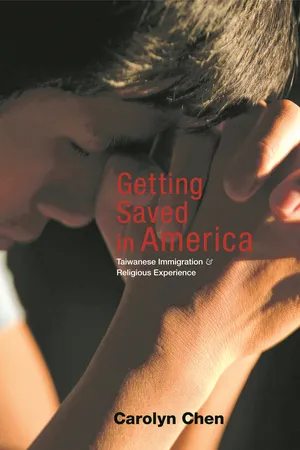
What does becoming American have to do with becoming religious? Many immigrants become more religious after coming to the United States. Taiwanese are no different. Like many Asian immigrants to the United States, Taiwanese frequently convert to Christianity after immigrating. But Americanization is more than simply a process of Christianization. Most Taiwanese American Buddhists also say they converted only after arriving in the United States even though Buddhism is a part of Taiwan's dominant religion. By examining the experiences of Christian and Buddhist Taiwanese Americans, Getting Saved in America tells "a story of how people become religious by becoming American, and how people become American by becoming religious."
Carolyn Chen argues that many Taiwanese immigrants deal with the challenges of becoming American by becoming religious. Based on in-depth interviews with Taiwanese American Christians and Buddhists, and extensive ethnographic fieldwork at a Taiwanese Buddhist temple and a Taiwanese Christian church in Southern California, Getting Saved in America is the first book to compare how two religions influence the experiences of one immigrant group. By showing how religion transforms many immigrants into Americans, it sheds new light on the question of how immigrants become American.
- 256 pages
- English
- ePUB (mobile friendly)
- Available on iOS & Android
eBook - ePub
About this book
Information
Publisher
Princeton University PressYear
2009Print ISBN
9780691164663
9780691119625
eBook ISBN
9781400824175
1
From Beautiful Island (Ilha Formosa) to Beautiful Country (America: Bi-kuo/Mei-guo)
TAIWANESE IMMIGRATION AND RELIGION IN SOUTHERN CALIFORNIA
During the recent 20-year immigration period, Taiwanese Americans have become one of the “model minorities.”
—From a Taiwanese American Heritage Committee brochure
—From a Taiwanese American Heritage Committee brochure
ON APRIL 24, 1999, over two thousand eager Taiwanese Americans gathered at Pasadena City College in Southern California to support one of Taiwan’s presidential candidates, Chen Shui-Ben.1 Recognizing the importance of overseas Taiwanese financial and electoral support to his campaign,2 Chen visited Southern California—home of the largest Taiwanese community in the United States. After the performance of several church choirs singing traditional Taiwanese folk songs, and speeches by several local leaders extolling his virtues, an excited and hoarse Chen arrived on stage. The crowd went wild, chanting “Ah-biah,” his nickname in Taiwanese, for ten minutes before he could begin his speech. In a characteristically Taiwanese manner, he assured the supporters of his humility; his campaign for presidency was not motivated by an egoistic desire for power. Rather, he told the audience, the presidency was the “cross” he had to bear, an awesome and heavy burden that he was willing to carry. This, of course, is not the first time that politicians have used the image of the cross to describe their mission. But surely most of those leaders represent Christian populations or are Christian themselves. Why would Chen Shui-Ben refer to the cross when Christians are only 3.9 percent of the Taiwanese population?
This example illustrates both the continuity and transformation in Taiwanese Americans. Their support of Chen Shui-ben’s presidential campaign shows that Taiwanese immigrants maintain a strong sense of ethnic identity and political involvement even in diaspora. But Chen Shui-Ben’s rhetorical reference to the Christian cross in a secular political rally in Southern California suggests that these overseas Taiwanese are different from those in the homeland. Taiwanese Americans have adopted new icons, in particular, religious icons. To reach out to some of them, he has to speak their language. In this case, it was Christian language.
This chapter discusses the social, political, economic, and religious contexts that shape Taiwanese immigration and religious experience in Southern California. Taiwanese immigration is a product of shifting geopolitical and economic forces in the post–World War II era. American labor needs and foreign policies have created a distinctly educated, highly skilled population of Taiwanese Americans. Capitalizing on mass Chinese emigration from Taiwan and Hong Kong, Chinese developers have drawn Chinese to Southern California’s San Gabriel Valley, transforming it into a mecca for Chinese economic, cultural, and religious activity. My fieldsites, Grace Evangelical Church and Dharma Light Temple, illustrate how immigration patterns and trends in American and Taiwanese religion have shaped the religious experience of Taiwanese in Southern California.
FORMOSA
Taiwan was named Ilha Formosa, or “beautiful island,” by Portuguese sailors in the late sixteenth century. Formosa is a mountainous island ninety-six miles east of the South China coast. The island is a mere 36,000 square kilometers, approximately the size of the Netherlands. With a population of twenty-three million people, it is second only to Bangladesh as the most densely populated place on earth.
Today Taiwan is best known to Americans for two things. The first is its “miracle economy” that has transformed Taiwan from an agrarian society to a postindustrial society in a mere fifty years—what took the United States and Great Britain two hundred years to achieve. The second is its ambiguous political status as either a sovereign nation or a renegade province of China that has generated endless tension between China and the United States. Its strategic location less than one hundred miles from China has made it indispensable to American foreign interests in Asia. Taiwan’s former claim to be the legitimate government of China, and now, independent from China, make it a perpetual thorn in China’s side.
The legacy of Taiwan’s political history forms the backdrop for contemporary Taiwanese emigration. The people of Taiwan were ruled briefly by the Spanish, Portuguese, and Dutch from the late sixteenth century to the mid-seventeenth century. Beginning in 1662, Taiwan came under Chinese rule, first under the warlord Chen Ch’eng-kung (or Koxinga) for twenty years, and then under Manchu China for more than 250 years. After China’s loss to Japan in the Sino-Japanese war, China ceded Taiwan to Japan in 1895. Taiwan was ruled by Japan for nearly fifty years. After World War II, the Allies placed Taiwan under Chinese control. At the time, China was embroiled in a civil war between the Nationalists or the Kuomintang, led by Chiang Kai Shek, and the Communists under Mao Zhedong. In defeat, Chiang Kai Shek and roughly two million mainland Chinese, also known as “Mainlanders,” retreated to the island of Taiwan in 1949. Chiang and his troops intended to temporarily recuperate in Taiwan before reclaiming Mainland China from the Communists. With the outbreak of the Korean War in 1950, the United States poured military and economic aid into neighboring Taiwan to prevent communist domination in the region. During this time, the United States, along with the United Nations, recognized the Kuomingtang in Taipei, and not the People’s Republic of China (PRC) in Beijing, as the legitimate government of China. All of this changed in the 1970s, when the United Nations switched and recognized the PRC and not the Kuomingtang as the state of China, and the United States began normalizing relations with communist China. This sudden drop in diplomatic status created a sense of political uncertainty that has motivated large-scale emigration from the island since then.3
For over forty years, the Kuomingtang controlled Taiwan under an authoritarian military state. The Kuomintang did little to warm the hearts of the ethnic Taiwanese, or the pre-1949 Han Chinese, who comprise over 70 percent of the population. The Kuomingtang repressed the usage of Taiwanese, or the local Minnan dialect, barred ethnic Taiwanese from important political positions, and killed people expressing political dissent. These repressive practices heightened tension between the ethnic Taiwanese and Mainlanders. The Kuomingtang finally loosened its iron grip on Taiwan in the 1980s. With the ending of martial law, the legalization of oppositional parties, and the lifting of media control in the late 1980s, Taiwan peacefully transitioned from an authoritarian state to a democratic society (Clough 1998; Gold 1998).
Despite or perhaps because of its suppression of civil society, the Kuomingtang helped to grow Taiwan’s “miracle economy” (Aspalter 2001; Gold 1986). With the backing of tremendous American foreign aid, the Kuomingtang built an impressive economic infrastructure. In the 1950s the Kuomingtung instituted major land reform, leading to increased agricultural productivity (Rubinstein 1994). Agricultural profits generated the capital to finance labor intensive manufacturing industries beginning in the 1960s and throughout. As Western industrialized nations were beginning to outsource manufacturing, Taiwan was perfectly poised to meet their demands. By the 1970s, Taiwan had transformed into an export economy specializing in labor-intensive industries. Today Taiwan’s economy is concentrated in technology-intensive and service-oriented industries, like most Western industrialized countries. As I will discuss, Taiwan’s economic growth spurt, coupled with its political uncertainty, has produced an educated and skilled class of potential émigrés who meet the labor needs of the postwar American economy.
TAIWANESE IMMIGRATION TO THE UNITED STATES
The Immigration and Nationality Act of 1965 opened the possibility for large-scale Taiwanese immigration by removing previous policies restricting Asians. It increased the annual quota of Chinese immigrants (this includes Taiwanese) to twenty thousand, included a provision for the reunification of immediate family members, and established a system of preferences for individuals possessing scientific and technical skills. The American attempt to curb communist proliferation around the globe heavily influenced this seismic shift in immigration policy (Ong and Liu 1994). Under international pressure to live up to its image as the champion of the free world, especially with the racist contradictions of the Civil Rights movement mounting internally, the United States had to reconsider its former immigration policies barring those of nonwhite descent. Cold War anxieties motivated the United States to establish a preference system for immigrants with scientific and technical skills to bolster the nation’s scientific armor against the Soviets (ibid.). American political and economic concerns coincided neatly with Taiwanese desires for political security and economic advancement in the postwar era.
Before the 1970s, the majority of immigrants from Taiwan were elite graduate students from middle class backgrounds.4 After taking control of Taiwan, the Kuomingtang implemented a widespread campaign to modernize and expand the educational system. This program invested heavily in basic education and vocational schooling, however, leaving those seeking advanced degrees to study abroad. Because of better economic opportunities in the United States, most students remained after completing their degrees—contributing to the “brain drain” of Taiwan. Students who had entered the country on an F-1 (student) visa adjusted their status to permanent residency based on the category of occupational preferences. Since the 1950s, nearly 80,000 Taiwanese have pursued graduate education in the United States, and only 20 percent have returned to Taiwan (Chang 1998; O’Neil 2003).
The number of Taiwanese who immigrate through occupation preference categories is quite high compared to other groups. Along with the Phillipines, India, China, and Iran, Taiwan is one of the top countries sending professionals to the United States (Kanjanapan 1995). For example, in 1989 42 percent of Taiwanese immigrated to the United States under occupational categories reserved for highly skilled individuals and their families. By 2004, this proportion decreased to approximately 30 percent, but is still significant. The brain drain has slowed and partially reversed since the mid-1980s. Two things have attracted highly skilled overseas Taiwanese back to Taiwan—its booming economy, particularly in the high-tech sector, and new state policies that encourage the return of professionals (Chen 1989).
Since the mid-1970s, they majority of Taiwanese immigrants have established permanent residency through the preference category of family reunification. Highly educated Taiwanese who had immigrated during the 1960s and early 1970s sponsored their family members—usually siblings—leading to a pattern of chain migration. These immigrants come from more diverse class and educational backgrounds than the earlier immigrants.
Undocumented immigration is not typically associated with Taiwanese, but it also occurs among Taiwanese immigrants. Unlike the popular stereotype of undocumented immigrants who are smuggled across the border, undocumented Taiwanese immigrants have become “illegal” by overstaying their student or visitor visas. Many are middle-class and educated. Some undocumented Taiwanese, particularly before the mid-1980s, were able to establish permanent residency as political asylees from the Kuomingtang.5 Other undocumented Taiwanese immigrants have been able to adjust their status to legal permanent residency by meeting the criteria set forth by the Immigration Reform and Control Act of 1986 and the current “Registry” Provision of the Immigration and Nationality Act.6
Taiwan’s political uncertainty has spurred much of Taiwanese immigration since the 1970s. The absence of recognition as an official state, plus the constant threat of invasion by the People’s Republic of China, elicits an ever present state of insecurity in Taiwanese people. Emigration, or at least possession of another country’s passport, is a strategy for security among those who can afford it. Having at least one member of the family outside of Taiwan ensures the future immigration of other members should tensions between Taiwan and China escalate. The United States has always been the first choice for Taiwanese emigrants, but it is also the most difficult country to establish residency. Canada, Australia, and New Zealand are second-choice options, with countries like Brazil in South America as well as South Africa as alternatives. Some Taiwanese will first immigrate to these countries to gain easier access into the United States.
Besides political security and economic opportunity, the most commonly cited reasons for emigration are deteriorating living conditions in Taiwan, and access to higher education for children (Chee 2005; Ng 1998; Tseng 2001). The rapid economic development of Taiwan has come at a high environmental cost. Several respondents claim that pollution, congestion, and urbanization have made living in Taiwan highly unpleasant and undesirable. More recently fewer immigrants complain about this as a highly successful environmental movement in the last decade has improved the lives of Taiwanese urbanites.
Taiwanese frequently claim that they move to the United States for their children’s education. Because there are relatively few universities, getting into a Taiwanese university is notoriously competitive. Taiwanese claim that children’s lives in Taiwan are miserable. After school, children regularly attend “cram schools” until ten or eleven o’clock to prepare for exams that track them into particular schools. Their fates hinge on their performance in the university entrance exam. In the United States, on the other hand, higher education is accessible to virtually anyone who can afford it. Children can have access to higher education without the miserable lifestyle. As one Taiwanese immigrant explains, “Now my children don’t live with the constant pressure of having to be the best in their class” (Arax 1987). But Taiwanese American parents still hold very high educational expectations from their children. For example, the Southern California Chinese Yellow Pages includes a list of the top ten American universities as pertinent information to all Chinese immigrants, demonstrating how central educational achievement is to Taiwanese.
The desire to offer educational opportunities for their children has led some Taiwanese to engage in creative immigration arrangements. Some Taiwanese immigrants resolve conflicting interests through split family migration, where the wife and children remain in the host country while the husband-bread winner shuttles like an “astronaut” (taikongren)7 between Taiwan and the United States (Chang 2006; Chee 2005). One of my respondents who grew up in a split-family migrant household admitted that the reason his mother brought him to the United States was because he could not get into a university in Taiwan with his poor grades. His father, on the other, a surgeon in Taiwan, stayed behind to fund two households. Certainly this is a strategy of class reproduction that only the affluent can afford.
Other Taiwanese send their children to live in the United States alone, without adult supervision. These young immigrants, known as “parachute children” or “little students abroad” (shaio liu shuesheng), have developed a reputation for being affluent, spoiled, and delinquent (Pih and Mao 2005). Southern California Chinese leaders have even requested the Taiwanese government to tighten visa requirements to reduce their numbers (Hamilton 1993).
Since the 1980s, a growing number of Taiwanese have immigrated to the United States for business investment. Countries such as Australia (Ip, Wu, and Inglis 1998), Canada (Wong 1997), and the United States (Tseng 2001, 1997) have implemented immigration policies attracting affluent business migrants, mostly from newly industrialized countries like Taiwan and Hong Kong, as links to foreign investment. In 1990, the U.S. Congress expanded occupational preference categories to include a fifth category (EB-5) to compete with Australia’s and Canada’s lure for affluent investors. This category admitted persons who could invest one million dollars and create ten new jobs in the American economy. With higher wages and stricter environmental and labor standards in Taiwan, Taiwanese businesspersons have sought to plant their businesses elsewhere, such as China, and Latin America, but also the United States (Kwong and Miščević 2005). Furthermore, an American passport offers Taiwanese capitalists pursuing international investment opportunities the diplomatic protection and internationally mobility that a Taiwanese passport does not.
Taiwanese immigration to the United States has shifted in the last forty years, vacillating between 6,745–16,698 immigrants a year. Taiwanese immigration peaked between the years 1977–96, drawing over 10,000 nearly ever year. My own sample of fifty respondents reflects this immigration pattern, with ten immigrating in the 1970s or earlier, twenty-seven in the 1980s, and thirteen in the 1990s.
Immigration from Taiwan has slowed down since the late 1990s. Incredible growth in Taiwan’s economy, particularly the high tech industry, improved living conditions, and expanded educat...
Table of contents
- Cover Page
- Title Page
- Copyright Page
- Dedication Page
- Contents
- A Note on Translations
- Acknowledgments
- Introduction: Becoming Religious by Becoming American
- 1. From Beautiful Island (Ilha Formosa) to Beautiful Country (America: Bi-kuo/Mei-guo): Taiwanese Immigration and Religion in Southern California
- 2. Becoming Christian: Breaking Traditions and Making Traditions
- 3. Becoming Buddhist: From Embedded Religion to Explicit Religion
- 4. Becoming American Men and Women: Otherworldly Narratives and This-Worldly Selves
- 5. Cultivating American Saints: Religious Disciplines of the Self
- Conclusion: Becoming Americans: From Migrants to Pilgrims
- Appendix: Interview Schedule
- References
- Index
Trusted by 375,005 students
Access to over 1.5 million titles for a fair monthly price.
Study more efficiently using our study tools.
Frequently asked questions
Yes, you can cancel anytime from the Subscription tab in your account settings on the Perlego website. Your subscription will stay active until the end of your current billing period. Learn how to cancel your subscription
No, books cannot be downloaded as external files, such as PDFs, for use outside of Perlego. However, you can download books within the Perlego app for offline reading on mobile or tablet. Learn how to download books offline
Perlego offers two plans: Essential and Complete
- Essential is ideal for learners and professionals who enjoy exploring a wide range of subjects. Access the Essential Library with 800,000+ trusted titles and best-sellers across business, personal growth, and the humanities. Includes unlimited reading time and Standard Read Aloud voice.
- Complete: Perfect for advanced learners and researchers needing full, unrestricted access. Unlock 1.5M+ books across hundreds of subjects, including academic and specialized titles. The Complete Plan also includes advanced features like Premium Read Aloud and Research Assistant.
We are an online textbook subscription service, where you can get access to an entire online library for less than the price of a single book per month. With over 1.5 million books across 990+ topics, we’ve got you covered! Learn about our mission
Look out for the read-aloud symbol on your next book to see if you can listen to it. The read-aloud tool reads text aloud for you, highlighting the text as it is being read. You can pause it, speed it up and slow it down. Learn more about Read Aloud
Yes! You can use the Perlego app on both iOS and Android devices to read anytime, anywhere — even offline. Perfect for commutes or when you’re on the go.
Please note we cannot support devices running on iOS 13 and Android 7 or earlier. Learn more about using the app
Please note we cannot support devices running on iOS 13 and Android 7 or earlier. Learn more about using the app
Yes, you can access Getting Saved in America by Carolyn Chen in PDF and/or ePUB format, as well as other popular books in Social Sciences & Buddhism. We have over 1.5 million books available in our catalogue for you to explore.