In the first book-length history of Puerto Rican civil rights in New York City, Sonia Lee traces the rise and fall of an uneasy coalition between Puerto Rican and African American activists from the 1950s through the 1970s. Previous work has tended to see blacks and Latinos as either naturally unified as “people of color” or irreconcilably at odds as two competing minorities. Lee demonstrates instead that Puerto Ricans and African Americans in New York City shaped the complex and shifting meanings of “Puerto Rican–ness” and “blackness” through political activism. African American and Puerto Rican New Yorkers came to see themselves as minorities joined in the civil rights struggle, the War on Poverty, and the Black Power movement — until white backlash and internal class divisions helped break the coalition, remaking “Hispanicity” as an ethnic identity that was mutually exclusive from “blackness.”
Drawing on extensive archival research and oral history interviews, Lee vividly portrays this crucial chapter in postwar New York, revealing the permeability of boundaries between African American and Puerto Rican communities.
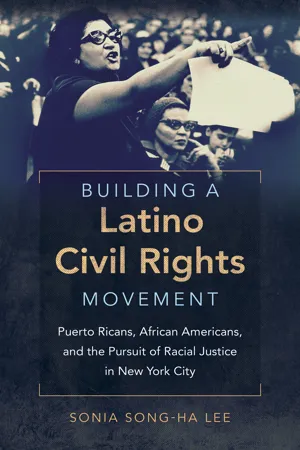
eBook - ePub
Building a Latino Civil Rights Movement
Puerto Ricans, African Americans, and the Pursuit of Racial Justice in New York City
- 352 pages
- English
- ePUB (mobile friendly)
- Available on iOS & Android
eBook - ePub
Building a Latino Civil Rights Movement
Puerto Ricans, African Americans, and the Pursuit of Racial Justice in New York City
About this book
Information
Chapter One: Puerto Ricans, Race, and Ethnicity in Postwar New York City
When Armando Boullon walked into a barbershop in Fort Greene, Brooklyn, on February 19, 1958, he expected to spend an ordinary afternoon getting a haircut. He had been to the same barbershop three months earlier and had gotten a haircut from the owner himself, Frank De Bello, an Italian man. He was shocked that day, however, when he was refused service as soon as he entered the premises. “What do you want here? We don’t cut colored people’s hair,” De Bello told him. When Boullon reminded him that he had gotten a haircut from him before, De Bello insisted that he was not telling the truth. This could have simply been one of the many racial confrontations that Boullon experienced as a second-generation West Indian immigrant living in New York City, but what aggravated him this time was that this Italian man seemed to arbitrarily choose when he would treat another man as a “colored” person. Boullon then remembered that, during his first visit, De Bello had initially asked him, “Porto Ricano?” Boullon had nodded affirmatively, not caring whether being a Puerto Rican should determine his ability to receive a haircut. When Boullon later brought this case to the New York State Division of Human Rights, however, he learned that De Bello based his rationale on this perception. When questioned by Commissioner of Human Rights John A. Davis, De Bello argued that he had been willing to cut Boullon’s hair at first because he thought Boullon was a Puerto Rican. He could cut “Puerto Rican hair” because Puerto Ricans had “very soft hair,” whereas he could not cut “Negro hair” because he had “botched up a mess” the last time he had tried to cut such hair. Upon further questioning, he admitted that some Puerto Ricans have “hair like a Negro,” but not in general. Still, he never explained how this “Porto Ricano” became a “colored” man in his eyes from one day to another. In his mind, there were clear and fixed boundaries between Puerto Ricans and “colored” people. When the commissioner recommended that he send a letter to Boullon telling him that he would cut his hair in the future, De Bello simply refused to do so. Left with no power of enforcement, the commissioner simply dropped the case.1
Puerto Ricans occupied a racially ambiguous place in New York City in the first two decades of the postwar era. Their “soft hair” and “light skin” marked their similarity in physical appearance to Europeans and their potential to pass as “white.” Yet they could also be indistinguishable from West Indians and the broader Afro-descendant population of the city. Puerto Ricans, however, came to occupy an increasingly similar location to African Americans in the racial spectrum in this era. This chapter examines the racial discourses and structures that shaped the lives of Puerto Rican migrants from the late 1940s through the 1950s. The rise of Nazi Germany in the 1930s and 1940s demanded that Americans conceptualize a way to understand group differences apart from notions of biological inferiorities. Leading American scholars and public figures thus adopted the “cult of ethnicity” as a way of portraying America as a racially democratic and egalitarian nation. According to this discourse, Puerto Ricans and African Americans were no different from European ethnic groups. Their high rates of poverty and cultural marginalization reflected rural migrants’ general difficulty in adjusting to an industrial, urban center. With time, however, they would form their own cultural and political organizations that would help them assimilate into the broader society. Their ability to integrate would prove not only their individual capacities, but also the flexibility and pluralistic nature of American democracy. Although sociologists from the University of Chicago had first developed the ethnic framework in the 1910s, government officials tapped into this concept in order to galvanize civilian morale primarily during World War II.2
The postwar era, however, also saw the rise of another discourse that was much more ominous for “nonwhite” Americans. The “culture of poverty” literature predicted that migrants of color were much less likely to assimilate into mainstream American society than former European immigrants. It shared a focus on culture with the “cult of ethnicity” discourse, but it adopted a much more pessimistic outlook on racial minorities’ capacity to overcome poverty. Propagated by social scientists and public policymakers in the 1950s and 1960s, this literature argued that poor environments, such as high rates of female-headed households and high unemployment rates, produced psychological pathologies among the poor, such as self-hatred and defeatism. Some policymakers believed that such pathologies were fixable through government intervention in housing and schools, but others claimed that they were permanent deficiencies that would be transmitted from one generation of the poor to the next.3
As deindustrialization and urban renewal increasingly constrained African Americans’ and Puerto Ricans’ access to good jobs and housing in the 1950s, the more ominous predictions of the “culture of poverty” discourse came to prevail over the more optimistic tone that had inspired the “cult of ethnicity.” Puerto Ricans, though occupying a racially ambiguous position of being neither “white” nor “black,” came to be increasingly associated with African Americans as a result of their presumed “culture of poverty.” Puerto Ricans were thus racialized alongside African Americans in the postwar era. Puerto Ricans struggled to defend themselves against the stigmatizing impact of such a discourse. But their desire to find their own voices and create independent political leadership often went unheeded in this period.
Placing Puerto Ricans within the U.S. Racial Spectrum
Since invading the island of Puerto Rico in 1898, North Americans had had difficulty assigning Puerto Ricans a place within their racial spectrum. The United States had strategic reasons for colonizing the island: the island provided a military outpost; islanders provided a larger market for U.S. products and cheap labor for U.S. corporations; and the island provided a laboratory to test new economic and political arrangements between the United States and Latin America.4 According to the interests of American capitalists who sought to exploit cheap Puerto Rican labor, Puerto Rican workers were imagined as in need of discipline and order. American traveler and entrepreneur Alfred G. Robinson noted that Puerto Ricans, who were “lazy, easy-going and . . . idle people,” would transform themselves “into active and energetic workers” when infused with North American capital and governance.5 Puerto Ricans’ racial inferiority also justified their subjugation to American rule. Whitelaw Reid, a member of the U.S. delegation that shaped the Treaty of Paris, claimed that Puerto Rico was made up of a “mixed population, a little more than half colonial Spanish, the rest negro and half-breed, illiterate, alien in language, alien in ideas of right, interests, and government.”6 Spain itself, which symbolized the “white” heritage of Puerto Ricans, was imagined as an inferior type of the West. “Spain . . . was the Turk of the West,” claimed journalist A. D. Hall in Cuba: Its Past, Present, and Future (1898). “Spain is an obsolete nation. Living in the past, and lacking cause of pride today, she gloats over her glorious explorations and her intellectual prowess of the middle ages when much of Europe was in darkness,” argued Hall.7 At the same time that Puerto Ricans were viewed as racially impure, however, they also ranked somewhere above the people inhabiting other territories the United States acquired at this time. North American legislators extended U.S. citizenship by birth to Puerto Ricans in 1917 partly because they considered Puerto Ricans to be the “whitest of the Antilles.” Such a status would not be granted to Filipinos, whom Americans considered too “Oriental” to be assimilable to American values and norms.8
As Puerto Ricans began to migrate to the mainland in the early part of the twentieth century, the label of “Hispanicity” partially shielded them from becoming racialized as “Negro.” “By insisting that he is Puerto Rican and Spanish,” wrote Claude McKay in 1940, a Puerto Rican could, “like the swarthy Sicilian, escape a little from that stigma which fixes the American Negro in a specific position in the social set up.”9 The Puerto Rican and the general Latin American populations in New York City were relatively small at the beginning of the twentieth century—the Hispanic population composed only .7 percent of the population of the city. There were about 41,094 Spanish-speaking individuals living in New York City in 1920, of whom 17.9 percent were Puerto Rican, 35.7 percent were Spanish, and the rest were Cuban, West Indian, and Central and South American.10 Situated within a small Hispanic population composed mostly of Spanish immigrants, Puerto Ricans blended in as an inconspicuous “semi-white” group of Spanish people. This privilege paid them some dividends. For example, in the 1920s, the majority of Puerto Ricans shared buildings with European ethnic groups, such as Italians, Jews, Russians, and the Irish, rather than with African American residents. Jewish and Italian neighbors still expressed their distrust of Puerto Ricans—especially during violent street confrontations—but their suspicions did not lead them to actively block Puerto Rican settlement in their neighborhoods.11
Due to their position of racial ambiguity, Puerto Ricans helped break the color line in certain neighborhoods of the city. Once light-skinned Puerto Ricans entered East Harlem sections below 116th Street, which had been mostly populated by Italians and Jews, their darker-skinned compatriots and African Americans followed.12 Like European immigrants, Puerto Ricans were also relatively successful at creating small businesses, such as bodegas, restaurants, cigar stores, and bookstores. In the 1920s, they had organized the Liga Puertorriqueña e Hispana partly to protect Puerto Ricans from Jewish attacks motivated by their competition for small businesses in East Harlem.13 Although the majority of Puerto Rican jazz musicians became famous by performing with African American musicians in Harlem clubs, Latin relief bands made up of Puerto Ricans and Cubans of “light complexion” performed in elegant hotels and clubs in downtown Manhattan to a mostly white clientele. Their status as relief bands allowed club owners to pay them less than union wages—relief bands only played when the headliner bands were on break—but the fact that they could perform at such clubs indicated the privileges their light skin could bring.14
At the same time, though, Puerto Ricans were not able to overcome the economic and political marginalization that many African Americans suffered. Most Puerto Ricans in the 1920s, whether possessing “white” or “Negro” features, worked as factory workers or rural farmers, often enduring low wages and poor working conditions. Close to 60 percent of the Puerto Rican population in the city was made up of tabaqueros (cigar workers) at this time.15 Puerto Rican low-wage workers, along with African American, Cuban, and other Afro-Caribbean workers, were seen as “exploitable” by their employers. In the 1930s, Puerto Rican workers became particularly vulnerable when First Lady Eleanor Roosevelt spread fears among New Yorkers that Puerto Rican restaurant, hotel, and domestic workers could spread tuberculosis to other employees and customers. According to Puerto Rican migrant Bernardo Vega, the First Lady’s portrayal of “Puerto Ricans as a racial group with contagious diseases” significantly jeopardized their chances of securing good jobs.16 Puerto Ricans were also racialized as intellectually inferior and born with criminal tendencies. In a 1935 study commissioned by the New York State Chamber of Commerce’s Special Committee on Immigration and Naturalization, Puerto Rican children were depicted as worsening the “problem of intellectual subnormal school retardates of alien parentage, whence are recruited most delinquents and criminals.”17
New Yorkers’ inability to place Puerto Ricans in a specific place within the white-black binary became more confounding to them in the postwar era, when the black and Puerto Rican populations in the city increased dramatically. Southern black and Puerto Rican migrants began to reside in New York City in large numbers due to the postwar prosperity in the North and the shortage of jobs in their home regions. Between 1950 and 1970, the black population in the city increased from 748,000 (9.5 percent) to 1,668,000 (21.1 percent), and the Puerto Rican population increased from 246,000 (3.1 percent) to 846,700 (10.7 percent). Meanwhile, the white population in the city shrank considerably. Between 1940 and 1960, 1,698,200 whites left New York City and settled in the suburbs. New York’s suburban population exceeded its urban population for the first time in the 1950s—the suburban population increased by 2,180,492 and the urban population decreased by 109,973.18
When Puerto Ricans were counted officially for the first time in the U.S. Census of 1960, they were counted neither as a “race” like African Americans nor as a “foreign stock” like European immigrants. While there were three categories for races (“white, “Negro,” and “other races”) and thirteen categories for “foreign stock” (such as from the United Kingdom, Germany, Italy, or Mexico), the category of those “born in Puerto Rico” or of “Puerto Rican parentage” was entirely separate. The census did note that 4 percent of Puerto Ricans in New York City were “nonwhite” (24,871 out of 612,574), but it did not have a separate count for “white” Puerto Ricans, signaling that census takers considered the majority of Puerto Ricans neither “white” nor “nonwhite.”19
Puerto Ricans themselves hesitated from categorizing themselves as either “white” or “nonwhite.” Many recounted experiences of coming to the United States and being “shocked” at North Americans’ practice of strictly dividing people into two racial groups. Antonia Pantoja, who migrated to New York City in 1944 at the age of twenty-two, described how surprised she was when she saw passengers being segregated by race in the train she took from New Orleans to New York City. The group of Puerto Rican friends that accompanied her—a “black man,” “a white man with reddish hair,” and another “white-complexioned woman with wavy black hair and thick lips and nose”—did not know how to follow the rules on the train, given their “combination of color and facial characteristics.” To her, the whole experience felt like “the raping of our innocence.” Against the backdrop of an unpretentious, cordial group of racially mixed Puerto Ricans, she painted North Americans as cold, calcula...
Table of contents
- Cover Page
- Building A Latino Civil Rights Movement
- Copyright Page
- Contents
- Figures and Maps
- Acknowledgments
- Introduction
- Chapter One: Puerto Ricans, Race, and Ethnicity in Postwar New York City
- Chapter Two: We Were Walking on Egg Shells
- Chapter Three: From Social Reform to Political Organizing
- Chapter Four: If You Have a Black Numero Uno, Let’s Have a Puerto Rican Numero Dos
- Chapter Five: From Racial Integration to Community Control
- Chapter Six: The Breaking of a Coalition
- Epilogue
- Notes
- Bibliography
- Index
Trusted by 375,005 students
Access to over 1.5 million titles for a fair monthly price.
Study more efficiently using our study tools.
Frequently asked questions
Yes, you can cancel anytime from the Subscription tab in your account settings on the Perlego website. Your subscription will stay active until the end of your current billing period. Learn how to cancel your subscription
No, books cannot be downloaded as external files, such as PDFs, for use outside of Perlego. However, you can download books within the Perlego app for offline reading on mobile or tablet. Learn how to download books offline
Perlego offers two plans: Essential and Complete
- Essential is ideal for learners and professionals who enjoy exploring a wide range of subjects. Access the Essential Library with 800,000+ trusted titles and best-sellers across business, personal growth, and the humanities. Includes unlimited reading time and Standard Read Aloud voice.
- Complete: Perfect for advanced learners and researchers needing full, unrestricted access. Unlock 1.5M+ books across hundreds of subjects, including academic and specialized titles. The Complete Plan also includes advanced features like Premium Read Aloud and Research Assistant.
We are an online textbook subscription service, where you can get access to an entire online library for less than the price of a single book per month. With over 1.5 million books across 990+ topics, we’ve got you covered! Learn about our mission
Look out for the read-aloud symbol on your next book to see if you can listen to it. The read-aloud tool reads text aloud for you, highlighting the text as it is being read. You can pause it, speed it up and slow it down. Learn more about Read Aloud
Yes! You can use the Perlego app on both iOS and Android devices to read anytime, anywhere — even offline. Perfect for commutes or when you’re on the go.
Please note we cannot support devices running on iOS 13 and Android 7 or earlier. Learn more about using the app
Please note we cannot support devices running on iOS 13 and Android 7 or earlier. Learn more about using the app
Yes, you can access Building a Latino Civil Rights Movement by Sonia Song-Ha Lee in PDF and/or ePUB format, as well as other popular books in Social Sciences & North American History. We have over 1.5 million books available in our catalogue for you to explore.