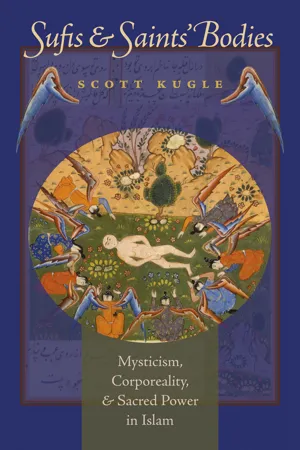
Islam is often described as abstract, ascetic, and uniquely disengaged from the human body. Scott Kugle refutes this assertion in the first full study of Islamic mysticism as it relates to the human body. Examining Sufi conceptions of the body in religious writings from the late fifteenth through the nineteenth century, Kugle demonstrates that literature from this era often treated saints' physical bodies as sites of sacred power.
Sufis and Saints' Bodies focuses on six important saints from Sufi communities in North Africa and South Asia. Kugle singles out a specific part of the body to which each saint is frequently associated in religious literature. The saints' bodies, Kugle argues, are treated as symbolic resources for generating religious meaning, communal solidarity, and the experience of sacred power. In each chapter, Kugle also features a particular theoretical problem, drawing methodologically from religious studies, anthropology, studies of gender and sexuality, theology, feminism, and philosophy. Bringing a new perspective to Islamic studies, Kugle shows how an important Islamic tradition integrated myriad understandings of the body in its nurturing role in the material, social, and spiritual realms.
- 368 pages
- English
- ePUB (mobile friendly)
- Available on iOS & Android
eBook - ePub
About this book
Information
Topic
Theology & ReligionSubtopic
Islamic Theology1
BODY ENSHRINED
The Bones of Mawlay Idrīs
Look at the bones, how we revive them
And clothe them once more in flesh.
—Qurʾan 2:259
The Qurʾan insists that there is life after death, announcing the inevitability of resurrection in ways that inspire both awe and dread. In the verses above, an unnamed man passes by a ruined city and cries out in despair, “How will God bring this to life after its demise?” God causes him to fall into a deathlike state for a century and then revives him to give him firsthand knowledge of God’s power to take life away and give it again. He looks to his donkey, which has turned to bones, and before his eyes God reweaves the flesh upon its frame. Interpreters of the Qurʾan have identified this unnamed prophetic figure as Ezra, the Jewish scholar and community leader who returned to Jerusalem after the long exile in Babylon. He found it a ruined city, devoid of the vibrant Jewish community that had once worshiped there. Having expressed despair and survived his trial by God, Ezra mounted his now breathing donkey and set about the task of writing down the Hebrew scriptures anew and reviving Jewish life in the holy city.
Muhammad also tried to revive a holy city, Mecca, which had been hallowed by Abraham’s building a shrine, like Jerusalem. Muhammad tried to revive the Abrahamic worship of the singular God at that shrine, the Kaʿba, to revitalize the city’s spiritual life, which had become desolate through greed, corruption, and idolatry. His opponents among the Arabs scoffed at the idea that the shrine in the center of their city needed purification, just as they scoffed at the idea that the body could be restored after it had decayed. On the verge of despair, Muhammad conveyed to them the Qurʾan’s repeated teaching through vivid images, parables, and stories of the prophets. The tribulations of former prophets echoed Muhammad’s own trials, and the Qurʾan insists that each prophet came with the same message and met the same resistance by the powerful few from the time of Noah until Muhammad: They retort, “He’s nothing special! He’s just a man, who eats what you eat and drinks what you drink. If you obey one who is no better than you, then you are surely losers. He warns you, when you have died and become dust and bones that you will emerge once again. What a silly thing you are promised! Life is only this life of ours in the world—we die just as we live and we are never resurrected again to life” (Q 23:33–37). It is not surprising that bones are the metaphor to which the Qurʾan turns insistently to preach the doctrine of resurrection. Bones are a constant reminder of death, for we see them only after the rest of the body has decayed. However, bones are also a constant reminder that we persist and that our personality is durable even beyond the portal of death, since bones remain intact long after other tissues have rotted away.
The Qurʾan links the One who firmed up the bones in each gelatinous fetal body in the first instance to the One who will restore life to them after their flesh has putrefied into liquid and drained away. Earlier in the same chapter in which it recalls how the elite of Noah’s community rejected his teaching, the Qurʾan reminds us of our origin while calling us to bear in mind our inexorable though unobservable fate: We surely created the human being from an essence of clay. Then we made the clay into a minuscule sperm in a place of safe repose. Then we transformed the sperm into a mucuslike clot. Then we fashioned this clot into a soft fleshy lump. Then we created firm bones within the flesh and clothed the bones with muscle. Then we devised for it another creation [breathing life into it]. Blessed be God, the best of creators! Then after your creation you will all surely die, and after death you will all surely be raised on the day of reckoning (Q 23:12–16). The Qurʾan presents God, the best of creators, as both the shaper of the human body and the fashioner of the earth. The two worlds, the human body’s inner world and the terrestrial expanse’s outer world, are presented in parallel. The bones represent structure and foundation, the framework that allows the whole creation to stand and the firm planting that keeps its motion in order.
This homology between the world and the body is common in ancient mythologies. Often the world is imagined as the body of a cosmic giant, the first primal man, who sacrifices himself and whose divided body constitutes the created world: the dome of the sky is his skull, the earth his flesh, precious minerals his teeth, rivers his blood, and mountains his bones.1 The bones in the human body are like the mountains of the earth—they give it its characteristic shape while anchoring its surface deep within its structural foundation. One Sufi master taught that “the 360 days of the solar year are equivalent to the 360 bones in the human body which are equivalent to the 360 mountains of the earth.”2
As a radical monotheism, Islam shies away from this outright anthropomorphism of mythic imagination, for it suggests that God had a body or that a primordial being other than God was responsible for creating the world. However, the Qurʾan echoes the ancient fascination with the earth’s bones; it replaces the idea of mountains as the cosmic man’s bones with the idea of mountains as pegs (awtād) driven by God deep into the earth’s structure: Have we not made the earth a smooth resting place? And made the mountains as vertical pegs?... And built above you seven mighty heavens?... The day of decision is a term appointed! The day the trumpet is sounded—you rise in throngs to come forth like waves (Q8:6–18). In this vivid passage, the Qurʾan compares the terrestrial and celestial world to the human environment on the scale of the body. The earth is a carpet, the mountains tent pegs sunk deep, and the sky a pavilion’s canopies. The universe takes the form of an abode, a habitation, built to the scale of the human body and reflecting its contours. This imagery resembles Daoist cosmologies, for “in China the body is perceived as a replica of the universe.... The Daoists were the ones to pursue the most extreme implications of this widely held theory. To them, the body was not merely constructed on the basis of the celestial model and norm, it was the universe, it contained the universe in its totality. The equivalence between microcosm and macrocosm in the Wufuwu (Book of the Five Talismans), for instance, is absolute.... In the body one discovered not only flora and fauna, but the whole of society and the buildings in which it lives.”3 Al-Zahī notes the same dynamic in Islamic imagery when he asks, “The beauty of the human form ... acts as a perpetual source of wonder that engenders passionate love and deep contemplation. Isn’t human beauty a sign indicating the beautiful goodness of the creation and the harmony of the cosmos? Aren’t the human body and the cosmos interchangeable? Since mythological times, it is these two forms through which the being (al-kāʾin) enters into its body in a relation of intimate adhesion with the cosmic body (jism al-kawn) and the universe expansive all around it?”4 Yet in the midst of this familiarity and comfort comes a warning that it is ephemeral. The body and its abode will pass away and then be recalled on the day of reckoning and decision, when the body will rise again to a world utterly unfamiliar, when the mountains are moving and disappear like a mirage (Q 78:20).
The Qurʾan’s image of mountains as “pegs” that secure the earth’s order is very potent in Islamic societies. Sufi communities call saints “pegs” who keep the spiritual order of the earth, specifically by suspending the natural order upon occasion through miracles. Vincent Cornell has shown how certain Muslim saints in the early medieval period in Fes were considered “Pegs of the Earth” and helped to establish a social order with Fes, the imperial capital under the rule of Islamic law. In this chapter, we will explore how the bones of dead saints are pegs that secure the foundation of our human social world, acting as pivot points in time and space that establish a sacred order. As Peter Brown points out, the tombs of saints and other relic shrines create “a privileged suspension of the flat tyranny of distance” in monotheistic societies.5 The principal architectural feature of Sufi communities consists of shrines built over saints’ bones, often with political patronage and popular acclaim. Such shrines also serve as gathering places and ritual sites for Sufis. This chapter explores the posthumous legacy of one body, that of the saintking of Morocco, Mawlay Idrīs al-Azhar, who founded the city of Fes. His bones are the focus of our inquiry into human obsession with permanence, the urge to build durable structures that will preserve order against that inevitable day when all things pass away. We will follow the Qurʾan’s hint that bones remain potent even after the death of the body that enrobed them.
Bones, Stones, and the Body Politic
In saints’ tombs in Morocco, bones marked powerful epicenters of sacred space and power. However, Muslims do not hold the physical object of bones sacred, as was common in many societies, from Polynesians to Latin Christians.6 In Morocco and other Islamic regions, the buried body was abstracted as a mark in time and space, much like the Islamic style of art. In the tile work that covers the interior of tomb shrines, shapes that may have origins in living forms become abstracted in their representation. Similarly, the buried body is abstracted, represented by a geographical space in the tomb and a chronological time in the death anniversary celebration. Tombs mark the passage from life to death, giving physical form to the permeable boundary between this world and the next. It is not surprising, therefore, that in all religions, including Islam, tombs become important devotional sites and are defining features of sacred geography. This is especially true of holy people, such as the Prophet himself, his closest companions, his family members and descendants, and saints who are infused with his charisma. The demise of such holy people’s bodies marks a sacred time in the calendar and sacred place in geography.
In Islam, tombs are architectural but not sculptural, in great contrast to Christianity. There is no attempt to replicate the shape of the body or the features of the deceased. Even when a raised stone cenotaph is a feature of the tomb (most often for royal or saintly tombs), the stone block provides a three-dimensional form for displaying carved calligraphy (much like the cloth covering of the Kaʿba itself). Rather than re-create the form of the living body, Islamic tombs mark a time and a place, like a threshold object signifying the person’s transition from life through death to the life beyond, especially since Islamic custom encourages the dead to be buried on the spot where they died. If the tomb becomes a site of frequent visitation (ziyāra), a shrine is built over the tomb by enclosing the tomb in a chamber, covering it with a dome, providing a courtyard for devotional gatherings, and building an attached mosque for formal prayers. The shrine then becomes analogous to a “house” in which the dead body “dwells.” By building a house, patrons and visitors emphasize that the person’s spirit is still present in this world and therefore providing a conduit to the next world, more concentrated in this spot and most intense at the anniversary of passing.
Just as the body houses a person’s soul during life, so the tomb houses a person’s spirit after death. It is a powerfully simple analogy. Our Sufi guide to the body, Nakhshabi, recited: “Imagine the poor body as the form of a dwelling, but know the spirit in it as master of the house.”7 Sufis internalized this analogy more systematically and emphatically than other Muslims by stressing the importance of visiting the tombs of holy people. Such visits served many purposes. Shrines provided places for meeting, like community halls. They provided a site for meditation or retreat, a venue for the singing of devotional songs outside the strict norms of ritual prayer, occasion for making vows, offering gifts, repaying debts, and making other kinds of transactions with the sacred realm. Many of these rituals took forms from royal protocol for approaching an inaccessible emperor through his delegated ministers, transposing them into a devotional setting, in which one could approach a transcendent God through immanent mediators who have been granted intimate proximity to the divine. Thus, most important, tombs of saints provided emotional connection with a chain of spiritual masters, some living and some dead, who gave a Sufi disciple a vivid connection back to the Prophet Muhammad and through him to God. So vivid was this chain of authorities that it remained potent even after the personalities who constitute it have passed beyond the life of the body—in fact, it may be more potent through the dead than through living saints.
Many Muslim theologians of a more legalistic orientation were uncomfortable with this ritual use of tombs and the spiritual hierarchal order that they maintained like “pegs of the earth.” Long before the Wahhabi ideological challenge to Sufi ritual at tombs, which we will examine in detail in the concluding chapter, Muslim theologians denounced the visitation of tombs, the building of shrines over them, the association of mosques with them, and the mixing of classes and genders that happened around them. However, even when their critique was bitter, these theologians had to admit that the practice of building tombs, visiting them, and considering the dead as present in them was an authentic part of the Prophet Muhammad’s teachings.
The issue was not whether one could communicate with the dead or visit their tombs but rather how one communicated and with what intent one made visitation. Of course, in an Islamic environment such arguments returned rhetorically to the specific practices of the Prophet Muhammad and his early community (sunna). However, the practice of visiting tombs, based as it is upon a deep-seated analogy between the body and the house, is more universal than its Islamic practice and is embedded deeply in the Abrahamic legacy that Islam inherited and upon which it elaborated.
This analogy is found in Jewish tradition, in controversies around how a building can house the spirit of God, either in the Ark of the Covenant or the Temple. Traces of these controversies are discussed in the Qurʾan as it retells the story of Saul, who rose as a ruler over the Tribes of Israel after Moses led them to Canaan and they established a polity there. Their Prophet said to them, “God has indeed sent Saul (Tālūt) as your ruler.” But they replied, “We refuse that he should rule over us for we are more deserving than him to rule and he has not come with sufficient money.” He [the Prophet] said, “Indeed God has chosen him and increased him expansively in knowledge and in body. Surely God gives ruling power to whomever God wills, for God is the expansive One, the One who knows all things.” Their Prophet told them, “The sign of his rule is that he brings you the Ark in which is present the immanence of God (sakīna...
Table of contents
- Cover Page
- Sufis & Saints’ Bodies
- Copyright Page
- Dedication
- CONTENTS
- ILLUSTRATIONS, FIGURES, & MAP
- FOREWORD
- PREFACE
- NOTE ON TRANSLITERATION
- INTRODUCTION
- 1 BODY ENSHRINED
- 2 BODY POLITICIZED
- 3 BODY REFINED
- 4 BODY ENRAPTURED
- 5 BODY REVIVED
- CONCLUSION
- NOTES
- BIBLIOGRAPHY
- INDEX
- Series
Trusted by 375,005 students
Access to over 1.5 million titles for a fair monthly price.
Study more efficiently using our study tools.
Frequently asked questions
Yes, you can cancel anytime from the Subscription tab in your account settings on the Perlego website. Your subscription will stay active until the end of your current billing period. Learn how to cancel your subscription
No, books cannot be downloaded as external files, such as PDFs, for use outside of Perlego. However, you can download books within the Perlego app for offline reading on mobile or tablet. Learn how to download books offline
Perlego offers two plans: Essential and Complete
- Essential is ideal for learners and professionals who enjoy exploring a wide range of subjects. Access the Essential Library with 800,000+ trusted titles and best-sellers across business, personal growth, and the humanities. Includes unlimited reading time and Standard Read Aloud voice.
- Complete: Perfect for advanced learners and researchers needing full, unrestricted access. Unlock 1.5M+ books across hundreds of subjects, including academic and specialized titles. The Complete Plan also includes advanced features like Premium Read Aloud and Research Assistant.
We are an online textbook subscription service, where you can get access to an entire online library for less than the price of a single book per month. With over 1.5 million books across 990+ topics, we’ve got you covered! Learn about our mission
Look out for the read-aloud symbol on your next book to see if you can listen to it. The read-aloud tool reads text aloud for you, highlighting the text as it is being read. You can pause it, speed it up and slow it down. Learn more about Read Aloud
Yes! You can use the Perlego app on both iOS and Android devices to read anytime, anywhere — even offline. Perfect for commutes or when you’re on the go.
Please note we cannot support devices running on iOS 13 and Android 7 or earlier. Learn more about using the app
Please note we cannot support devices running on iOS 13 and Android 7 or earlier. Learn more about using the app
Yes, you can access Sufis and Saints' Bodies by Scott Kugle in PDF and/or ePUB format, as well as other popular books in Theology & Religion & Islamic Theology. We have over 1.5 million books available in our catalogue for you to explore.