In 1982, Harvard-trained ethnobotanist Wade Davis traveled into the Haitian countryside to research reports of zombies — the infamous living dead of Haitian folklore. A report by a team of physicians of a verifiable case of zombification led him to try to obtain the poison associated with the process and examine it for potential medical use.
Interdisciplinary in nature, this study reveals a network of power relations reaching all levels of Haitian political life. It sheds light on recent Haitian political history, including the meteoric rise under Duvalier of the Tonton Macoute. By explaining zombification as a rational process within the context of traditional Vodoun society, Davis demystifies one of the most exploited of folk beliefs, one that has been used to denigrate an entire people and their religion.
- 365 pages
- English
- ePUB (mobile friendly)
- Available on iOS & Android
eBook - ePub
About this book
Information
Topic
SozialwissenschaftenSubtopic
Kultur- & SozialanthropologieCHAPTER ONE
THE HISTORICAL AND CULTURAL SETTING
COLONIAL ORIGINS AND THE BIRTH OF THE HAITIAN PEASANTRY
Following his first voyage, when asked by Isabella to describe the island of Hispaniola, Columbus took the nearest piece of paper, crumpled it in his hand, and threw it on the table. “That,” he said, “is Hispaniola.” Columbus had come to the land now known as Haiti by way of the island of San Salvador, his first landfall in the Americas, where the inhabitants had told enticing tales of a mountainous island where the rivers ran yellow with gold. The admiral found some gold, but to his greater excitement he also discovered a tropical paradise. In rapture, he wrote back to his queen that nowhere under the sun were there lands of such fertility, so void of pestilence, where the rivers were countless and the trees reached into the heavens.
The indigenous Arawaks he praised as generous and good, and he beseeched Isabella to take them under her protection. This she did. The Spaniards introduced all the elements of sixteenth-century European civilization to the island, and within fifteen years a combination of disease and wanton cruelty had reduced the native population from approximately half a million to sixty thousand (James 1963; Courlander and Bastien 1966). Although isolated communities of Indians may have survived in the interior as late as the seventeenth century, the fundamental patterns of European settlement on the island occurred, to a large extent, as if the land had never been inhabited (Mintz 1972). As a result, aboriginal patterns of social organization, land tenure, religious beliefs, and even the basic elements of the subsistence economy played a comparatively limited role in the evolution of the Haitian amalgam (Murray 1977).
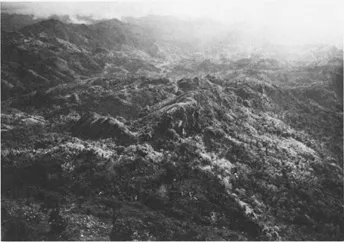
The rugged, mountainous terrain of northern Haiti
As the original dreams of gold proved to be illusory, Spanish imperial interest turned to Mexico and South America; those Europeans who remained on Hispaniola supported themselves principally by raising livestock and exporting lumber. Throughout most of the sixteenth century the western half of the island that would eventually become Haiti, with its rugged mountainous terrain and dearth of navigable rivers, remained virtually deserted (Leyburn 1941).
Ironically, it was gold once again—but from a different source—that attracted the next wave of Europeans. In 1629 Norman and Breton pirates harrying the Spanish Main sought refuge on the small island of Tortuga, six miles off the northwestern coast of Hispaniola. From this haven, they crossed to Hispaniola to hunt wild cattle, smoking the meat to supply food for their predatory raids. They became known as the boucaniers (from the French boucaner, to smoke meat) and, together with a polyglot of European outcasts and adventurers, they systematically raided not only the returning Spanish galleons, but also the settlements in eastern Hispaniola and the British outposts in nearby Jamaica. Despite the concerted efforts of the Spanish and British fleets, the buccaneers, eventually supported by the French crown, maintained their outpost and then spread to the mainland of Hispaniola.
Beginning around 1650 a wave of agriculturalists arrived, establishing small freeholdings dedicated principally to the cultivation of tobacco, which would be the colony’s most important export for the next fifty years (Murray 1977). The growth of this yeoman population effectively secured the French presence in the nominally Spanish colony; French hegemony was officially established by the Treaty of Ryswick in 1697, which ceded the western half of Hispaniola to France (Leyburn 1941). The new colony was rechristened Saint Domingue.
The Treaty of Ryswick catalyzed a profound transformation in the agricultural base of the colony. Years before, in eastern Hispaniola, the Spanish had established a fledgling plantation economy based on the production of sugar and other export commodities. Labor shortages were a problem from the start, and as early as 1517 Charles V had authorized the importation of 15,000 black slaves to replace the dwindling stock of Indians—a race one prominent Spanish official had described at the time as “so weak that they can only be employed in tasks requiring little endurance” (Williams 1971, 53). One African, it was argued, was worth four Indians.
In the half of the island dominated by the French, by contrast, official policy had actually frowned on the planting of sugar, encouraging instead the growing of tobacco, which as late as 1689 remained the principal crop (Murray 1977). In 1684 the total population of Saint Domingue consisted of some 2,200 blacks, 1,421 colonists, and 1,565 indentured persons (Fouchard 1981); the ratio indicates that yeomen growing tobacco must have done much of the field labor themselves. The security afforded by the Treaty of Ryswick, however, brought a new sort of agriculturalist to the French colony—highly capitalized proprietors who could afford both the labor and the machinery necessary to produce plantation crops, particularly sugar. This shift in the agricultural base was recognized or perhaps even stimulated by an abrupt change in official policy that lifted restrictions on the cultivation of sugar and placed them instead on the production of tobacco. By 1716 sugar had become the colony’s dominant export (Murray 1977), and its ascendancy set in motion a social, demographic, and economic transformation of staggering proportions. In 1697 there were three Europeans for every African in Saint Domingue; less than a hundred years later there were eleven blacks for every European, and on the plantations the blacks outnumbered the whites a hundred to one (Thompson 1983; Herskovits 1975; James 1963; Fouchard 1981).
By the closing decades of the eighteenth century the French colony of Saint Domingue had become the envy of all Europe. A mere 36,000 whites and an equal number of free mulattoes dominated a slave force of almost half a million and generated two-thirds of France’s overseas trade—a productivity that easily surpassed that of the newly formed United States (James 1963) and actually outranked the total annual output of all the declining Spanish Indies combined (Leyburn 1941). In the single year 1789 the exports of cotton and indigo, coffee, cacao, tobacco, hides, and sugar filled the holds of over four thousand ships. On the eve of the French Revolution, Saint Domingue grew 60 percent of the world’s coffee, more sugar than all the British Caribbean possessions combined, and over two-thirds of France’s tropical produce (Rotberg 1971). Two-thirds of France’s foreign commercial interests centered in the colony, which accounted for 40 percent of the country’s foreign trade (Leyburn 1941). No other European colony contributed so much to the economic well-being of its mother country; in France no fewer than five million of the twenty-seven million citizens of the ancien régime depended economically on the trade from Saint Domingue (Rotberg 1971; Leyburn 1941). It was a tremendous concentration of wealth, and it readily cast Saint Domingue as the jewel of the French Empire and the most coveted colony of the age.
In 1791, two years after the French Revolution, the colony was shaken and then utterly destroyed by the only successful slave revolt in history. The resulting war lasted twelve years, as the newly freed slaves were called on to defeat the greatest powers of Europe. They faced first the remaining troops of the French monarchy, then a force of French republicans, and finally drove off a Spanish and then a British invasion. The British, in their attempt to conquer the slaves, lost more men than Wellington did some years later in the entire Peninsular Campaign against Napoleon (James 1963).
In December 1801, two years before the Louisiana Purchase, Napoleon, who was at the height of his power, dispatched the largest expedition ever to have sailed from France. Its mission was to take control of the Mississippi River, hem in the expanding United States, and reestablish the French Empire in what had become British North America. En route to Louisiana, the expedition was to pass by Saint Domingue and quell the slave revolt. The first wave of the invading force consisted of twenty thousand troops under Bonaparte’s ablest officers, commanded by his own brother-in-law, Leclerc. So vast was the flotilla of support vessels that, when it arrived in Haitian waters, the leaders of the revolt momentarily despaired, convinced that all of France had appeared to overwhelm them (James 1963; Leyburn 1941).
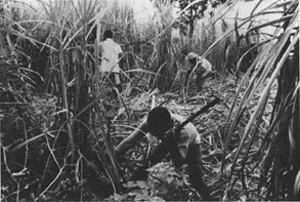
Haitian peasant cutting cane. In the late eighteenth century the French colony of Saint Domingue exported some 163 million pounds of sugar annually. Today sugar remains a dominant agricultural product of Haiti.
Leclerc never did reach Louisiana. Within a year he was dead, and of the 34,000 troops that landed with him, a mere 2,000 exhausted men remained in service. Following Leclerc’s death, French command in Haiti passed to the infamous Rochambeau, who immediately declared a war of extermination against the former slaves. Common prisoners were put to the torch; rebel generals were chained to rocks and allowed to starve. The wife and children of one prominent rebel were drowned before his eyes while French sailors nailed a pair of epaulettes into his naked shoulders. Fifteen hundred dogs were imported from Jamaica and taught to devour black prisoners in obscene public events housed in hastily built amphitheaters in Port-au-Prince. Yet despite this deliberate policy of torture and murder, Rochambeau failed to regain control of the island. A reinforcement of 20,000 men simply added to the casualty figures. At the end of November 1803, the French, having lost over 60,000 veteran troops, finally evacuated Saint Domingue (James 1963; Fouchard 1981; Leyburn 1941; Dorsainvil 1934).
That the revolutionary slaves of Saint Domingue defeated one of the strongest armies of Europe is a historical fact that, though often overlooked, has never been denied. How they did it, however, has usually been misinterpreted. There are two common explanations. One invokes the scourge of yellow fever and implies that the white troops did not die at the hands of the blacks, but from the wretched conditions of the tropical lands. Although doubtless many soldiers did succumb to fever, this supposition is contradicted by two facts: first, European armies had been triumphant in many parts of the world plagued by endemic fevers and pestilence; second, in Haiti the fevers began with the regularity of the seasons and did not start until the onset of the rains in April. Yet the French forces led by Leclerc landed in February 1802 and, before the beginning of the fever season, had suffered 10,000 casualties (James 1963).
The second explanation offered for the European defeat is that fanatic and insensate hordes of blacks rose as a single body to overwhelm the more “rational” white troops. It is true that in the early days of the revolt the slaves fought with few resources and extraordinary courage. Accounts of the time report that they went into battle armed only with knives and picks, or with sticks tipped in iron, and they charged bayonets and cannon led by the passionate belief that the spirits would protect them, and that their deaths, if realized, would lead them back to Guinée, the African homeland (Fouchard 1981; James 1963; Leyburn 1941). Indeed, the strength of their convictions is reflected in one of their battle songs of the war (cited in Laroche 1976, 54–55):
| Grenadier à laso | Grenadiers to the assault |
| Sa ki mouri zafé à yo | What is death? |
| Nan pouin maman | We have no mother |
| Nan pouin pitit | No child |
| Sa ki mouri zafé à yo | What is death? |
Their fanaticism, however, sprang not only from spiritual conviction but also from a very human and fundamental awareness of their circumstances. In victory lay freedom, in capture awaited torture, in defeat stalked death. Moreover, after the initial spasm of revolt, the actual number of slaves who took part in the fighting was not that high. The largest of the rebel armies never contained more than 18,000 men (Murray 1977). As in every revolutionary era, the struggle was carried on by relatively few of those afflicted by the tyranny. The European forces did suffer from fever, but ultimately they were defeated by men—not marauding hordes but relatively small, well-disciplined, and highly motivated rebel armies led by men of some military genius.
If the historians have clouded the character of the struggle, they have also inaccurately idealized the revolutionary leaders—Toussaint L’Ouverture, Henri Christophe, and Jean-Jacques Dessalines, in particular—by disguising their ambitions in lofty libertarian visions that these individuals most certainly did not share. The primary interest of the French, in the immediate wake of the uprising, was the maintenance of an agrarian economy devoted to the production of export crops. How this goal was accomplished was of little concern. Once they realized that the restoration of slavery was not possible—before Napoleon attempted to storm the island by force—the French ministers devised an alternative system whereby freed slaves would be forged into a new form of indentured labor as sharecroppers. The plantations would remain essentially intact. Lacking the military presence to enforce this scheme, the French turned to the leaders of the revolutionary armies and found willing collaborators, including Toussaint L’Ouverture, who became a major figure in the restoration of French authority on the island. The French, however, made a critical error in assuming that this coopted leadership would submit to the whims of Paris. On the contrary, the black leaders did what they had always planned to do. They secured for themselves positions at the top of a new social order.
Toussaint L’Ouverture had no intention of overseeing the dismantling of the colonial plantations. In the abstract he was committed to the freedom of his people, but in practice he believed that the only way to maintain the country’s prosperity and the free status of its citizens was through agricultural production. One of the most persistent myths about the Haitian revolution is the belief that the original plantations, having been destroyed in the initial uprising, never regained their former prosperity—the tacit assumption being that, in the wake of the revolt, the blacks who took over were incapable of governing. This is historically untrue. Within eighteen months of attaining power, Toussaint L’Ouverture had restored agricultural production to two-thirds of what it had been at the height of the French colony (James 1963; Murray 1977; Leyburn 1941). Had the French bourgeoisie been willing to share power with the revolutionary, elite, an export economy might have been maintained for some time.
It was destined to collapse, however, not from the lack of interest or inability of the new elite, nor even because of the chaos unleashed by Leclerc’s invasion. Its eventual demise was assured by an expedient policy begun by the French long before the revolt of 1791. The French plantation owners, faced with the difficulty of feeding close to half a million slaves, had granted provisional plots of land on which the slaves could produce their own food (Murray 1977, 1980). Not only were the slaves encouraged to cultivate their plots, but they were allowed to sell their surplus, and as a result a vast internal marketing system developed even before the revolution. In a calculated gesture the plantation owners had inadvertently sown the seeds of an agrarian peasantry. There is another related, lingering myth concerning the revolution that holds that once the slaves were liberated from the plantations it was virtually impossible to entice them back onto the land. In fact, in the wake of the revolt, most of the freed slaves went directly to the land, where they energetically produced the staple foodstuffs that the internal market of the country demanded. Reading popular accounts of the twelve-year revolutionary war, one might assume that the entire population had scavenged for its sustenance. On the contrary, it was eating yams, beans, and plantains grown and sold by a majority of the former slaves, who now cultivated their lands as freedmen. The problem facing the revolutionary elite was not how to get the people back to the land, but how to get them from their own lands back to the plantations (Murray 1977).
An independent peasantry was the last thing the black military leaders wanted. Jean-Jacques Dessalines, for example, maintained until his assassination in 1806 a dream of an export economy based on chain-gang labor. In the northern half of the country Henri Christophe, who used measures every bit as harsh as those of the colonial era, was able for ten years to produce export crops that allowed him to build an opulent palace and support a lavish court. But eventually his people revolted, and his death in 1820 ended the last serious attempt to create a plantation-based economy (Leyburn 1941...
Table of contents
- Cover Page
- PASSAGE OF DARKNESS
- Copyright Page
- Dedication
- Epigraph
- CONTENTS
- FOREWORD
- PREFACE
- ACKNOWLEDGMENTS
- INTRODUCTION
- CHAPTER ONE THE HISTORICAL AND CULTURAL SETTING
- CHAPTER TWO THE HAITIAN ZOMBIE
- CHAPTER THREE THE PROBLEM OF DEATH
- CHAPTER FOUR THE POISON
- CHAPTER FIVE THE “ANTIDOTE”
- CHAPTER SIX EVERYTHING IS POISON, NOTHING IS POISON: THE EMIC VIEW
- CHAPTER SEVEN ZOMBIFICATION AS A SOCIAL PROCESS
- CHAPTER EIGHT THE BIZANGO SECRET SOCIETIES
- CONCLUSION ETHNOBIOLOGY AND THE HAITIAN ZOMBIE
- NOTE ON ORTHOGRAPHY
- GLOSSARY
- BIBLIOGRAPHY
- INDEX
Trusted by 375,005 students
Access to over 1.5 million titles for a fair monthly price.
Study more efficiently using our study tools.
Frequently asked questions
Yes, you can cancel anytime from the Subscription tab in your account settings on the Perlego website. Your subscription will stay active until the end of your current billing period. Learn how to cancel your subscription
No, books cannot be downloaded as external files, such as PDFs, for use outside of Perlego. However, you can download books within the Perlego app for offline reading on mobile or tablet. Learn how to download books offline
Perlego offers two plans: Essential and Complete
- Essential is ideal for learners and professionals who enjoy exploring a wide range of subjects. Access the Essential Library with 800,000+ trusted titles and best-sellers across business, personal growth, and the humanities. Includes unlimited reading time and Standard Read Aloud voice.
- Complete: Perfect for advanced learners and researchers needing full, unrestricted access. Unlock 1.5M+ books across hundreds of subjects, including academic and specialized titles. The Complete Plan also includes advanced features like Premium Read Aloud and Research Assistant.
We are an online textbook subscription service, where you can get access to an entire online library for less than the price of a single book per month. With over 1.5 million books across 990+ topics, we’ve got you covered! Learn about our mission
Look out for the read-aloud symbol on your next book to see if you can listen to it. The read-aloud tool reads text aloud for you, highlighting the text as it is being read. You can pause it, speed it up and slow it down. Learn more about Read Aloud
Yes! You can use the Perlego app on both iOS and Android devices to read anytime, anywhere — even offline. Perfect for commutes or when you’re on the go.
Please note we cannot support devices running on iOS 13 and Android 7 or earlier. Learn more about using the app
Please note we cannot support devices running on iOS 13 and Android 7 or earlier. Learn more about using the app
Yes, you can access Passage of Darkness by Wade Davis in PDF and/or ePUB format, as well as other popular books in Sozialwissenschaften & Kultur- & Sozialanthropologie. We have over 1.5 million books available in our catalogue for you to explore.