In the years following Cuba’s independence, nationalists aimed to transcend racial categories in order to create a unified polity, yet racial and cultural heterogeneity posed continual challenges to these liberal notions of citizenship. Alejandra Bronfman traces the formation of Cuba’s multiracial legal and political order in the early Republic by exploring the responses of social scientists, such as Fernando Ortiz and Israel Castellanos, and black and mulatto activists, including Gustavo Urrutia and Nicolás Guillén, to the paradoxes of modern nationhood.
Law, science, and the social sciences — which, during this era, enjoyed growing status in Cuba as well as in many other countries — played central roles in producing knowledge and shaping social categories in postindependence Cuba. Anthropologists, criminologists, and eugenicists embarked on projects intended to employ the tools of science to rid Cuba of the last vestiges of a colonial past. Meanwhile, the legal arena created both new freedoms and new modes of repression. Black and mulatto intellectuals and activists, working to ensure that citizenship offered concrete advantages rather than empty promises, appropriated changing social scientific and legal categories and turned them to their own uses. In the midst of several decades of intermittent racial violence and expanding social and political mobilization by Cubans of African descent, debates among intellectuals and activists, state officials, and legislators transformed not only understandings of race, but also the terms of citizenship for all Cubans.
eBook - ePub
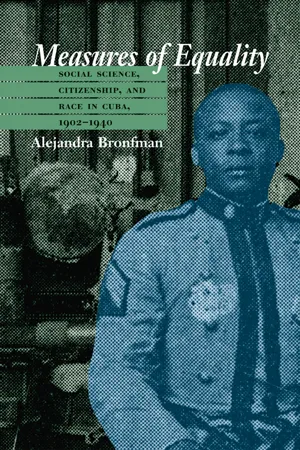
Measures of Equality
Social Science, Citizenship, and Race in Cuba, 1902-1940
- 256 pages
- English
- ePUB (mobile friendly)
- Available on iOS & Android
eBook - ePub
About this book
Information
Table of contents
- Cover Page
- Measures of Equality
- Copyright Page
- Dedication
- Contents
- Illustrations
- Acknowledgments
- Introduction
- 1 Unsettled and Nomadic
- 2 Social Science and the Negro Brujo
- 3 Barbarism and Its Discontents
- 4 Contested Histories
- 5 Social Science, State-Making, and the Politics of Time
- 6 The Politics of Blackness on the Eve of Revolution
- 7 From Comparsas to Constitutions
- Epilogue
- Notes
- Bibliography
- Index
Trusted by 375,005 students
Access to over 1.5 million titles for a fair monthly price.
Study more efficiently using our study tools.
Frequently asked questions
Yes, you can cancel anytime from the Subscription tab in your account settings on the Perlego website. Your subscription will stay active until the end of your current billing period. Learn how to cancel your subscription
No, books cannot be downloaded as external files, such as PDFs, for use outside of Perlego. However, you can download books within the Perlego app for offline reading on mobile or tablet. Learn how to download books offline
Perlego offers two plans: Essential and Complete
- Essential is ideal for learners and professionals who enjoy exploring a wide range of subjects. Access the Essential Library with 800,000+ trusted titles and best-sellers across business, personal growth, and the humanities. Includes unlimited reading time and Standard Read Aloud voice.
- Complete: Perfect for advanced learners and researchers needing full, unrestricted access. Unlock 1.5M+ books across hundreds of subjects, including academic and specialized titles. The Complete Plan also includes advanced features like Premium Read Aloud and Research Assistant.
We are an online textbook subscription service, where you can get access to an entire online library for less than the price of a single book per month. With over 1.5 million books across 990+ topics, we’ve got you covered! Learn about our mission
Look out for the read-aloud symbol on your next book to see if you can listen to it. The read-aloud tool reads text aloud for you, highlighting the text as it is being read. You can pause it, speed it up and slow it down. Learn more about Read Aloud
Yes! You can use the Perlego app on both iOS and Android devices to read anytime, anywhere — even offline. Perfect for commutes or when you’re on the go.
Please note we cannot support devices running on iOS 13 and Android 7 or earlier. Learn more about using the app
Please note we cannot support devices running on iOS 13 and Android 7 or earlier. Learn more about using the app
Yes, you can access Measures of Equality by Alejandra M. Bronfman in PDF and/or ePUB format, as well as other popular books in History & Latin American & Caribbean History. We have over 1.5 million books available in our catalogue for you to explore.