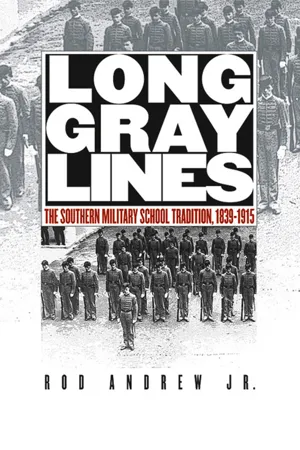
Military training was a prominent feature of higher education across the nineteenth-century South. Virginia Military Institute and the Citadel, as well as land-grant schools such as Texas A&M, Auburn, and Clemson, organized themselves on a military basis, requiring their male students to wear uniforms, join a corps of cadets, and subject themselves to constant military discipline. Several southern black colleges also adopted a military approach.
Challenging assumptions about a distinctive “southern military tradition,” Rod Andrew demonstrates that southern military schools were less concerned with preparing young men for actual combat than with instilling in their students broader values of honor, patriotism, civic duty, and virtue. Southerners had a remarkable tendency to reconcile militarism with republicanism, Andrew says, and following the Civil War, the Lost Cause legend further strengthened the link in southerners' minds between military and civic virtue.
Though traditionally black colleges faced struggles that white schools did not, notes Andrew, they were motivated by the same conviction that powered white military schools — the belief that a good soldier was by definition a good citizen.
- 184 pages
- English
- ePUB (mobile friendly)
- Available on iOS & Android
eBook - ePub
About this book
Information
Chapter 1: Educating the Citizen-Soldier
Republicanism and Militarism in Southern Military Schools, 1839–1861
Southern military schools seem to be well outside the mainstream of American life. Many modern Americans view VMI and the Citadel, for example, as bastions of extreme conservatism, sexism, and neo-Confederate militarism. To many people they are anachronisms—bypassed islands in the onrushing current of sexual equality, democracy, and liberalism.
This perception of southern military schools began with the reputation for bellicosity and militance ascribed by contemporaries to the nineteenth-century South. “The fiery blood of the South,” “a bloodthirsty ferocity,” “a modern Sparta”—all were terms that outside observers used to describe a region that sometimes seemed to be out of touch with the prevailing currents of democracy and peaceful civilization.1 After the Civil War, and even before Fort Sumter, many northerners pointed to the many military schools of the South as proof that the region had been sharpening its military readiness in a plot to disrupt the Union. Historian John Hope Franklin likewise saw southern military schools as the natural symptom of a militaristic society. Southerners, he says, influenced by notions of “honor,” slavery, frontier conditions, and a lack of formal law enforcement institutions, developed violent personalities and militaristic beliefs. In such a society the popularity of military schools and military education for young men was only natural, particularly as southerners began to sense an ever intensifying attack on their social institutions and prepared for the day when they might have to defend their institutions and their rights with force.2
Mid-nineteenth-century military schools, however, were not out of the mainstream of Jacksonian republicanism. They were, instead, in touch with the dominant political and social trends of their day. Many Americans, perhaps southerners especially, saw military education for the young as essential to liberty and to the health of the republic.
The southern preoccupation with inculcating military virtues in the young was a received tradition more than it was an indigenous development.3 It is true that the dangers and rigors of rural southern life, incessant warfare on the frontier, and the need to control a large slave population reinforced southerners’ respect for military prowess. But nineteenth-century southerners, along with their fellow Americans in the North, inherited the idea that the safety of a republic depended on a well-trained and law-abiding citizenry able to defend the nation in times of crisis.
Educators and philosophers have traditionally offered two main justifications for including military training in the education of the citizens of republics. One, of course, was to meet the requirements of national defense. Closely related to this argument was the claim that military training molded a more virtuous, disciplined, and law-abiding citizenry. Republics as conceived by Thucydides, Socrates, Plato, Xenophon, Aristotle, and Cicero were small, homogeneous communities that placed great demands on all of their citizens. They necessarily required courage and strict discipline in their citizen armies as well as self-restraint in their exercise of self-government in councils and assemblies.4
English poet-philosopher John Milton helped carry the classical republican version of militarism into the Enlightenment. As he did so, the argument for military education shifted from stressing the requirements of national defense to lauding what military training did for both the martial abilities and the moral character of the citizen. In his seventeenth-century tract On Education, Milton called for a “complete and generous education,” one that prepared a man “to perform justly, skillfully, and magnanimously all the offices both private and public, of peace and war.”5 Along with a broad liberal arts curriculum, he prescribed swordsmanship exercises and military maneuvers both on foot and on horseback. The object of the military training was to make the young men healthy and strong “and to inspire them with a gallant and fearless courage, which being tempered with seasonable lectures and precepts to them of true fortitude and patience, will turn into a native and heroic valor, and make them hate the cowardice of doing wrong.”6 Milton clearly saw a connection between training the young for military service and preparing them for civil leadership.
The argument that military education was vital for national safety was the main justification used by George Washington, Henry Knox, Benjamin Rush, John C. Calhoun, Alden Partridge, and others who argued for the establishment of military academies in the early republic and in the Jacksonian period. Washington, Knox, and Alexander Hamilton led the campaign for the national military academy that would become West Point. The art of war, they argued, was too complex and too important to be trusted to amateur militia officers. Rush included military training in his call for a Spartan-style education for American youth: “In a state where every citizen is liable to be a soldier and a legislator, it will be necessary to have some regular instruction given upon the ART OF WAR and upon PRACTICAL LEGISLATION.”7
Washington’s plans for a national military academy came to fruition with the founding of the U.S. Military Academy at West Point in 1802. One of its graduates and ex-superintendents, Alden Partridge, was responsible for transmitting the main features of West Point to private military academies and, indirectly, to similar state-supported institutions in the South. Shortly after his dismissal as the superintendent of West Point, Partridge founded the first private military school in the United States in his hometown of Norwich, Vermont, in 1820. He and his former students then established a network of dozens of private military academies throughout the nation, mostly in the South.8
Partridge put a Jeffersonian twist on Washington’s old arguments for the necessity of military training. Washington had believed in the need for a trained professional army, led by officers who had been trained at a national military academy, to defend the new republic. Partridge, though, criticized the monopoly of West Point over the commissioning of officers. He fed the fear and resentment of those who charged that an aristocratic, West Point–led clique held a monopoly over the nation’s military power. What the republic needed, Partridge claimed, was a strong, efficient, well-led militia.9
The militia, though, almost universally, was notoriously ill-prepared and untrained for war. Partridge claimed that the private military academies founded by him and his former students could turn out hundreds of young civilians who could raise, train, and—in times of emergency—lead the militia in combat. At the same time, the private military academies could give the nation’s young men a classical and scientific education, training them as engineers, lawyers, teachers, and other civilian professionals.10
The belief that a cadre of trained military officers dispersed throughout the civilian population was indispensable to the safety of the republic aided Alden Partridge in his movement to establish a network of private military academies. He and his former students established dozens of private military schools in the 1820s, 1830s, 1840s, and 1850s, especially in the South. His idea of combining military discipline and instruction with civilian education also reappeared in the nation’s first state-supported military schools, VMI in 1839 and the South Carolina Military Academy (the Arsenal and the Citadel) in 1842.11
In the long run the drive for military readiness was neither the sustaining force nor the overriding justification for the dozens of military schools that sprang up all over the South in the 1840s and 1850s, nor would it be the reason that southern educators between 1865 and 1917 enthusiastically embraced a West Point-style of education in the land-grant colleges. A summary of the arguments used to defend the establishment of VMI and the South Carolina Military Academy reveals that, initially, national and state defense were important but not primary considerations. As the threat of sectional conflict increased, the military services that these institutions could provide their respective states temporarily became more important. But even in 1860 these military considerations never completely overshadowed the collateral civilian benefits they presumably provided to society. The boosters of VMI, the Citadel, and the dozen or so other southern state-supported or state-encouraged military schools were at least as concerned with what military education could do for the internal health of society as with what it could contribute to society’s external defense.
It is true that defense was one ostensible justification for establishing state military academies at Lexington, Virginia, and Charleston and Columbia, South Carolina. The state legislatures of Virginia and South Carolina intended for the student bodies at VMI, the Citadel in Charleston, and the Arsenal in Columbia to function as military guards over state military supplies. These sites were not unguarded, but local citizens were unhappy with the existing guards and believed that the respective states could secure these arms as efficiently, and with better educational results, with student-soldiers. The citizens of Lexington viewed the state troops stationed there to guard the arms as a public nuisance, as an idle, dissolute, and odious class of drones.12
The residents of Charleston likewise wavered between the use of a municipal guard of hired “Aliens” and the equally distasteful sight of federal troops protecting the arms there. During the Nullification Crisis of 1832, the South Carolina state legislature instructed the governor to have the federal troops removed, and authorities reorganized the municipal guard. As late as 1842, however, many Charlestonians still distrusted the quality and character of the city guard. The Charleston Mercury argued that the many “Aliens” who made up the guard should be replaced with sober, responsible natives.13
The search for a military guard that was less threatening and more amenable to local control took a new turn as early as the early 1830s in Lexington. Local citizens there began to entertain the idea of replacing the arsenal guard with military school cadets. The most vocal proponent of a military school in Lexington was local attorney John T. L. Preston. Preston had no known military background, but he had been profoundly impressed with West Point when he had gone there with the son of a neighbor to have the young man enrolled as a cadet. He wrote several letters to the Lexington Gazette in which he suggested petitioning the Virginia General Assembly to turn the arsenal into a military school. He also expounded the major arguments in favor of military education.14
In his first “number” written to the newspaper, Preston, under the pseudonym “Cives,” set forth the principle on which the petition was to be based. That principle was not military readiness but the supremacy of popular will in a free government. Preston declared that the people had the right to inquire into “the character and operations of all public institutions, and to demand … that the benefits derived [from them] shall be as great as possible.”15
Cives then pointed out that a military school would benefit Virginia by providing trained officers for the improvement of the militia, and he noted that the quality of the militia had “been a subject of ridicule in every portion of the Union.”16 Well-known military school innovator Alden Partridge drove Preston’s point home in a letter to House of Delegates member and VMI supporter Colonel Charles P. Dorman later published in the Gazette. Partridge argued that without an efficient militia, the United States inevitably would have to rely on a mercenary army for defense, “and when this event shall arrive we can easily read our fate in that of every Republic which has gone before us. Some future Caesar will arise … [and] plant the standard of military despotism.”17 The militia, then, was not only for national defense; it was also an internal safeguard for liberty.
Along with improving the militia, the military school advocates claimed that military training would strengthen the character of Virginia’s young men. It would inculcate habits of order, diligence, and punctuality. Cadets would spend those hours not taken up with study in military drill rather than in the idleness that resulted in dissipation and mischief. Military education thus benefited the morals of the students as well.18
The most important habit that military education instilled, however, was that of “submission to lawful authority.” Antebellum southerners were deeply concerned with the perceived unruly, undisciplined, and rebellious behavior of their sons. Southern fathers had often confided to Alden Partridge in the 1820s and 1830s that they hoped he could discipline and reform their unruly sons.19 In the 1852–53 session of the Virginia General Assembly, a committee assigned to investigate a disciplinary case at VMI applauded the school’s attempts to apply military discipline to the young men of Virginia, “just at an age when waywardness is the only fully developed trait in their character.”20 Claudius Crozet, first president of VMI’s Board of Visitors, likewise argued that “at an age when passions are yet unmitigated by the lessons of experience, it is generally imprudent to trust to the self-government of a young man. Habits of unrestrained indulgence have frequently laid the foundation of ruin of youths, who, if submitted to proper discipline and restraint… would otherwise have become useful and distinguished members of society.”21
In place of “waywardness,” Crozet, Preston, and Superintendent Francis Henney Smith of VMI, as well as the leaders of the Citadel, sought to substitute patriotism, “subordination to lawful authority,” and “prompt obedience to every call of duty.” As Smith reported to the governor and the general assembly in 1841, the cadets were members of an institution created and supported by the state. The faculty, therefore, taught them “to respect its laws, and to obey those in authority; and … we have every reason to believe they will always prove themselves … ‘faithful to Virginia.’” 22 Governor John P. Richardson argued before the South Carolina legislature that providing a free military education to fifty young men a year would imbue those youths with patriotic gratitude toward the state for allowing them to rise by their own merits.23 Professor John P. Thomas of the Citadel praised military training for “the habits of order, self-dependence, and restraint that they engender; the sense of duty and responsibility they inculcate; the manly bearing they impart.”24 Professor Asbury Coward’s 1860 commencement addres...
Table of contents
- Cover Page
- Long Gray Lines The Southern Military School Tradition, 1839–1915
- Copyright Page
- Contents
- Illustrations
- Acknowledgments
- Introduction
- Chapter 1: Educating the Citizen-Soldier
- Chapter 2: Death and Rebirth
- Chapter 3: Soldiers, Christians, and Patriots
- Chapter 4: Discipline and Defiance
- Chapter 5: Military Law and Individual Rights
- Chapter 6: Military Education for Black Youth
- Chapter 7: Our Duty Is Plain
- Conclusion
- Appendix: Past and Present Names of Educational Institutions
- Notes
- Bibliography
- Index
Trusted by 375,005 students
Access to over 1.5 million titles for a fair monthly price.
Study more efficiently using our study tools.
Frequently asked questions
Yes, you can cancel anytime from the Subscription tab in your account settings on the Perlego website. Your subscription will stay active until the end of your current billing period. Learn how to cancel your subscription
No, books cannot be downloaded as external files, such as PDFs, for use outside of Perlego. However, you can download books within the Perlego app for offline reading on mobile or tablet. Learn how to download books offline
We are an online textbook subscription service, where you can get access to an entire online library for less than the price of a single book per month. With over 1.5 million books across 990+ topics, we’ve got you covered! Learn about our mission
Look out for the read-aloud symbol on your next book to see if you can listen to it. The read-aloud tool reads text aloud for you, highlighting the text as it is being read. You can pause it, speed it up and slow it down. Learn more about Read Aloud
Yes! You can use the Perlego app on both iOS and Android devices to read anytime, anywhere — even offline. Perfect for commutes or when you’re on the go.
Please note we cannot support devices running on iOS 13 and Android 7 or earlier. Learn more about using the app
Please note we cannot support devices running on iOS 13 and Android 7 or earlier. Learn more about using the app
Yes, you can access Long Gray Lines by Rod Andrew Jr. in PDF and/or ePUB format, as well as other popular books in History & Elementary Education. We have over 1.5 million books available in our catalogue for you to explore.