Of the more than 40 million people around the world currently living with HIV/AIDS, two million live in Latin America and the Caribbean. In an engaging chronicle illuminated by his travels in the region, Shawn Smallman shows how the varying histories and cultures of the nations of Latin America have influenced the course of the pandemic. He demonstrates that a disease spread in an intimate manner is profoundly shaped by impersonal forces.
In Latin America, Smallman explains, the AIDS pandemic has fractured into a series of subepidemics, driven by different factors in each country. Examining cultural issues and public policies at the country, regional, and global levels, he discusses why HIV has had such a heavy impact on Honduras, for instance, while leaving the neighboring state of Nicaragua relatively untouched, and why Latin America as a whole has kept infection rates lower than other global regions, such as Africa and Asia.
Smallman draws on the most recent scientific research as well as his own interviews with AIDS educators, gay leaders, drug traffickers, crack addicts, transvestites, and doctors in Cuba, Brazil, and Mexico. Highlighting the realities of gender, race, sexuality, poverty, politics, and international relations throughout Latin America and the Caribbean, Smallman brings a fresh perspective to understanding the cultures of the region as well as the global AIDS crisis.
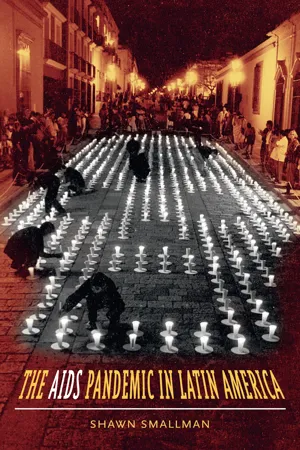
- 304 pages
- English
- ePUB (mobile friendly)
- Available on iOS & Android
eBook - ePub
The AIDS Pandemic in Latin America
About this book
1
THE CARIBBEAN: CUBA AND HAITI
For twenty-eight-year-old Noremia Duarte Perez the worst part about being HIV-positive wasn’t the illness but, rather, that she was separated from her son. The state had confined her to a sanatorium, and HIV-children could not be with their parents. Noremia’s family found it difficult to deal with the boy’s questions. Clara Perez, Noremia’s mother, had worked hard to prepare him for his trip to the sanatorium: “The first time he visited his mother he asked why he couldn’t live with her since she had such a nice little house? I drilled into him that she was living at a school and that children couldn’t live there.” Noremia’s illness devastated Clara Perez: “For several weeks I was sick. I had to see a psychologist since I was feeling suicidal.” But she had rallied because she believed she had to be strong for her daughter. Noremia knew how difficult her situation was for her family, but she carried a double burden in that she not only had to live with the disease but also had to keep secret the fact that she had deliberately injected HIV-positive blood: “My mother is terribly shaken too, but I’ve never told her about the self-injection. No-one would ever forgive me for that. I mean I have a child.” Her father still thought that her fiancé hadn’t told her that he was HIV-positive. Noremia herself couldn’t understand why she had done something that brought such suffering on her family: “I regret it terribly. I’d like to beat myself black and blue for what I did.” And she worried endlessly about her son and how he would deal with his mother’s illness and what she should tell him, because she had seen what this information could do to other children: “At the home, I have a girl friend with a nine year old boy. She told him that he had the disease and he tried to hang himself.”1 Somehow both Noremia and her friend—whose son survived—continued and tried hard to make a good life for their families.
Noremia and her friend weren’t alone. Throughout Cuba between 1989 and 1992 perhaps more than 200 people deliberately injected themselves with the virus. Some of them, like Mercedes, had seemed almost desperate to become infected: “I injected myself with blood eight times. I didn’t test positive. One day Ivan and I got into an argument and broke up temporarily. When I saw him again he told me that he injected himself. One month later Ivan was positive and I was still negative. Then he gave me a shot of his blood and one week later I was positive. I was confined to the sanatorium.”2 Like Noremia, Mercedes lamented her decision.
Early in my reading on HIV/AIDS in Latin America I came across a book by Marcos Cueto that referred to “a mosaic of infections” in the region.3 I loved this phrase, which captured the fractured nature of the epidemic. But certainly in no part of Latin America would this description be more apt than in the Caribbean. It is typical for works addressing the Caribbean to begin with a sentence such as “To construct a coherent overview of the Caribbean is extremely difficult because of the region’s profound geographical and cultural diversity.”4 This diversity is reflected in the varied presentations of the HIV/AIDS epidemic: from Puerto Rico, where the disease is often spread by IV drug users and where shooting gallery owners announce that their needles are “almost new,” to Haiti, which has a widespread epidemic driven by unprotected heterosexual sex, to Cuba, where a quarantine and education program have managed to contain the epidemic, which is becoming increasingly focused in the homosexual community.5
With its hundreds of islands, contested history, and cultural complexity, this region does not fit neatly into a history that focuses solely on Latin America. But it was here that a widespread heterosexual epidemic was first discovered outside Africa, and some countries now have HIV-positive rates that are surpassed only in Africa itself. Unless current trends are reversed, in the future AIDS may sharply decrease life expectancy in the region and lead to a corresponding rise in child mortality.6 Ties of trade, tourism, and migration link the region to the rest of the Americas. Any consideration of HIV in Latin America must address the Caribbean. This chapter will focus on two countries in particular: Haiti, which has the highest HIV-positive rate in the Americas, and Cuba, which has the lowest. Despite the obvious differences between the two countries, the perception and response to the epidemic in each was shaped by its relationship to the United States as well as its particular political culture. Thus the region demonstrates the extent to which international context and local culture continue to shape the development of this epidemic.
Haiti
During the early years of the HIV/AIDS epidemic, Haiti was depicted abroad as a barbaric land where inhuman rituals might have introduced the virus into people. These beliefs in turn reflected long-held stereotypes of Haiti not only in the United States but also in the West. It might seem surprising that such a small country—one-third of the island of Hispaniola, which it shares with the Dominican Republic—once caused fear throughout the Western hemisphere. Today the island has more than 7 million people inhabiting an area the size of a small New England state. The majority of Haitians live either in a single city (Port-au-Prince) and its suburbs or in rural communities straining under the weight of land shortages, high unemployment, and environmental degradation.7 Yet this small nation once terrified elites in the Americas, who constructed an image of Haiti that has influenced popular perceptions of this country until the present.
Haiti won its freedom in an uprising that began as a slave rebellion in 1791 and continued as a war for independence until 1804, when the nation escaped from the control of European powers under the leadership of Jean-Jacques Dessalines. Haitian independence terrified national leaders from Brazil to the United States, where plantation owners feared that this example might inspire their own slaves to rebellion. Worried that if Haiti proved to be an economic and political success then the entire model of slavery in the Western Hemisphere would be threatened, the United States withheld diplomatic recognition from Haiti for fifty years.8 Accordingly, Haiti was isolated from birth and was generally depicted in the United States and Europe as a place of cannibalism and voodoo.
Haiti faced immense challenges after defeating France militarily as well as repelling invading forces from both Spain and Britain. The plantation agricultural system collapsed as freed slaves refused to work the land for others. The island had been left without any administrative structure, and there were bitter divisions within Haitian society between a mulatto class that looked to French culture for its legitimacy and a black underclass that resented the mulattos’ power. These tensions exacerbated the political chaos (captured by Alejo Carpentier in his novel The Kingdom of This World [1949; first English trans., 1957]). The nation, already devastated by the wars for independence, was further damaged by civil wars as contending groups contested for the presidency. In 1915 the United States invaded Haiti to restore order, in accordance with the Roosevelt Doctrine. Although the United States fought and won a guerrilla war, in the long term the intervention failed to bring enduring political stability to Haiti.
In editorial cartoons in American newspapers in the early twentieth century, Haiti was inevitably depicted as a small black child engaged in some act of violence or rebellion, often with a knife in hand. In one image, published in the Detroit Journal in 1908, a small black child labeled “government” cowered in terror before an alligator named “revolution” while Uncle Sam looked on from a distance.9 The message in these cartoons was clear: only the United States could save the island from disaster. But U.S. leaders did not hide their belief that Haiti’s fundamental problem was the racial makeup of its population. After the United States had invaded in 1915, the new Haitian “president was barred from entering the U.S. Officers’ Club in Port-au-Prince because he was black.”10 The head of the U.S. military forces occupying Haiti also made his attitude toward the president clear: “Once he forced the refined head of government to sleep on the floor while he, the major, occupied the only bed in the room at the quarters where they put up during a tour of the country.”11 While ostensibly the U.S. intervention took place to bring stability to Haiti, many American leaders harbored serious doubts that Haiti could ever govern itself.12
These attitudes influenced the U.S. approach to governing Haiti and, after the United States withdrew from the island in 1934, perhaps encouraged the United States to tolerate Haitian dictators. For nearly two decades the Haitian political system seemed to function, but after Francois “Papa Doc” Duvalier seized power in 1957, the island descended into a reign of terror. Papa Doc based his rule on an informal police force, the Tontons Macoutes (the term means “bogeymen”), who protected his regime with force. Despite the corruption and brutality of Duvalier’s rule, the United States accepted it because of Haiti’s staunchly anti-Communist position during the Cold War. When Francois Duvalier died in 1971, his son came to power in a rule that echoed his father’s but lacked his political savvy. It was under the rule of “Little Doc” that AIDS came to Haiti. When Jean-Claude Duvalier fled Haiti in 1986, a military junta seized power, which led to political unrest and brutal repression that badly hampered basic social services on the island. Haitian migrants had been trying to leave the island for decades before this, but the ongoing violence and economic chaos led waves of refugees to take boats to try to reach Florida. In the United States this created a backlash, as people denounced the “economic” migrants who were shown on television landing on the beaches. This history, which created not only an exoticized image of Haiti but also a widespread fear that the United States would be swamped by illegal Haitian immigrants, underlay what can only be described as a hysterical U.S. reaction to the discovery of AIDS in Haiti.13
Fear and Hysteria: The Arrival of AIDS in Haiti
AIDS seems to have come to Haiti about the same time that it arrived in the United States, based on some possible early cases that scholars have uncovered. Two doctors at Toronto General Hospital first reported one early case, a Canadian woman who had spent twenty years in Haiti working as a nun. She had left the order in 1972 to begin working with prostitutes in the capital, which she continued until 1979. Sometime during this period (perhaps in 1976) she had a single sexual encounter. She then fell ill with a series of opportunistic infections and died in Montreal in 1981 of what was later diagnosed as AIDS. A few Western visitors also may have subsequently acquired the virus through sex or blood transfusions during their time in Haiti in 1978, although this is controversial.14 Retrospective tests on blood samples taken from 191 people in Haiti during 1977–79 failed to find any instances of HIV, so the disease was certainly not widespread.15 Nonetheless, it remains possible that HIV was first introduced to the island by 1976/1977, around the time it first arrived in New York and Los Angeles. The two earliest cases of AIDS in Haiti date from 1978 and 1979, and the number increased sharply after 1980.16 The existence of AIDS in Haiti, however, did not draw any international attention until cases appeared among Haitian emigrants to the United States in the 1980s.
On July 9, 1982, Morbidity and Mortality Weekly Report (the same journal that had first described a new disorder in gay men a year earlier) published an article titled “Opportunistic Infections and Kaposi’s Sarcoma among Haitians in the United States.” The report described how Haitian patients in Miami had died of strange infections that seemed similar to those reported earlier in the gay community. Many of these people were recent arrivals (fleeing the political violence and extreme poverty of Haiti) who already held a marginal position in American society. By September 1982, when Morbidity and Mortality Weekly Report published an article titled “Update on Acquired Immune Deficiency Syndrome (AIDS)—United States,” Haitians were noted as a category of people with the disease. By March 1983 the CDC referred to four groups that were at risk for AIDS, of which one was Haitians.17 The majority of the HIV-positive Haitians denied being homosexual, which set off a firestorm of media attention.
With Haiti’s popular association with voodoo rituals, extreme poverty, and social chaos, most Americans found the country to be a believable source for this frightening new disease. Because most early Haitian AIDS patients denied they were infected through gay sex, doctors wondered if the disease could be spread by mosquitoes or by voodoo rituals or if it began with an outbreak of swine fever in Haitian pigs.18 William Greenfield suggested in the Journal of the American Medical Association in 1986 that vood...
Table of contents
- Cover Page
- The AIDS Pandemic in Latin America
- Copyright Page
- Dedication
- Contents
- Illustrations
- Acknowledgments
- Introduction
- 1. The Caribbean: Cuba and Haiti
- 2. Brazil
- 3. Mexico and Central America
- 4. Spanish South America
- Conclusion
- Notes
- Bibliography
- Index
Trusted by 375,005 students
Access to over 1.5 million titles for a fair monthly price.
Study more efficiently using our study tools.
Frequently asked questions
Yes, you can cancel anytime from the Subscription tab in your account settings on the Perlego website. Your subscription will stay active until the end of your current billing period. Learn how to cancel your subscription
No, books cannot be downloaded as external files, such as PDFs, for use outside of Perlego. However, you can download books within the Perlego app for offline reading on mobile or tablet. Learn how to download books offline
Perlego offers two plans: Essential and Complete
- Essential is ideal for learners and professionals who enjoy exploring a wide range of subjects. Access the Essential Library with 800,000+ trusted titles and best-sellers across business, personal growth, and the humanities. Includes unlimited reading time and Standard Read Aloud voice.
- Complete: Perfect for advanced learners and researchers needing full, unrestricted access. Unlock 1.5M+ books across hundreds of subjects, including academic and specialized titles. The Complete Plan also includes advanced features like Premium Read Aloud and Research Assistant.
We are an online textbook subscription service, where you can get access to an entire online library for less than the price of a single book per month. With over 1.5 million books across 990+ topics, we’ve got you covered! Learn about our mission
Look out for the read-aloud symbol on your next book to see if you can listen to it. The read-aloud tool reads text aloud for you, highlighting the text as it is being read. You can pause it, speed it up and slow it down. Learn more about Read Aloud
Yes! You can use the Perlego app on both iOS and Android devices to read anytime, anywhere — even offline. Perfect for commutes or when you’re on the go.
Please note we cannot support devices running on iOS 13 and Android 7 or earlier. Learn more about using the app
Please note we cannot support devices running on iOS 13 and Android 7 or earlier. Learn more about using the app
Yes, you can access The AIDS Pandemic in Latin America by Shawn C. Smallman in PDF and/or ePUB format, as well as other popular books in Medicine & Latin American & Caribbean History. We have over 1.5 million books available in our catalogue for you to explore.