- 320 pages
- English
- ePUB (mobile friendly)
- Available on iOS & Android
eBook - ePub
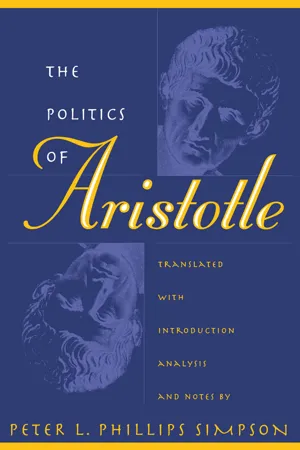
The Politics of Aristotle
About this book
A touchstone in Western debates about society and government, the Politics is Aristotle’s classic work on the nature of political community. Here, he argues that people band together into political communities to secure a good and self-sufficient life. He discusses the merits and defects of various regimes or ways of organizing political community — democracy in particular — and in the process examines such subjects as slavery, economics, the family, citizenship, justice, and revolution.Peter Simpson offers a new translation of Aristotle’s text from the ancient Greek. He renders the Politics into an English version that is accurate, readable, and in certain difficult passages, original. His innovative analytical division of the whole text, with headings and accompanying summaries, makes clear the progression and unity of the argument — a helpful feature for students or readers unfamiliar with Aristotle’s studied brevity and often elliptical style. Books 7 and 8 are repositioned — a move supported by Aristotle’s own words and much scholarly opinion — to restore the work’s logical organization and coherence. Finally, Simpson places the Politics in its proper philosophical context by beginning the text with the last chapter of Aristotle’s Nicomachean Ethics, which he sees as an introduction to what follows.
Information
Book 1: The Primacy of the City
CHAPTER 1
The Primacy of the City. The city, like any community, aims at some good, but the city is the controlling community and so must aim at the most controlling good of all. It is an error, therefore, to suppose that rule over the city differs in degree and not in kind from rule over other and lesser communities. This will be evident if the city is divided and examined in its parts.
1252a1 Since we see that every city is some sort of community1 and that every community gets established with some good in view (for everyone does everything for the sake of what they think good), it is clear that, while all communities have some good that they are aiming at, the community that has the most control of all and that embraces all the others is doing this most of all and is aiming at the most controlling of goods. This community is the city as it is called, the community that is political.
1252a7 Consequently all those who think that a politician, a royal ruler, a household manager, and a master over slaves are the same are not speaking nobly.2 For they suppose that these rulers do not differ in kind but only in the number of subjects ruled over. For instance, they think that if someone rules over a few people, he is a master; if over more than a few, a household manager; if over even more still, a politician or royal ruler, adopting the view that there is no difference between a large household and a small city. As for the politician and royal ruler, they say that the latter has control all by himself and that the former, on the basis of the principles of this sort of science, alternates between ruling and being ruled. But these opinions are not true, as will become clear if we carry out our investigation in the usual way.3 For as in other cases the composite whole must be divided up into its incomposite parts (for these are the smallest parts of the whole), so if we also look at what the city is made up of, we will get a better view of its parts too, both as to how they differ from each other and as to whether it is possible to get some grasp proper to art of each of the rulers just mentioned.
CHAPTER 2
The City and Its Parts
The Household. The first communities are the two natural ones of (i) husband and wife for generation and (ii) master and slave for survival. These two together form the household. Households exist for the needs of the day. Villages spring from households, above all through the generation of children and grandchildren, and exist for needs beyond the day.
1252a24 If one were to see how things develop naturally from the beginning, one would, in this as in other matters, get the noblest view of them. First, then, it is necessary that those who cannot exist without each other couple together, as female and male on the one hand for the sake of generation (and this not from deliberate choice, but because, like the other animals and plants, they have a natural desire to leave behind something else like themselves), and as ruler by nature and ruled on the other on account of preservation. For that which has the capacity to see ahead with its thought is by nature ruler and master, and that which has the capacity to carry out with its body what the other has seen is by nature ruled and slave. That is why the same thing benefits both master and slave.
1252a34 By nature, of course, female and slave are distinct. For nature makes nothing in the niggardly way that bronze workers make the Delphic knife;4 on the contrary, she makes one thing for one thing. For it is when instruments are made to serve only one work and not many that they are most nobly finished off. Among the barbarians, however, the female is in the same position as the slave. But that is because there is nothing among the barbarians with the natural capacity to rule, and their community is that of male and female slave. Therefore “it is reasonable for Greeks to rule barbarians,” say the poets,5 supposing that to be a barbarian and to be a slave are by nature the same thing.
1252b9 From the two communities just mentioned the household first came to be, so Hesiod spoke correctly when he composed the line: “first a house, a wife, and an ox for ploughing,”6 because as far as the poor are concerned, an ox takes the place of a slave. The household, then, is by nature a community set up for the needs of every day, whose members Charondas calls “fellows of the same bread” and Epimenides the Cretan “fellows of the same manger.”7
1252b15 But as soon as several households have come together into a community for other than the needs of the day, then there is a village. By nature, in fact, the village seems to be principally an offshoot8 of the household, namely the children and the children of children, those whom some call “fellows of the same milk.” That is also why cities used to be ruled by kings in the beginning, just as is still the case among the nations today, because those who came together into cities were living under kings. For in every household the eldest is king, and as a result the offshoots of the household were ruled in the same way because of their common descent. And this is what Homer says: “each one gave sacred law to children and wives.”9 For they were scattered about, and that is how they had their dwellings in ancient times. It is also for this same reason that everyone says the gods are ruled monarchically, because they themselves used to be ruled like that in times gone by or are still so ruled today; just as human beings make the form of the gods look like themselves, so they do the same with the way the gods live.
The City. The completion of household and village is the city, which is for the sake of good life and not life alone. Thus, (i) the city is natural because the households it completes are natural; (ii) human beings are by nature political for this same reason and also because they alone have speech; (iii) the city is prior to individuals and makes them to be what they are; (iv) the drive to the city is natural, but he who sets up a city is responsible for things of very great goodness, because justice, which makes men best, belongs to the city.
1252b27 When the community made up of several villages is complete, it is then a city, possessing the limit of every self-sufficiency, practically speaking; and though it originates for the sake of staying alive, it exists for the sake of living well.
1252b30 Consequently, every city exists by nature, if, that is, the first communities also do. For the city is the goal of those communities and nature is a goal, since we say that a thing’s nature is the sort of thing it is when its generation has reached its goal (as in the case of a human being, a horse, or a house). Further, that for the sake of which something exists—that is, its goal—is best, and self-sufficiency is both a goal and best.
1253a1 So it is manifest that the city is among the things that exist by nature, that a human being is by nature a political animal, and that anyone who is cityless by nature and not by chance is either of a depraved sort or better than a human being. He is like the one reproached by Homer as “without clan, without sacred law, without hearth.”10 For someone who is like this by nature is at the same time eager for war, after the manner of a solitary piece in draughts.
1253a7 It is clear, then, that a human being is more of a political animal than is any bee or than are any of those animals that live in herds. For nature, as we say, makes nothing in vain, and humans are the only animals who possess reasoned speech.11 Voice, of course, serves to indicate what is painful and pleasant; that is why it is also found in the other animals, because their nature has reached the point where they can perceive what is painful and pleasant and express these to each other. But speech serves to make plain what is advantageous and harmful and so also what is just and unjust. For it is a peculiarity of humans, in contrast to the other animals, to have perception of good and bad, just and unjust, and the like; and community in these things makes a household and a city.
1253a18 In addition, the city is by nature prior to the household and to each one of us taken singly. For the whole is necessarily prior to the part. For instance, there will be neither foot nor hand when the whole body has been destroyed (except equivocally, as when one speaks of a foot or hand made of stone), for such a foot or hand will have been ruined. Everything is defined by its work and by its power, so that a foot and hand in such a condition should no longer be said to be the same thing (except equivocally). It is clear, then, that the city exists by nature and that it has priority over the individual. For if no individual is self-sufficient when isolated, he will be like other parts in relation to their whole. But anyone who lacks the capacity to share in community, or has not need to because of his self-sufficiency, is no part of the city and as a result is either a beast or a god.
1253a29 By nature, then, the drive for such a community exists in everyone; but the first to set one up is responsible for things of very great goodness. For as human beings are the best of all animals when perfected, so they are the worst when divorced from law and right. The reason is that injustice is most difficult to deal with when furnished with weapons, and the weapons a human being has are meant by nature to go along with prudence and virtue, but it is only too possible to turn them to contrary uses. Consequently, if a human being lacks virtue, he is a most unholy and savage thing, and when it comes to sex and food, the worst. But justice is something political, for right is the arrangement of a political community, and right is discrimination of what is just.12
CHAPTER 3
Household Management and Its Parts. The household is composed of husband and wife, father and child, master and slave; and household management is divided into the management of these three relations. There is also a question about a possible fourth part of household management, namely business. Each of these parts requires investigation, and first comes mastery and slavery, both so as to see what slaves are for and to get a better understanding of mastery and slavery than is provided by current conceptions.
1253b1 Since it is manifest what parts the city is made up of, it is necessary first to speak of household management (for every city is made up of households). The parts of household management are the parts that the household itself is made up of, and these are, in the case of the complete household, free persons and slaves. But as we have to begin by examining each thing in its smallest parts,13 and as the first and smallest parts of the household are master and slave, husband and wife, and father and child, our investigation must focus on these three and on what they are and should be like. These three are the science of mastery, of marrying (for the being yoked together of woman and man has no name), and of child-getting (for this too lacks a name of its own).14 Let these three, then, be as we say. But there is a certain part that to some seems to be household management and to others a very great part of it, and we shall have to study how things stand with respect to it (I mean what is called business).15
1253b14 First, however, let us speak about master and slave, with these two aims in view: to see what relates to the use slaves are needed for and to see if we cannot get hold of some knowledge about master and slave that is superior to current conceptions. For, as we said at the beginning,16 some think that mastery is a sort of science and that household management, mastery, and political and royal rule are all the same science. But others think that to be a master is against nature, for they say it is by law that one person is a slave and another a master, whereas by nature there is no difference at all. Hence, they say the thing is also not just, because it is a matter of force.
CHAPTER 4
Slavery
The Definition of the Slave. Property is part of the household and property is the multitude of tools that household management, like any art, needs to compl...
Table of contents
- Cover Page
- The Politics of Aristotle
- Copyright Page
- Dedication
- Contents
- Acknowledgments
- Introduction
- Glossary
- Analytical Outline of the Politics
- Introduction to the Politics: Nicomachean Ethics 10.9
- Book 1: The Primacy of the City
- Book 2: Regimes Said by Others to Be Best
- Book 3: Definition and Division of Regime
- Book 4: The Best Regime
- Book 5: Education in the Best Regime
- Book 6: Division and Description of the Other Regimes
- Book 7: Destruction and Preservation of the Other Regimes
- Book 8: Addendum on Setting Up the Other Regimes
- Index
Trusted by 375,005 students
Access to over 1.5 million titles for a fair monthly price.
Study more efficiently using our study tools.
Frequently asked questions
Yes, you can cancel anytime from the Subscription tab in your account settings on the Perlego website. Your subscription will stay active until the end of your current billing period. Learn how to cancel your subscription
No, books cannot be downloaded as external files, such as PDFs, for use outside of Perlego. However, you can download books within the Perlego app for offline reading on mobile or tablet. Learn how to download books offline
Perlego offers two plans: Essential and Complete
- Essential is ideal for learners and professionals who enjoy exploring a wide range of subjects. Access the Essential Library with 800,000+ trusted titles and best-sellers across business, personal growth, and the humanities. Includes unlimited reading time and Standard Read Aloud voice.
- Complete: Perfect for advanced learners and researchers needing full, unrestricted access. Unlock 1.5M+ books across hundreds of subjects, including academic and specialized titles. The Complete Plan also includes advanced features like Premium Read Aloud and Research Assistant.
We are an online textbook subscription service, where you can get access to an entire online library for less than the price of a single book per month. With over 1.5 million books across 990+ topics, we’ve got you covered! Learn about our mission
Look out for the read-aloud symbol on your next book to see if you can listen to it. The read-aloud tool reads text aloud for you, highlighting the text as it is being read. You can pause it, speed it up and slow it down. Learn more about Read Aloud
Yes! You can use the Perlego app on both iOS and Android devices to read anytime, anywhere — even offline. Perfect for commutes or when you’re on the go.
Please note we cannot support devices running on iOS 13 and Android 7 or earlier. Learn more about using the app
Please note we cannot support devices running on iOS 13 and Android 7 or earlier. Learn more about using the app
Yes, you can access The Politics of Aristotle by Peter L. Phillips Simpson in PDF and/or ePUB format, as well as other popular books in Literature & Ancient & Classical Literary Collections. We have over 1.5 million books available in our catalogue for you to explore.